
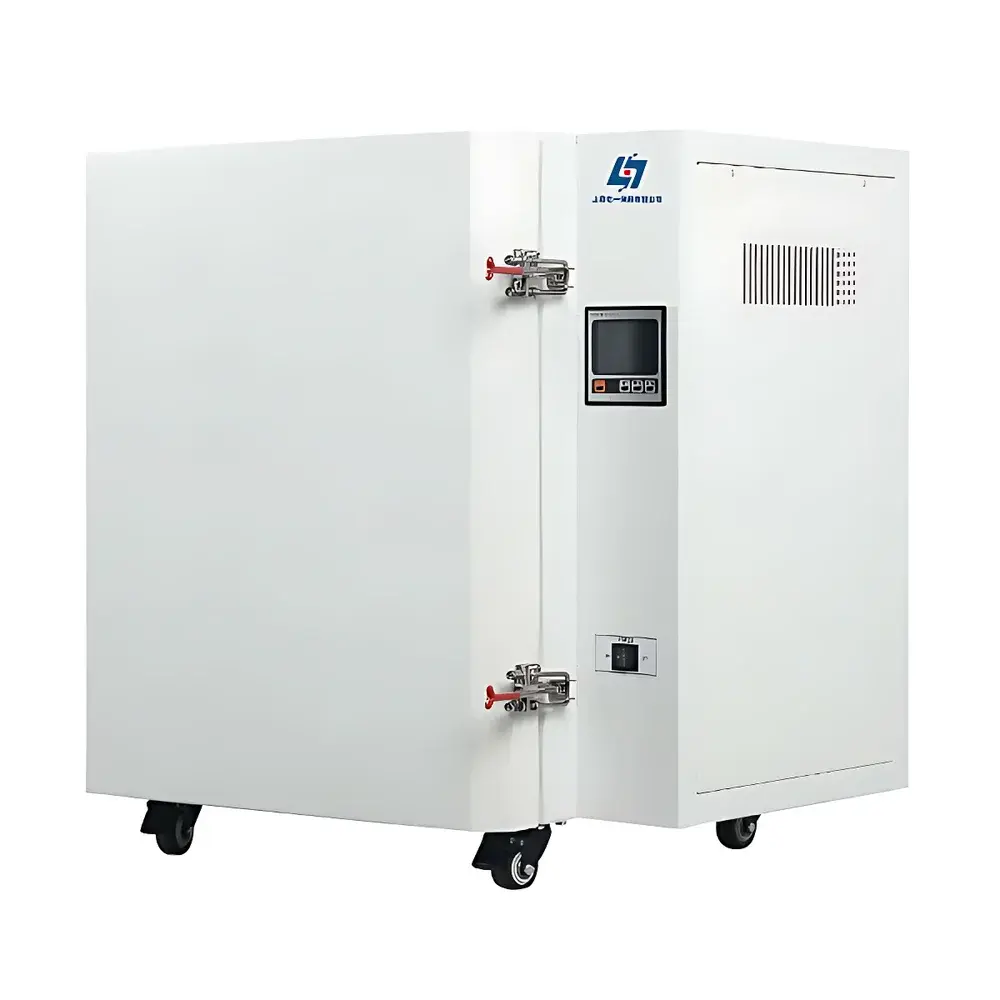
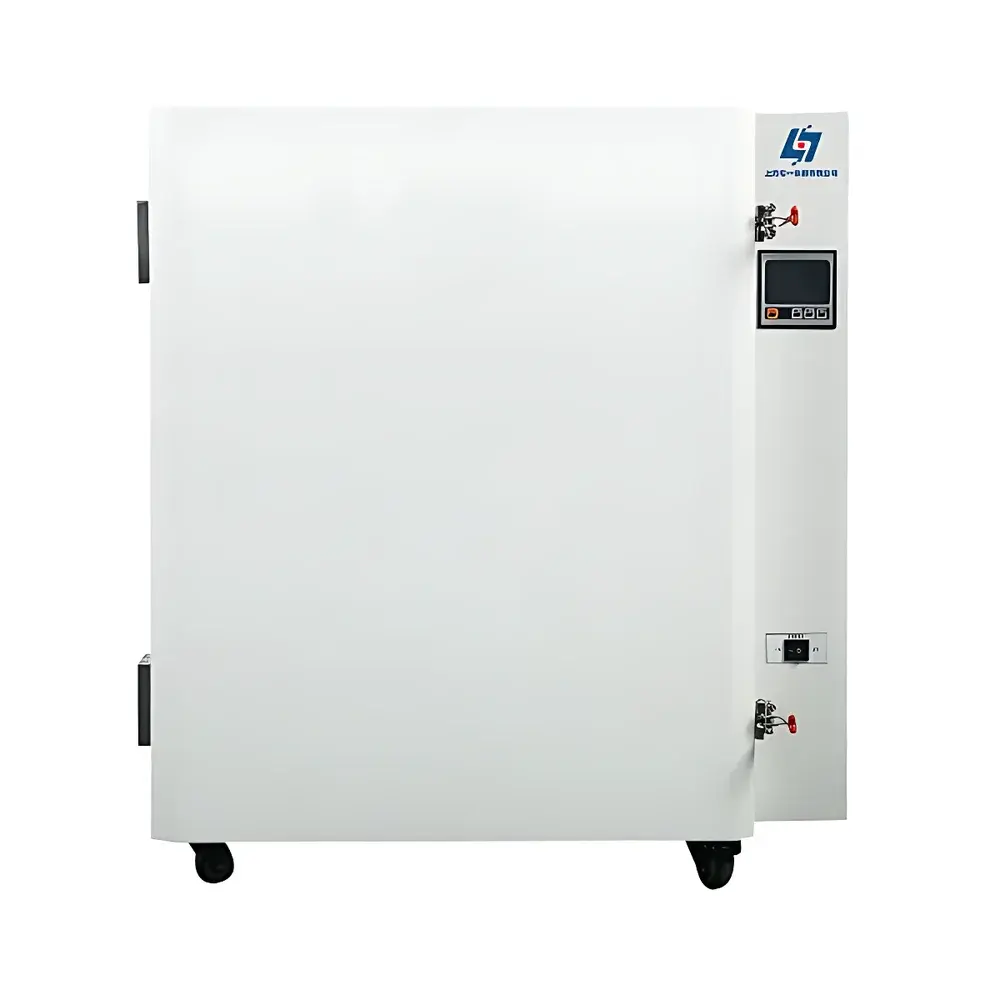
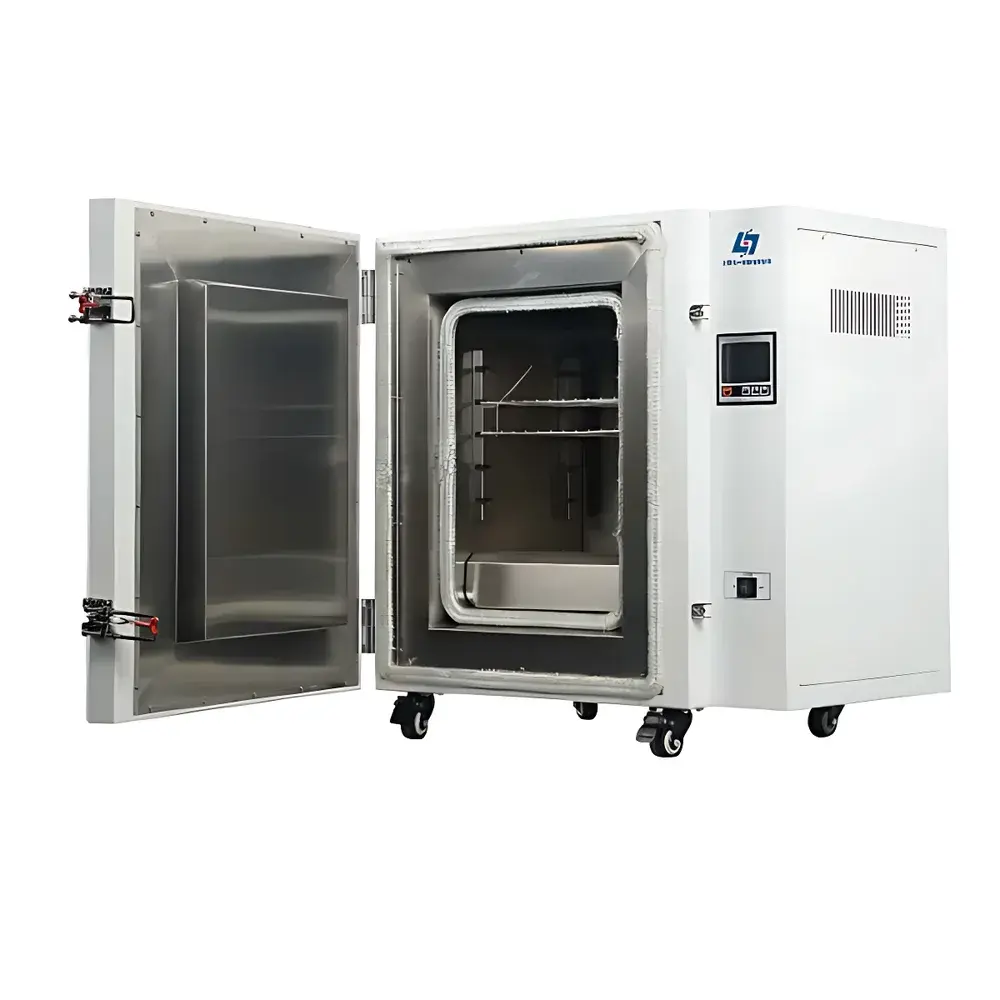
Yoyi DGG-148 High-Temperature Forced-Air Drying Oven (400 °C)
| Key | Brand: Yoyi |
|---|---|
| Origin | Shanghai, China |
| Manufacturer Type | Direct Manufacturer |
| Model | DGG-148 |
| Temperature Range | RT+20 °C to 400 °C |
| Temperature Uniformity | ±2.5% at 100 °C |
| Temperature Fluctuation | ±2.0 °C |
| Temperature Resolution | ±1.0 °C |
| External Dimensions (W×D×H) | 820×730×900 mm |
| Internal Chamber Dimensions (W×D×H) | 450×550×550 mm |
| Chamber Material | Mirror-Finish Stainless Steel |
| Insulation | Fiberglass Blanket |
| Door Seal | Dual-Layer Ceramic Rope Gasket |
| Air Circulation | Multi-Blade Centrifugal Fan with Rear Wall Air Intake |
| Power Supply | AC 380 V, 50 Hz |
| Input Power | 2500 W |
| Standard Shelving | 2 Adjustable Stainless Steel Trays |
| Timer Range | 1–9999 min |
Overview
The Yoyi DGG-148 is a precision-engineered forced-air drying oven designed for sustained operation up to 400 °C in research laboratories, quality control facilities, and industrial R&D environments. It operates on the principle of convection-based thermal processing—using a rear-mounted multi-blade centrifugal fan to circulate preheated air uniformly across the stainless steel chamber. Unlike natural convection ovens, this design ensures rapid heat-up times, tight temperature stability, and high spatial uniformity—critical for applications such as polymer curing, ceramic sintering pre-treatment, moisture loss analysis per ASTM D2240 or ISO 293, and thermal aging per IEC 60216. The unit complies with general safety requirements outlined in IEC 61010-1 for electrical equipment used in laboratory settings and incorporates structural features aligned with GLP-compliant thermal validation practices.
Key Features
- Microprocessor-based intelligent temperature controller with 4.3-inch backlit LCD interface, supporting programmable ramp-soak profiles, auto-tuning PID algorithm, and power modulation for enhanced thermal stability.
- Pre-heating air chamber design: Ambient air is drawn into an insulated pre-heat cavity, mixed with recirculated hot air, and delivered tangentially into the working chamber—minimizing cold spots and improving thermal response time.
- Double-layer ceramic rope door gasket rated for continuous use at 400 °C; maintains sealing integrity over extended cycles and resists compression set under thermal cycling.
- Mirror-finish 304 stainless steel interior chamber (450 × 550 × 550 mm) with smooth, non-porous surfaces facilitating cleaning and minimizing particulate retention—essential for cleanroom-adjacent workflows.
- High-efficiency fiberglass insulation (≥80 mm thickness) between chamber and outer casing reduces surface temperature rise and energy consumption during prolonged high-temperature operation.
- Robust cold-rolled steel exterior with electrostatic epoxy powder coating; reinforced hinges and spring-loaded pressure latches ensure repeatable door closure force and long-term alignment stability.
- Independent over-temperature cut-off system (optional): Mechanical limit thermostat interrupts heating if chamber temperature exceeds user-defined threshold—meeting functional safety expectations under ISO 13857.
Sample Compatibility & Compliance
The DGG-148 accommodates a broad range of sample formats—including crucibles, petri dishes, metal trays, glassware, and composite substrates—without risk of outgassing-induced contamination due to its inert stainless steel chamber and absence of organic insulation binders. It supports standardized test methods including ASTM E145 (Standard Specification for Gravity-Convection and Forced-Ventilation Ovens), ISO 5725 (Accuracy of measurement methods), and USP (Thermal Analysis). While not certified for Class I Div 1 hazardous locations, its construction meets IP20 ingress protection rating and conforms to CE marking directives for electromagnetic compatibility (2014/30/EU) and low-voltage safety (2014/35/EU).
Software & Data Management
The integrated controller logs real-time temperature data internally (up to 10,000 records) with timestamped entries. Optional RS485 communication enables bidirectional integration with SCADA systems or LabArchives/LabTrove ELN platforms using Modbus RTU protocol. An optional embedded thermal printer provides immediate hard-copy output of temperature curves, alarm events, and cycle completion reports—supporting 21 CFR Part 11 compliance when paired with audit-trail-enabled host software. All parameter changes are recorded with operator ID (if network-authenticated), date/time stamp, and pre/post-value logging—facilitating traceability during internal audits or regulatory inspections.
Applications
- Thermal gravimetric analysis (TGA) sample preparation and pre-drying prior to mass spectrometry coupling.
- Curing of epoxy, silicone, and polyimide coatings on electronic substrates per IPC-CC-830B.
- Moisture content determination in pharmaceutical excipients (e.g., lactose monohydrate) per USP .
- Accelerated aging of elastomers and cable jacketing materials per UL 1581 Section 1200.
- Calcination of catalyst precursors and metal oxide powders in materials science labs.
- Drying of filter papers and ashless crucibles in environmental testing per EPA Method 1664.
FAQ
What is the maximum recommended continuous operating temperature?
The DGG-148 is rated for continuous operation at 400 °C. Sustained use above this temperature may compromise gasket longevity and sensor calibration stability.
Can the oven be validated for IQ/OQ/PQ protocols?
Yes—the uniformity, fluctuation, and recovery performance metrics align with Annex 15 (EU GMP) and ASTM E2297 guidance; thermocouple mapping ports (25 mm and 50 mm options available) support probe insertion for qualification studies.
Is the stainless steel chamber electropolished or passivated?
The interior uses standard mirror-finish 304 stainless steel (No. 4 finish); electropolishing is available as a custom option upon request.
Does the unit include calibration documentation?
A factory-as-tested certificate of conformance is supplied; NIST-traceable calibration certificates for the PT100 sensor and reference thermometer can be ordered separately.
What maintenance intervals are recommended for optimal performance?
Fan bearings should be inspected every 12 months; door gaskets require visual inspection before each high-temperature run; air intake filters (if installed) must be cleaned quarterly.



