
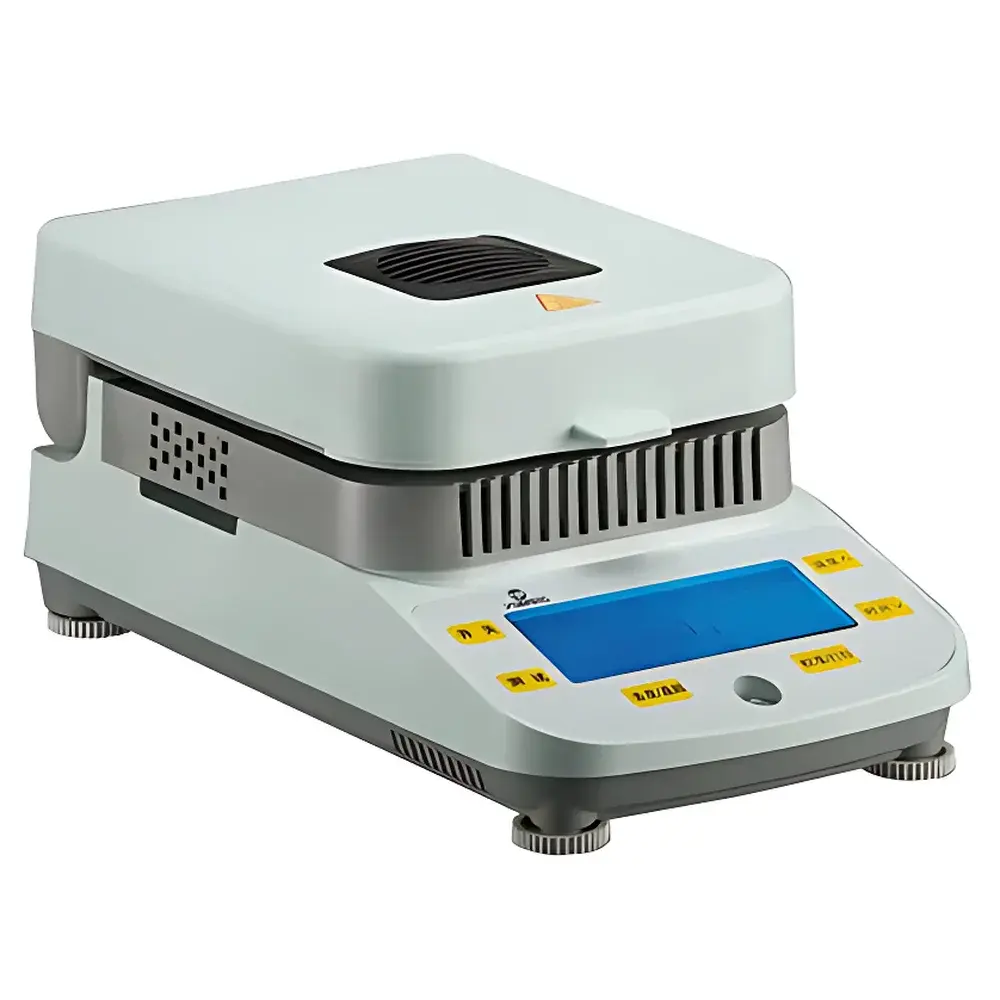
SHYP DSH-50-5 Halogen Moisture Analyzer
| Brand | SHYP |
|---|---|
| Origin | Shanghai, China |
| Model | DSH-50-5 |
| Heating Source | Halogen Lamp |
| Max Capacity | 50 g |
| Readability | 5 mg |
| Repeatability (3 g sample) | ±0.3% |
| Minimum Sample Mass | 0.5 g |
| Recommended Sample Mass | 3–10 g |
| Heating Time Range | 1–99 min (adjustable in 10-s increments) |
| Temperature Range | 50–180 °C (1 °C step) |
| Display | Dot-matrix LCD with backlight |
| Interface | RS232 serial port |
| Pan Diameter | 100 mm |
| Dimensions (L×W×H) | 285 × 160 × 150 mm |
| Net Weight | 3.0 kg |
| Operating Ambient | 10–30 °C |
Overview
The SHYP DSH-50-5 Halogen Moisture Analyzer is a precision benchtop instrument engineered for rapid, gravimetric determination of moisture content in solid and semi-solid samples via thermogravimetric analysis (TGA). It operates on the principle of controlled halogen lamp heating—delivering uniform, high-intensity infrared radiation to accelerate sample drying while minimizing thermal lag and edge effects common in conventional infrared or convection-based systems. Unlike microwave or capacitance methods, this analyzer relies on real-time mass loss monitoring under defined thermal profiles, ensuring traceable, method-agnostic results aligned with ASTM E1447, ISO 712, and USP <921> guidelines for loss-on-drying (LOD) assays. Its integrated high-stability weighing module employs an insulated load cell architecture to decouple thermal expansion from measurement drift—a critical design feature for maintaining accuracy during dynamic heating cycles.
Key Features
- Halogen heating system with programmable temperature control (50–180 °C in 1 °C increments), enabling precise thermal ramping and endpoint stabilization for diverse matrices including hygroscopic, thermally sensitive, or heterogeneous materials.
- Optimized thermal isolation between heating chamber and precision weighing sensor, mitigating thermal buoyancy and zero-point drift—verified through repeatability testing at ≤0.3% RSD (n=10, 3 g reference standard).
- Dot-matrix backlit LCD display providing simultaneous readouts of moisture %, solids %, residual mass (g), elapsed time (min:s), and current temperature (°C)—supporting real-time process evaluation without external software.
- Six-button intuitive interface with dedicated function keys for start/stop, tare, menu navigation, and parameter entry—eliminating nested menus and reducing operator training time.
- RS232 serial interface compliant with EIA/TIA-232 standards, supporting direct connection to label printers, data loggers, or laboratory information management systems (LIMS) for audit-ready data export.
- Compact footprint (285 × 160 × 150 mm) and lightweight construction (3.0 kg net) facilitate deployment in QC labs, production floors, or mobile testing stations where space and portability are constrained.
Sample Compatibility & Compliance
The DSH-50-5 accommodates a broad range of industrial and regulatory sample types—including pharmaceutical excipients (e.g., lactose, microcrystalline cellulose), food-grade starches and flours, polymer granules, mineral ores, paper pulp, textile fibers, and botanical extracts. Its 100 mm diameter stainless-steel pan supports even sample distribution and efficient heat transfer. The instrument meets essential environmental and operational compliance prerequisites: ambient operating conditions of 10–30 °C and ≤80% RH non-condensing; CE-marked electrical safety per IEC 61010-1; and mechanical design compatible with GLP/GMP documentation workflows when paired with validated RS232 data capture protocols. While not inherently 21 CFR Part 11-compliant, its deterministic output format and timestamped serial logs enable integration into validated electronic record systems when configured with appropriate audit-trail software layers.
Software & Data Management
Standalone operation requires no proprietary software—data is displayed and stored internally with time/date stamps for each measurement cycle. When connected via RS232, raw output follows ASCII-delimited format (e.g., “MOISTURE=12.45%, SOLIDS=87.55%, MASS=2.9845g, TIME=04:32, TEMP=105.0°C”), facilitating parsing into Excel, LabArchives, or custom LIMS parsers. Optional terminal emulation tools (e.g., Tera Term, PuTTY) allow batch export of historical runs for trend analysis or statistical process control (SPC) charting. All settings—including heating profile, endpoint criteria (timed vs. auto-stop), and tare offset—are retained in non-volatile memory after power cycling.
Applications
- Quality control of incoming raw materials in food manufacturing (e.g., flour moisture specification per AACC Method 44-15A).
- Batch release testing of active pharmaceutical ingredients (APIs) and intermediates per ICH Q5C stability guidance.
- Moisture profiling of lithium-ion battery cathode powders to prevent agglomeration and ensure electrode slurry rheology consistency.
- In-process verification of drying endpoints in spray-dried dairy or enzyme formulations.
- Regulatory submission support for cosmetics ingredient specifications (ISO 16128-2) and feed additive registration (EU Regulation 1831/2003).
- Academic research in material science involving hydrogel swelling kinetics or clay dehydration thermodynamics.
FAQ
What is the difference between halogen and traditional infrared moisture analyzers?
Halogen lamps emit a broader, more controllable IR spectrum (typically 0.8–4 µm) than quartz tube IR sources, allowing faster energy transfer and improved penetration into particulate or layered samples—reducing surface charring artifacts.
Can the DSH-50-5 be calibrated with NIST-traceable standards?
Yes—users may perform routine calibration using certified moisture reference standards (e.g., sodium tartrate dihydrate, ~15.66% H₂O) and external mass calibrators traceable to national metrology institutes.
Is automatic endpoint detection available?
The instrument supports both fixed-duration drying and auto-stop mode, which triggers completion when mass change falls below a user-defined threshold (e.g., 0.1 mg/5 s) over a configurable stabilization window.
How is zero-point drift compensated during long heating cycles?
The insulated sensor housing minimizes thermal coupling, while internal zero-tracking algorithms apply real-time offset correction based on pre-heating baseline drift characterization.
Does the unit support multi-step heating programs?
No—the DSH-50-5 implements single-stage heating only; multi-ramp protocols require external scripting via RS232 command set or manual intervention between cycles.





