
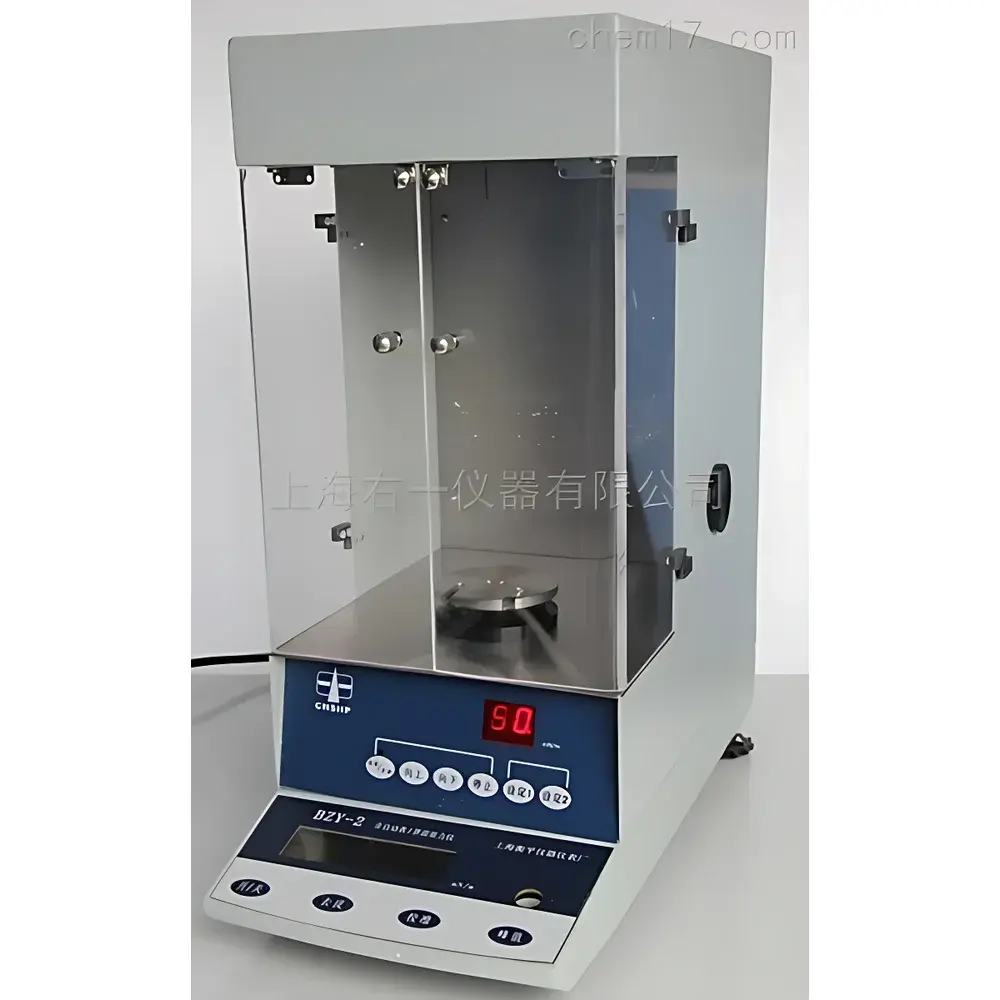
Hangping BZY-1 Automated Surface & Interfacial Tensiometer
| Brand | Hangping |
|---|---|
| Model | BZY-1 |
| Measurement Principle | Wilhelmy Plate Method |
| Range | 0–400 mN/m |
| Resolution | ±0.1 mN/m |
| Accuracy (Standard Error) | ±0.1 mN/m |
| Repeatability | ±0.1 mN/m |
| Platform Travel | 60 mm (motorized, programmable) |
| Temperature Range (with optional bath) | 0–110 °C |
| Temperature Sensor | PT100 (±0.1 °C display resolution) |
| Display | Integrated LED screen |
| Interface | RS232C |
| Power Supply | AC 220 V ±10% |
| Dimensions (W×D×H) | 400 × 200 × 400 mm |
| Net Weight | 15 kg |
| Compliance | GB/T 6541–1986, GB/T 22237–2008, ISO 1409:1995, JB/T 9388–2002, SH/T 1156–1999 |
Overview
The Hangping BZY-1 Automated Surface & Interfacial Tensiometer is a precision laboratory instrument engineered for the quantitative determination of surface tension (liquid–air) and interfacial tension (liquid–liquid) using the Wilhelmy plate method—a gravimetric technique grounded in classical capillary physics. Based on the force balance principle, the instrument measures the vertical pull exerted on a vertically immersed platinum plate as it contacts or withdraws from the liquid interface. This method provides direct, real-time force-to-tension conversion without empirical correction factors required by ring-based alternatives, ensuring high linearity and traceable measurement integrity across dynamic and equilibrium conditions. Designed for routine QC, R&D, and method validation environments, the BZY-1 delivers stable, reproducible results under ambient or precisely controlled thermal conditions—critical for characterizing surfactant adsorption kinetics, critical micelle concentration (CMC), emulsion stability, and formulation aging behavior.
Key Features
- Electromagnetic closed-loop force transduction system with microprocessor-controlled actuation and auto-zeroing (0–400 mN range)
- Motorized sample stage with programmable lift/drop profile and 60 mm travel range for consistent immersion depth control
- Integrated Wilhelmy platinum plate sensor (certified purity ≥99.95%) compliant with ASTM D971 and ISO 1409 requirements
- Onboard LED display with real-time tension readout and automatic equilibrium detection algorithm
- One-button calibration using supplied certified weights; no external PC required for basic operation
- RS232C serial interface supporting data logging and curve export via included real-time plotting software
- Modular thermal compatibility: supports optional standard (0–60 °C) and wide-range (−5 to 110 °C)恒温 baths linked via silicone tubing
- PT100 temperature probe (BZY-1/23) for direct in-situ sample temperature monitoring with 0.1 °C resolution
Sample Compatibility & Compliance
The BZY-1 accommodates low- to medium-viscosity liquids—including aqueous surfactant solutions, hydrocarbon oils, polymer dispersions, pharmaceutical emulsions, and agrochemical formulations—as well as immiscible liquid pairs such as oil–water, solvent–aqueous, and molten polymer–metal systems. Its Wilhelmy plate geometry enables reliable measurement of time-dependent interfacial relaxation phenomena, making it suitable for dynamic surface tension studies where equilibrium cannot be assumed. The instrument conforms to multiple international and national standards governing tensiometric testing, including GB/T 6541–1986 (petroleum oil–water interfacial tension), GB/T 22237–2008 (surfactant surface tension), ISO 1409:1995 (plastics and rubber dispersions), and SH/T 1156–1999 (synthetic rubber). While not inherently 21 CFR Part 11–compliant, audit trails and electronic records can be generated through the bundled software when deployed in GLP/GMP-aligned workflows with appropriate procedural controls.
Software & Data Management
The included real-time curve acquisition software runs on Windows platforms and communicates via RS232C to capture continuous force–time datasets at configurable sampling intervals (default: 10 Hz). It supports overlay comparison of multiple runs, automatic equilibrium point identification based on user-defined slope thresholds, and export of raw ASCII files for post-processing in MATLAB, Origin, or Excel. All measurements are timestamped and annotated with operator ID, sample ID, ambient temperature, and bath temperature (if monitored). Though the instrument operates autonomously, the software enhances method documentation—particularly valuable for regulatory submissions requiring traceability of CMC determinations, formulation screening, or stability assessment per USP analytical instrument qualification guidelines.
Applications
- Petroleum refining: monitoring transformer oil aging, evaluating demulsifier efficiency, and quantifying crude oil–brine interfacial tension for EOR screening
- Pharmaceutical development: optimizing micellar solubilization, assessing wetting of APIs, and validating emulsion-based delivery systems
- Coatings & inks: correlating surface tension with substrate wettability, leveling behavior, and pigment dispersion stability
- Agrochemical formulation: determining surfactant efficacy in pesticide adjuvants and spray droplet spreading kinetics
- Electroplating bath analysis: verifying surfactant concentration to suppress pitting and ensure uniform current distribution
- Food science: characterizing protein–lipid interfacial films, foam stability in dairy products, and encapsulation efficiency
- Academic research: experimental validation of adsorption isotherms (e.g., Langmuir, Frumkin), diffusion-controlled vs. adsorption-controlled dynamics, and polymer–surfactant interactions
FAQ
What measurement principle does the BZY-1 employ?
It uses the Wilhelmy plate method, measuring the force exerted on a vertically oriented platinum plate during controlled immersion and withdrawal from the liquid interface.
Can the BZY-1 measure interfacial tension between two immiscible liquids?
Yes—it is validated for liquid–liquid systems such as hydrocarbon–water, silicone oil–aqueous phases, and polymer melt–metal interfaces.
Is temperature control integrated or optional?
Temperature regulation is optional but fully supported via external circulation baths; the instrument accepts PT100 input and displays real-time sample temperature when paired with the BZY-1/23 probe.
Does the system support GMP/GLP-compliant data handling?
While the hardware lacks built-in electronic signatures or audit trail encryption, the RS232 output enables integration into validated LIMS or ELN systems when combined with documented SOPs and user access controls.
How is calibration performed?
Using the supplied certified stainless-steel calibration weights, users execute a one-step zero-and-span procedure directly on the instrument’s front panel—no external tools or software required.



