
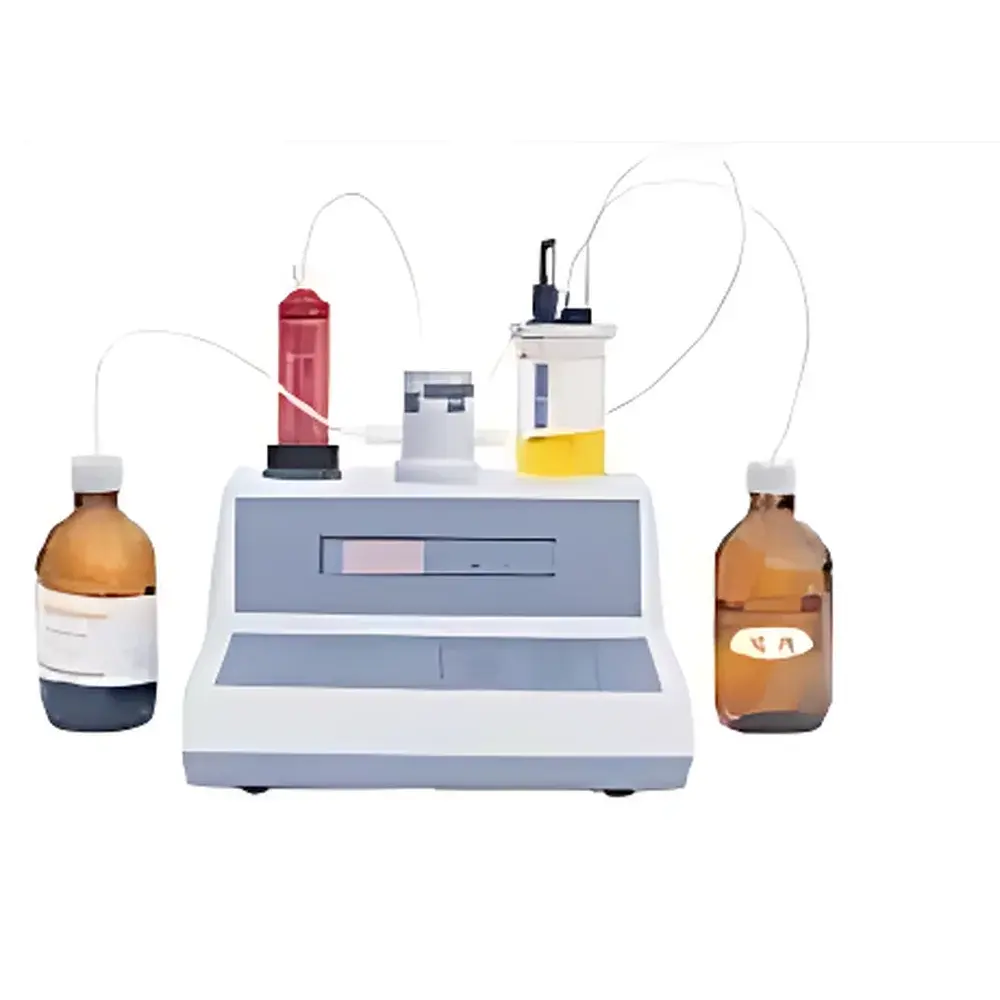
AnTing ZSD-2 Anling Karl Fischer Moisture Titrator (Volumetric Method)
| Brand | AnTing |
|---|---|
| Origin | Shanghai, China |
| Model | ZSD-2 |
| Titration Method | Fully Automated Volumetric Karl Fischer Titration |
| Moisture Range | 0.02% – 100% |
| Polarization Voltage | −20 mV |
| Sensitivity | 10⁻⁶ A |
| Endpoint Delay | 10 ± 2 s |
| Resolution | 0.01 mL |
| Titration Flow Rate | 0.01 mL/s |
| Display | LED Digital (mL) |
| Power Supply | 220 V, 50 Hz |
| Power Consumption | 18 W |
| Display Accuracy Error | ≤2% |
Overview
The AnTing ZSD-2 Anling Karl Fischer Moisture Titrator is a fully automated volumetric titration system engineered for precise and reproducible determination of water content in solid, liquid, and gaseous samples across pharmaceutical, chemical, food, agricultural, and industrial quality control laboratories. It operates on the classical Karl Fischer (KF) reaction principle—where iodine, sulfur dioxide, methanol, and a base quantitatively react with water in a stoichiometric 1:1 molar ratio—and employs bipotentiometric endpoint detection via dual platinum electrodes. The instrument applies a constant polarization voltage (−20 mV) to monitor real-time current changes during titration; the endpoint is identified when the current drops below a predefined threshold (10⁻⁶ A sensitivity), confirming complete reaction completion. Designed for routine compliance-driven workflows, the ZSD-2 supports both open-cell and closed-cell titration cells and integrates seamlessly into environments requiring adherence to ASTM E203, ISO 760, USP , and EP 2.5.10 methodologies.
Key Features
- Fully automated operation: integrated peristaltic pump for reagent delivery, automatic solvent dispensing, sample injection (via optional syringe interface), endpoint detection, and waste fluid evacuation.
- Digital LED display showing real-time titrant volume (0.01 mL resolution), cumulative consumption, and endpoint confirmation status.
- Programmable endpoint delay (10 ± 2 s) to accommodate slow-reacting or viscous matrices without premature termination.
- Stable bipotentiometric detection circuitry with fixed −20 mV polarization voltage and sub-microampere (10⁻⁶ A) current resolution for high signal-to-noise ratio.
- Robust architecture compliant with IEC 61010-1 safety standards; designed for continuous use in ISO 17025-accredited laboratories under GLP/GMP conditions.
- Low power consumption (18 W) and universal 220 V / 50 Hz input enable stable deployment in resource-constrained or mobile QC labs.
Sample Compatibility & Compliance
The ZSD-2 accommodates a broad spectrum of sample types—including hygroscopic solids (e.g., APIs, excipients), volatile liquids (e.g., solvents, monomers), suspensions (e.g., catalyst slurries), and semi-solids (e.g., ointments, polymers)—when paired with appropriate KF reagents (single-component or two-component) and sample preparation accessories (e.g., oven couplers, headspace samplers). All measurements conform to internationally recognized moisture analysis standards: ASTM E203 (standard test method for water using volumetric KF titration), ISO 760 (determination of water—volumetric KF method), and pharmacopoeial requirements (USP , Ph. Eur. 2.5.10). Data integrity is maintained through non-volatile memory storage of method parameters and endpoint logs, supporting audit readiness for FDA 21 CFR Part 11–aligned documentation practices where electronic records are retained with time-stamped operator identification.
Software & Data Management
While the ZSD-2 operates as a standalone hardware platform with embedded firmware, it supports manual data export via printed reports (when connected to a compatible thermal printer) and enables traceable recordkeeping through user-defined method naming, batch ID entry, and timestamped result storage (up to 100 test records retained in internal memory). Each measurement captures titrant volume consumed, calculated water mass (mg), moisture percentage (% w/w), and endpoint stability duration. For laboratories requiring full digital integration, the instrument’s RS-232 interface allows connection to LIMS or custom SCADA systems for automated result ingestion—provided third-party drivers comply with standard ASCII-based command protocols used in legacy KF titrators. Audit trails include operator-initiated start/stop actions and any manual override events, satisfying minimum ALCOA+ principles (Attributable, Legible, Contemporaneous, Original, Accurate).
Applications
- Pharmaceutical QC: verification of residual moisture in lyophilized powders, tablet granules, and active pharmaceutical ingredients per ICH Q5C stability guidelines.
- Chemical manufacturing: assay of water in acetic anhydride, polyols, silicone fluids, and catalysts where trace moisture compromises reaction yield or shelf life.
- Food & agriculture: quantification of water in dairy powders, flour, feedstuffs, and fertilizers to ensure compliance with labeling regulations and microbial stability thresholds.
- Polymer & electronics: moisture screening in epoxy resins, lithium battery electrolytes, and PCB substrate materials prior to curing or assembly.
- Research & development: method development for novel KF-compatible solvents and optimization of titration kinetics in complex matrices.
FAQ
What titration method does the ZSD-2 support?
The ZSD-2 implements volumetric Karl Fischer titration only; it does not support coulometric determination.
Can the instrument be calibrated with certified water standards?
Yes—traceable calibration is performed using certified standard solutions (e.g., 1.00 mg H₂O/mL methanol) following ASTM E203 Section 8 procedures.
Is the endpoint detection adjustable for difficult samples?
Endpoint delay is fixed at 10 ± 2 seconds; however, users may manually initiate titration hold or repeat titration cycles if required for matrix-specific validation.
Does the ZSD-2 meet regulatory requirements for GMP documentation?
It supports core GMP data integrity elements (time-stamped results, operator ID, method recall) but requires complementary procedural controls (e.g., SOPs, manual logbooks, or external LIMS) to fulfill full 21 CFR Part 11 compliance.
What maintenance is recommended for long-term reliability?
Daily electrode cleaning with dry acetone, weekly drying of the titration cell, and quarterly verification of pump tubing wear and reagent delivery accuracy using gravimetric checks are advised.




