
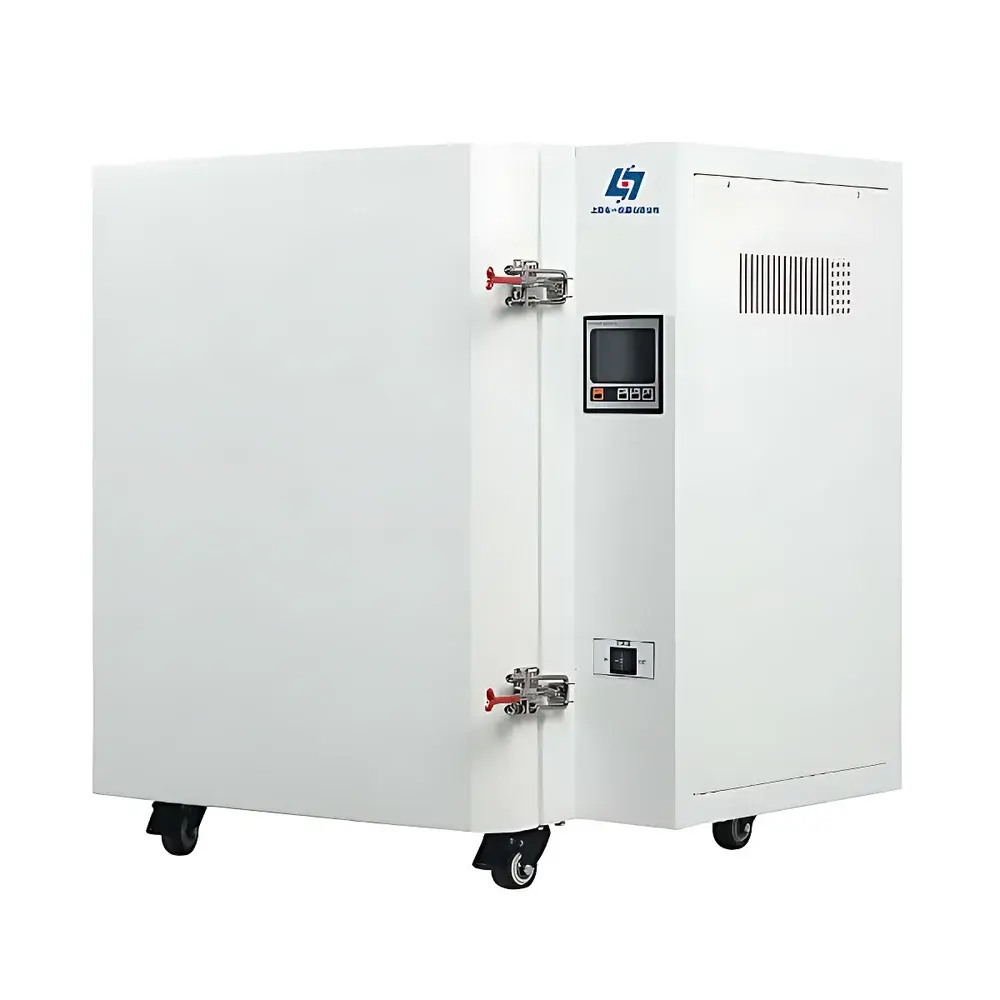
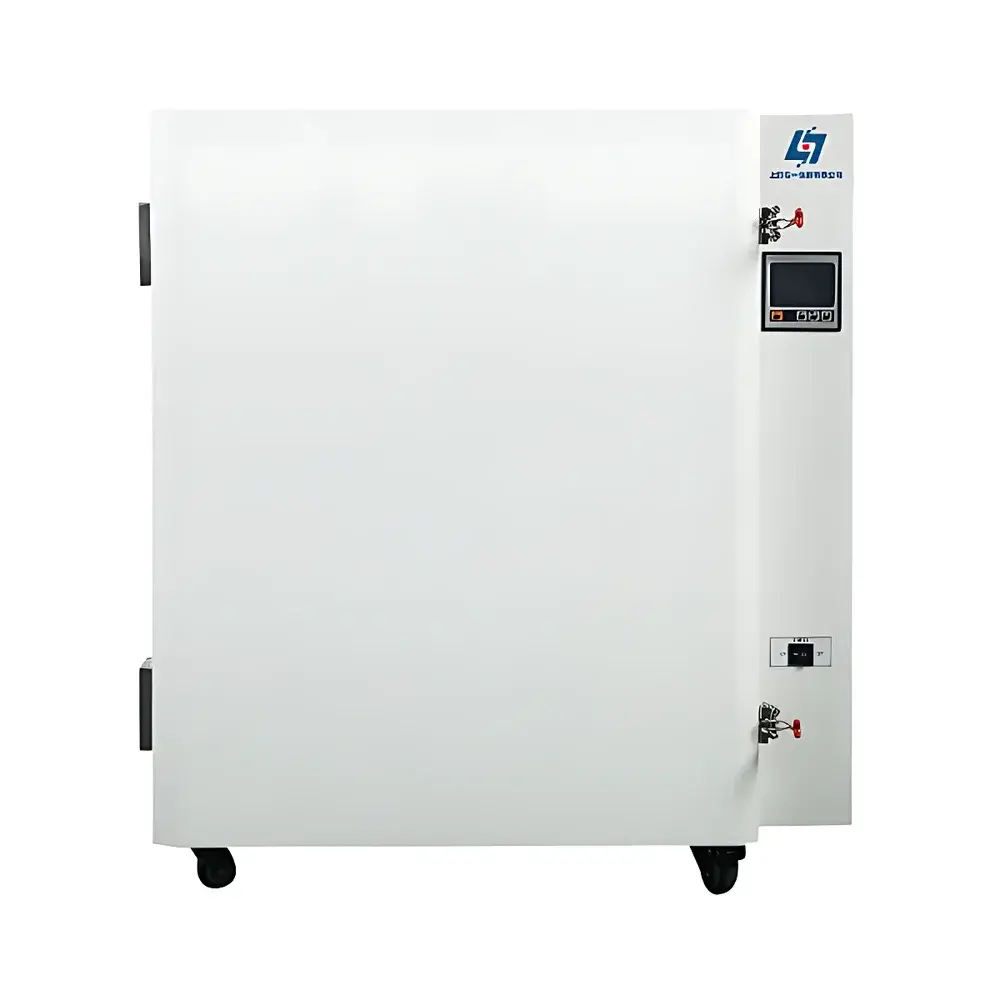
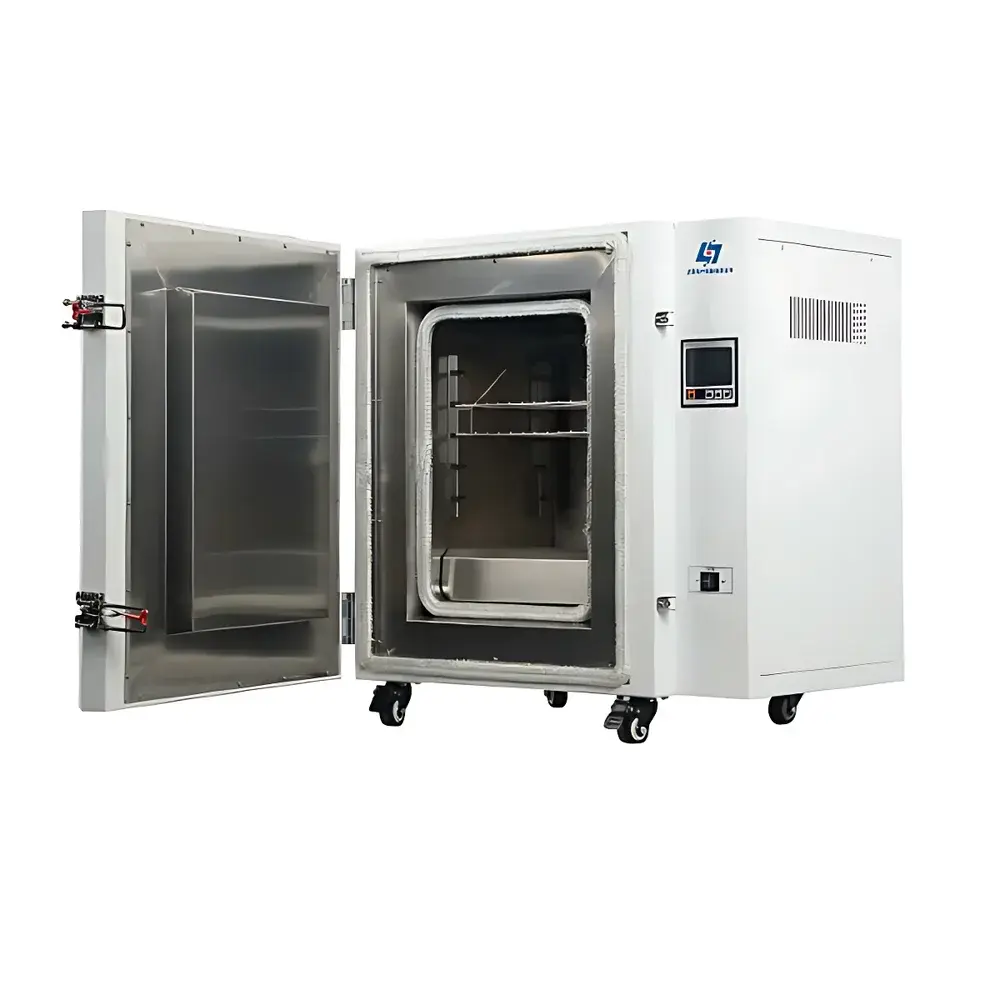
Yoyi DGG-249C High-Temperature Nitrogen-Purged Forced-Air Oven
| Brand | Yoyi |
|---|---|
| Model | DGG-249C |
| Type | High-Temperature Purged Drying Oven |
| Temperature Range | RT+20°C to 500°C |
| Temperature Resolution | 1°C |
| Interior Material | Mirror-Finish Stainless Steel (SUS304) |
| Temperature Uniformity | ±2.5% (measured at 100°C, non-purged condition) |
| Heating Method | Preheated Air Circulation via Dual-Speed Fan Assembly |
| Purge Interface | Φ10 mm Inert Gas Inlet with Float Flowmeter (0–10 L/min) |
| Insulation | High-Density Ceramic Fiber + Glass Wool Composite |
| Door Seal | High-Temperature Ceramic Fiber Gasket |
| Control System | Microprocessor-Based PID Controller with LCD Menu Interface |
| Power Supply | AC 380 V, 50 Hz |
| Rated Power | 5500 W |
| Internal Chamber Dimensions (W×D×H) | 500 × 600 × 750 mm |
| Net Volume | 240 L |
| Standard Shelving | 2 Adjustable Stainless Steel Trays |
| Timer Range | 1–9999 min |
| Ambient Operating Temperature | +5°C to +40°C |
Overview
The Yoyi DGG-249C is a high-temperature, nitrogen-purged forced-air oven engineered for precise thermal processing under inert atmospheric conditions. Designed for applications requiring oxidation-sensitive thermal treatment—such as sintering of metal powders, carbonization of polymer precursors, catalyst activation, and moisture-free annealing—the unit integrates robust thermal architecture with controlled gas displacement capability. Its operating range spans from ambient +20°C up to 500°C, supported by a dual-stage air preheating cavity and tangential airflow distribution system that ensures rapid thermal ramping and minimizes vertical and horizontal temperature gradients. The chamber employs a microprocessor-driven PID temperature controller with real-time deviation compensation, delivering stable setpoint maintenance even during extended dwell cycles. Unlike conventional convection ovens, the DGG-249C features an integrated inert gas management interface enabling seamless transition between ambient air and nitrogen (or argon) atmospheres—critical for preventing surface oxidation, suppressing volatile decomposition pathways, or eliminating residual oxygen in vacuum-adjacent workflows.
Key Features
- High-efficiency thermal insulation using layered ceramic fiber and glass wool, reducing external surface temperature rise and improving energy retention.
- Mirror-finish SUS304 stainless steel interior with radiused corners and removable, height-adjustable shelves for unrestricted cleaning and sample access.
- Dual-speed, high-torque centrifugal blower assembly with aluminum alloy impeller and IP54-rated motor, ensuring consistent laminar airflow and low particulate generation.
- Double-sealed, counterbalanced door with ceramic fiber gasket and dual cam-action latches for long-term sealing integrity at elevated temperatures.
- LCD-based menu interface displaying setpoint, actual chamber temperature, elapsed time, remaining hold time, and purge status—all simultaneously on a single screen.
- Power-loss recovery function with non-volatile memory: automatically resumes prior operational parameters (setpoint, timer, purge mode) following unexpected power interruption.
- Preheated air mixing chamber upstream of the working zone enables uniform thermal delivery and reduces cold-spot formation during startup.
Sample Compatibility & Compliance
The DGG-249C accommodates a broad range of sample formats—including crucibles, quartz boats, ceramic setters, and custom fixtures—within its 240 L chamber volume. Its inert gas compatibility supports ASTM E1112 (standard practice for inert atmosphere heat treatment), ISO 8501-1 (surface preparation prior to coating), and internal quality protocols for oxide-sensitive materials. While not certified to UL/CSA or IEC 61010-1 out-of-the-box, the unit meets fundamental electrical safety and thermal isolation requirements for laboratory-grade Class II equipment. Optional accessories—including independent overtemperature cut-off controllers (compliant with IEC 60519-2 for industrial heating equipment) and RS485-modbus interfaces—facilitate integration into GLP/GMP environments requiring audit-trail-capable process documentation.
Software & Data Management
The embedded control system supports time-stamped logging of temperature profiles (setpoint vs. measured) at user-defined intervals (1–60 sec). Optional RS485 communication module enables connection to SCADA platforms or third-party data acquisition software (e.g., LabVIEW, WinCC) for remote monitoring and historical trend analysis. When paired with the optional multi-segment programmable controller, users can define up to 30 ramp-hold cycles with slope-controlled heating rates—enabling complex thermal schedules required for ceramic co-firing or graded polymer pyrolysis. All configuration changes are logged with timestamp and operator ID when linked to external authentication systems. The built-in timer supports both continuous operation and automatic shutdown, with alarm outputs configurable for relay-triggered external actions (e.g., gas shutoff, exhaust activation).
Applications
- Thermal stabilization of lithium-ion battery cathode materials (e.g., NMC, LFP) under nitrogen to prevent Ni²⁺ oxidation and Li₂CO₃ formation.
- Controlled pyrolysis of biomass-derived precursors for activated carbon synthesis.
- Post-deposition annealing of thin-film photovoltaic layers (CIGS, perovskite) without interfacial oxidation.
- Drying and curing of high-performance composites (e.g., polyimide laminates, carbon fiber prepregs) where moisture entrapment must be avoided.
- Calibration and aging of temperature-sensitive sensors and reference standards under reproducible inert thermal stress.
- Residue-free ashing of organic matrices prior to elemental analysis (ICP-OES, XRF).
FAQ
What inert gases are compatible with the DGG-249C?
Nitrogen (N₂) and argon (Ar) are fully supported; helium may be used with flow rate adjustment due to higher thermal conductivity.
Is the oven suitable for use under partial vacuum?
No—this model is designed exclusively for positive-pressure inert gas purging. Vacuum operation requires dedicated vacuum-compatible ovens with reinforced chamber construction.
Can the temperature uniformity specification be verified under nitrogen flow?
Yes; uniformity testing per ISO 15504-2 may be performed with thermocouple mapping under nominal purge conditions (5 L/min N₂ at 450°C), typically yielding ±2.8% across the working volume.
Does the unit comply with FDA 21 CFR Part 11 requirements?
Out-of-the-box, it does not include electronic signature or audit trail functionality—but the optional RS485 + software package supports validation-ready data export for Part 11-compliant systems.
What maintenance intervals are recommended for long-term reliability?
Blower motor bearings should be inspected annually; ceramic fiber door gaskets require replacement every 2–3 years depending on thermal cycling frequency and peak temperature exposure.



