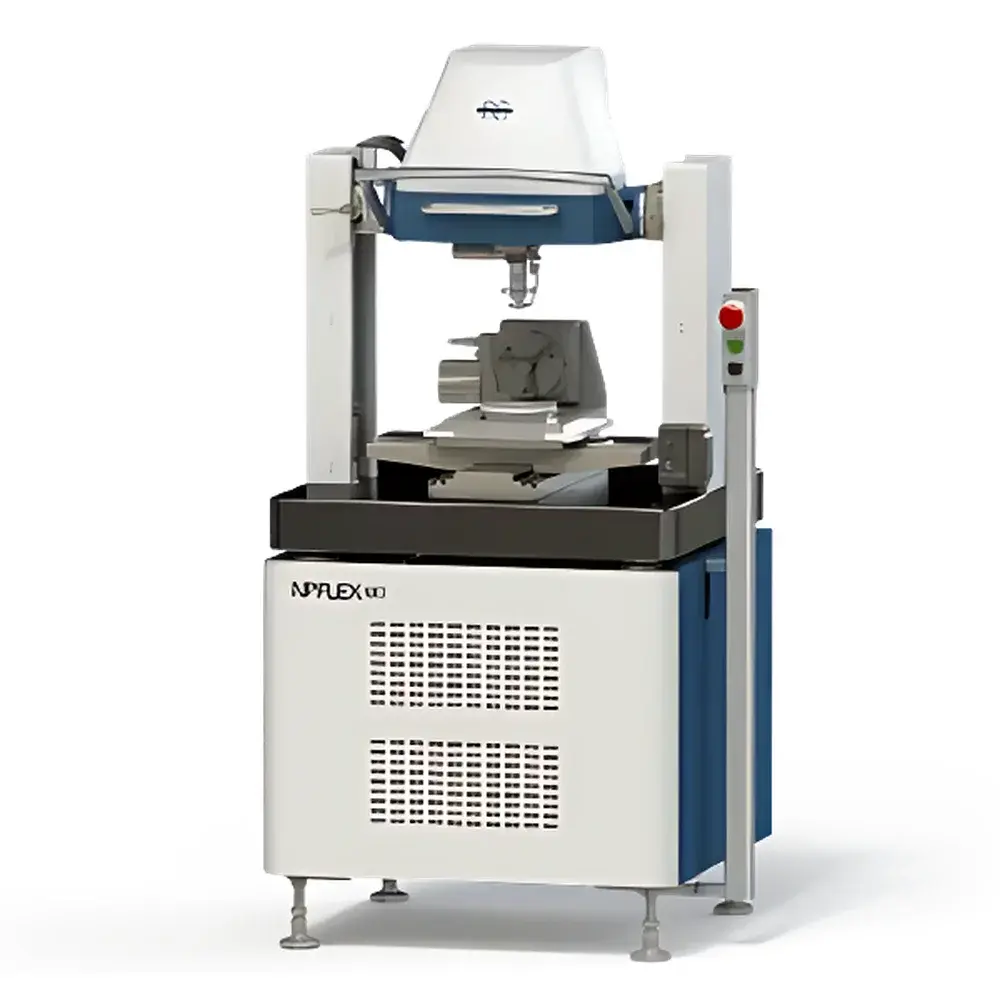
Bruker NPFLEX-1000 3D Optical Profilometer
| Brand | Bruker |
|---|---|
| Origin | USA |
| Model | NPFLEX-1000 |
| Product Type | Non-contact Profilometer / Surface Roughness Analyzer |
| Operating Principle | White Light Interferometry (WLI) |
| Sample Stage Travel | 300 mm X-Y |
| Bridge Architecture | Open龙门-style rigid bridge |
| Objective Options | Motorized turret with multiple magnification objectives |
| Auto-Focus & Auto-Illumination | Integrated “Advanced Surface Find™” |
| Vibration Isolation | Built-in active/passive isolation system |
| Reflectivity Range | 0.05% – 100% |
| Maximum Surface Slope | ±70° |
| Vertical Resolution | Sub-nanometer (typical) |
| Lateral Resolution | Diffraction-limited (~0.3–1.2 µm, dependent on objective) |
| Compliance | Designed for ISO 25178, ISO 4287/4288, ASME B46.1, and ASTM E2922 standards |
Overview
The Bruker NPFLEX-1000 is a high-precision, floor-standing 3D optical profilometer engineered for non-contact surface topography measurement using white light interferometry (WLI). This technique relies on the principle of low-coherence interference between light reflected from a reference mirror and the sample surface, enabling nanoscale vertical resolution and quantitative characterization of surface height variations across macro- to micro-scale features. Unlike stylus-based profilers, the NPFLEX-1000 eliminates mechanical contact, preserving delicate or soft surfaces while delivering traceable, repeatable metrology in both R&D and production environments. Its open-bridge architecture supports large-format samples up to 300 mm in X-Y travel range, making it suitable for components used in automotive powertrain systems, orthopedic implants, additively manufactured aerospace parts, and semiconductor packaging substrates.
Key Features
- Open龙门-style rigid bridge structure with integrated vibration isolation—optimized for factory-floor deployment without external optical tables.
- Motorized objective turret with interchangeable magnifications (e.g., 2.5× to 100×), supporting wide-field imaging and high-magnification roughness analysis.
- Advanced Surface Find™ automation—combines real-time focus detection and adaptive illumination control to eliminate manual focusing prior to each scan.
- Wide dynamic reflectivity tolerance (0.05%–100%) enables reliable measurements on polished metals, anodized aluminum, polymer films, and matte ceramics without parameter reconfiguration.
- High-slope capability (±70°) allows full characterization of steep sidewalls, gear flanks, threaded surfaces, and curved geometries without shadowing artifacts.
- Sub-nanometer vertical resolution and diffraction-limited lateral resolution ensure compliance with ISO 25178-2 areal surface texture parameters (Sa, Sq, Sz, Sdr, etc.) and ISO 4287 profile-based metrics (Ra, Rz, Rsk).
Sample Compatibility & Compliance
The NPFLEX-1000 accommodates diverse sample geometries—from flat wafers and machined plates to cylindrical engine blocks and freeform medical implants—without requiring custom fixturing. Its large working distance and rotational sensor head support oblique-angle acquisition for complex curvature. The system is validated for use in regulated environments: measurement workflows support audit trails, electronic signatures, and data integrity per FDA 21 CFR Part 11 when deployed with Bruker’s optional GxP-compliant software modules. It meets requirements for ISO/IEC 17025 accredited laboratories performing surface metrology, and its results are traceable to NIST-traceable step-height standards.
Software & Data Management
Bruker’s proprietary Vision64™ software provides a unified platform for acquisition, analysis, reporting, and automation scripting. Predefined templates align with ISO 25178, ASME B46.1, and ASTM E2922 test methods—including corrosion pit volume quantification, wear track depth profiling, cylinder bore cross-hatch analysis, cam lobe periodicity assessment, and seal surface lead angle evaluation. Batch processing, recipe-based operation, and Python API integration allow seamless incorporation into automated QA/QC lines. All raw interferograms and processed height maps are stored in vendor-neutral HDF5 format, ensuring long-term archival compatibility and third-party interoperability.
Applications
- Automotive QA: Cylinder bore cross-hatch texture analysis, piston ring groove roughness, gear flank micro-topography, and turbocharger blade surface integrity verification.
- Medical Device Manufacturing: Quantitative assessment of additive-manufactured implant surface porosity, grit-blasted orthopedic coating uniformity, and laser-textured dental abutment topography.
- Aerospace & Energy: Thermal barrier coating thickness variation mapping, turbine vane leading-edge erosion monitoring, and weld seam surface continuity validation.
- Electronics Packaging: Die attach void detection, underfill fillet geometry, and solder bump coplanarity measurement at sub-micron resolution.
- Materials R&D: Corrosion pit morphology evolution tracking, tribological wear volume loss quantification, and functional surface texture–performance correlation studies.
FAQ
What surface materials can the NPFLEX-1000 measure reliably?
It supports reflective, semi-transparent, and highly scattering surfaces—including bare metals, oxides, polymers, ceramics, and composites—across a reflectivity range of 0.05% to 100%.
Is the system suitable for in-line or shop-floor deployment?
Yes. Its built-in passive/active vibration isolation, robust bridge design, and thermal drift compensation enable stable operation in non-laboratory environments.
Does it comply with international surface metrology standards?
Yes. It supports full implementation of ISO 25178 (areal), ISO 4287/4288 (profile), ASME B46.1, and ASTM E2922, with traceable calibration options available.
Can measurement routines be automated for unattended operation?
Yes. Vision64™ supports fully scripted workflows, conditional logic, pass/fail thresholds, and export to MES/SPC systems via OPC UA or CSV.
How is data integrity ensured for regulated applications?
With optional GxP modules, the system provides electronic signatures, audit trails, role-based access control, and 21 CFR Part 11–compliant data archiving.