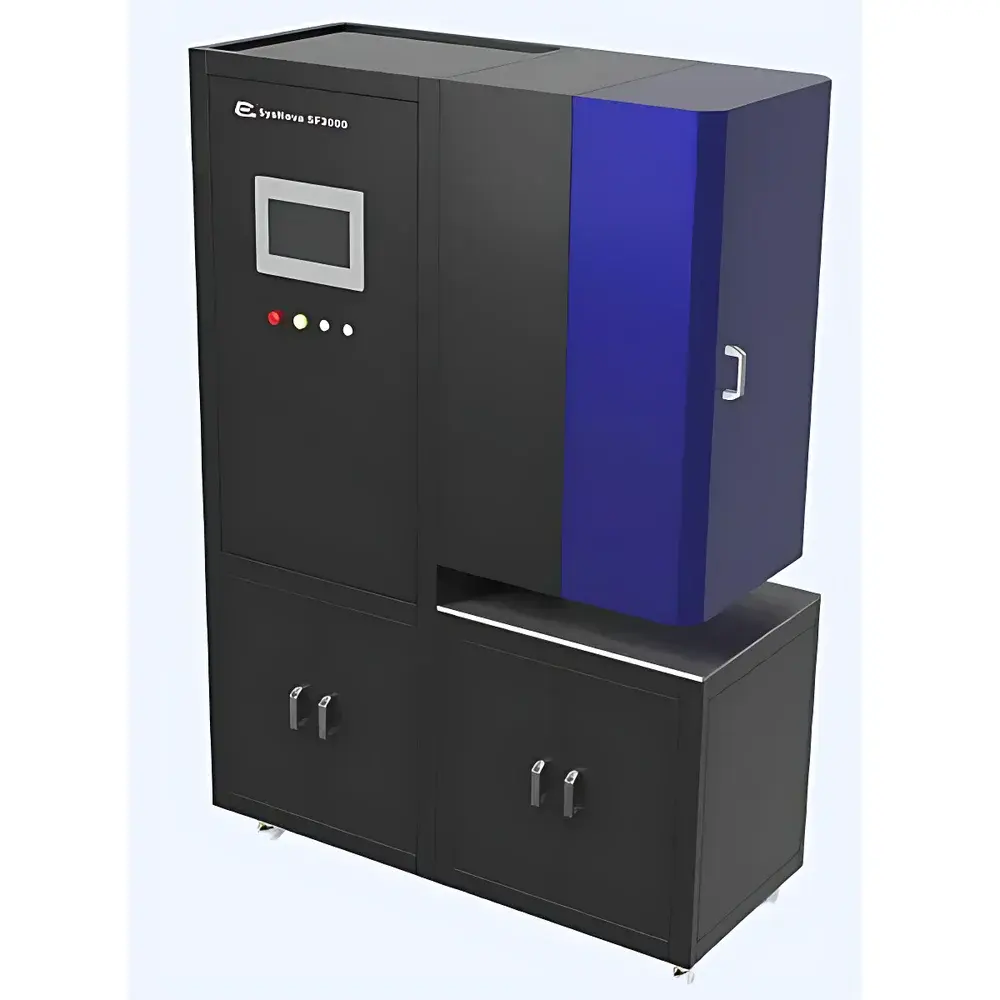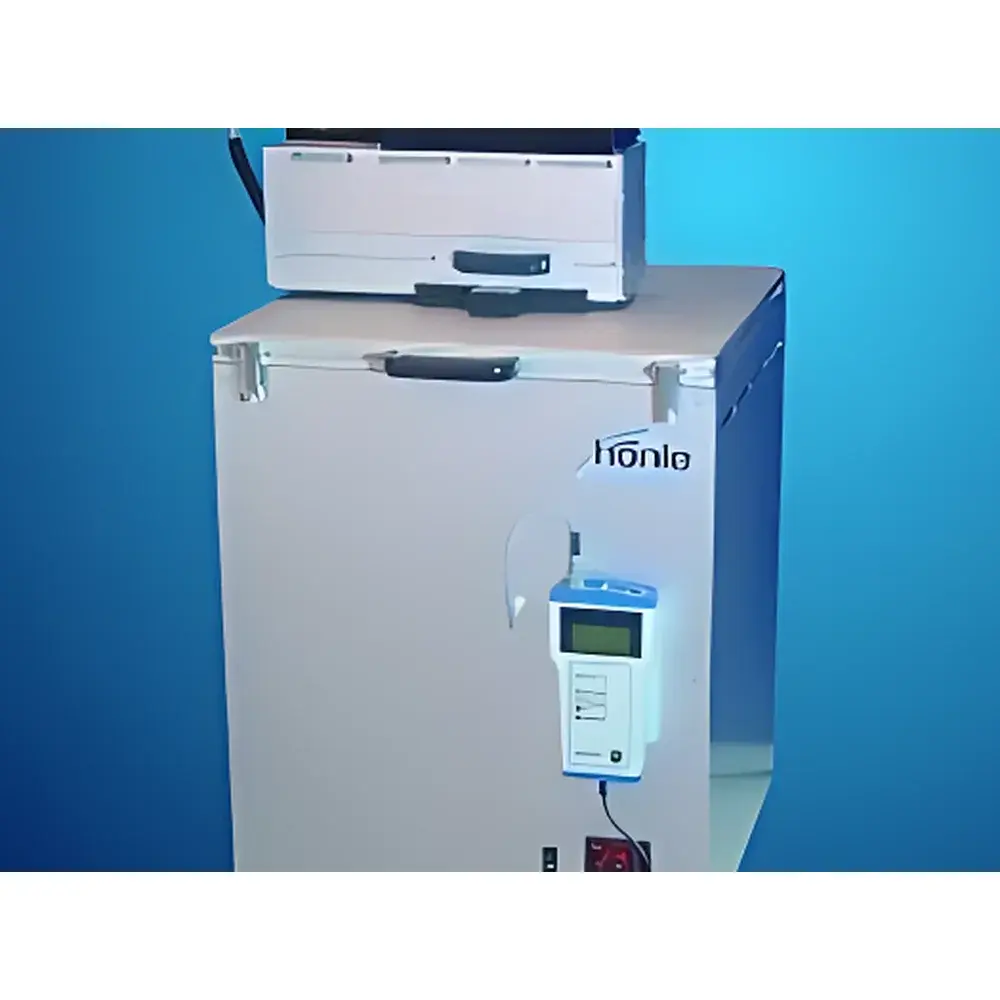
Honle UVACUBE Inert CO₂-Atmosphere UV Curing Chamber
| Brand | Hönle |
|---|---|
| Origin | Germany |
| Model | UVACUBE Inert |
| Chamber Dimensions (W×H×D) | 450 × 450 × 450 mm |
| External Dimensions (W×H×D) | 530 × 920 × 530 mm |
| Door Opening (W×H) | 450 × 450 mm |
| Atmosphere | CO₂-controlled inert environment |
| Oxygen Residual Monitoring | Continuous in-situ measurement |
| UV Intensity Monitoring | Integrated real-time sensor |
| Safety | Interlocked light-shielding door and shutter with audible end-of-cycle signal |
| Optional | Motorized height-adjustable workbench |
Overview
The Honle UVACUBE Inert is an engineered CO₂-atmosphere UV curing chamber designed for high-fidelity photopolymerization of UV-curable formulations under tightly controlled inert conditions. Unlike standard nitrogen-purged systems, the UVACUBE Inert utilizes carbon dioxide as the primary inerting gas—offering superior oxygen displacement efficiency, reduced gas consumption, and enhanced compatibility with heat-sensitive substrates due to CO₂’s higher thermal conductivity and lower dew point. The system operates on the principle of broadband or narrowband UV irradiation (typically 200–400 nm), where photons initiate free-radical or cationic polymerization in acrylate-, epoxy-, or vinyl ether-based resins. Its sealed, recirculating atmosphere architecture maintains residual oxygen concentrations below 100 ppm (measurable in real time), minimizing premature surface inhibition and ensuring uniform through-cure in complex 3D geometries—critical for adhesives, conformal coatings, and microfluidic device encapsulation.
Key Features
- CO₂-based inert atmosphere generation with continuous electrochemical oxygen sensor feedback for closed-loop control
- Real-time UV irradiance monitoring via calibrated silicon carbide photodiode, traceable to PTB (Physikalisch-Technische Bundesanstalt) standards
- Programmable shutter with integrated timer (0.1 s–999 min resolution) and acoustic end-of-cycle notification
- Interlocked safety system: automatic UV source cutoff upon door or shutter actuation, compliant with EN 60204-1 and IEC 62471 (Photobiological Safety)
- Modular lamp/filter configuration supporting UVA (320–400 nm), UVV (395–445 nm), and broadband (200–400 nm) spectral outputs
- Optional motorized height-adjustable workbench (ISO 9241-5 ergonomic compliance) for operator-specific positioning and repeatable sample loading
Sample Compatibility & Compliance
The UVACUBE Inert accommodates substrates up to 450 × 450 × 450 mm, including printed circuit boards, medical device housings, optical lenses, and multi-layer polymer assemblies. Its inert CO₂ environment prevents oxidation of reactive monomers and inhibits amine-based surface tackiness commonly observed in nitrogen-only systems. The chamber meets ISO 17025 requirements for calibration traceability of UV intensity and oxygen sensors. It supports GLP-compliant workflows through configurable audit trails (when paired with optional Hönle UV-Software Suite v5.x), and its electrical architecture conforms to CE, UL 61010-1, and RoHS directives. For regulated industries, the system can be validated per IQ/OQ protocols aligned with ASTM D4459 (Standard Practice for Fluorescent UV Exposure of Plastics) and ISO 11507 (Plastics — Exposure to Artificial Weathering).
Software & Data Management
While the base unit operates via front-panel controls, optional integration with Hönle UV-Software Suite enables full remote operation, parameter logging (UV dose, O₂ ppm, elapsed time), and export of CSV-formatted datasets for LIMS or statistical process control (SPC). The software supports user-defined curing profiles with up to 10 sequential steps, each with independent irradiance setpoints, dwell times, and shutter states. All measurement data—including sensor drift compensation logs and lamp aging curves—is timestamped and stored with SHA-256 hash integrity verification. When configured for 21 CFR Part 11 compliance, the system provides electronic signatures, role-based access control, and immutable audit trails meeting FDA expectations for GMP environments.
Applications
- Curing of low-VOC, high-solids UV inks and clearcoats on automotive trim and aerospace composites
- Encapsulation of MEMS sensors and flexible electronics requiring void-free, stress-minimized polymerization
- Assembly bonding of glass-to-metal and polymer-to-ceramic joints in diagnostic cartridges
- Rapid prototyping of dental restoratives and biocompatible hydrogel scaffolds
- Accelerated aging studies of UV-stabilized polymers under controlled oxidative stress conditions
FAQ
What inert gas options does the UVACUBE Inert support besides CO₂?
The system is specifically engineered for CO₂ operation; nitrogen or argon configurations are not supported due to fundamental differences in gas handling, sensor calibration, and thermal management architecture.
Can the chamber accommodate samples taller than 450 mm?
No—the internal curing volume is strictly limited to 450 mm in all three axes; oversized samples require custom chamber variants (e.g., UVACUBE Inert XL, available under separate quotation).
Is UV spectral output data provided with each lamp installation?
Yes—each lamp module ships with a NIST-traceable spectral irradiance certificate (200–450 nm, 1 nm resolution), measured using an Ocean Insight QE Pro spectroradiometer calibrated against a 1000 K blackbody reference.
How frequently must the oxygen sensor be recalibrated?
The electrochemical O₂ sensor requires annual verification against a certified zero-air standard (≤1 ppm O₂); field recalibration is performed via the service menu using a two-point gas standard protocol.
Does the system support external PLC integration?
Yes—RS-485 (Modbus RTU) and Ethernet/IP interfaces are available as factory-installed options for synchronized operation within automated production lines.