
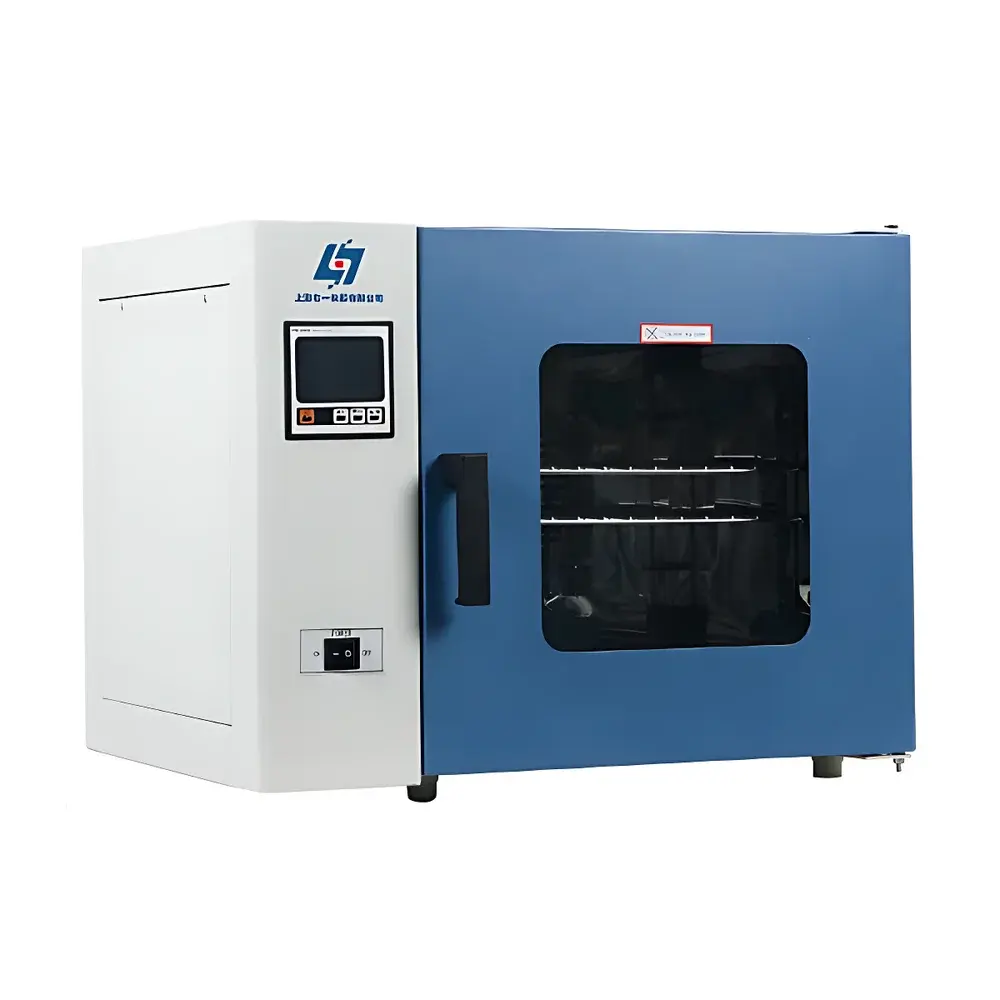
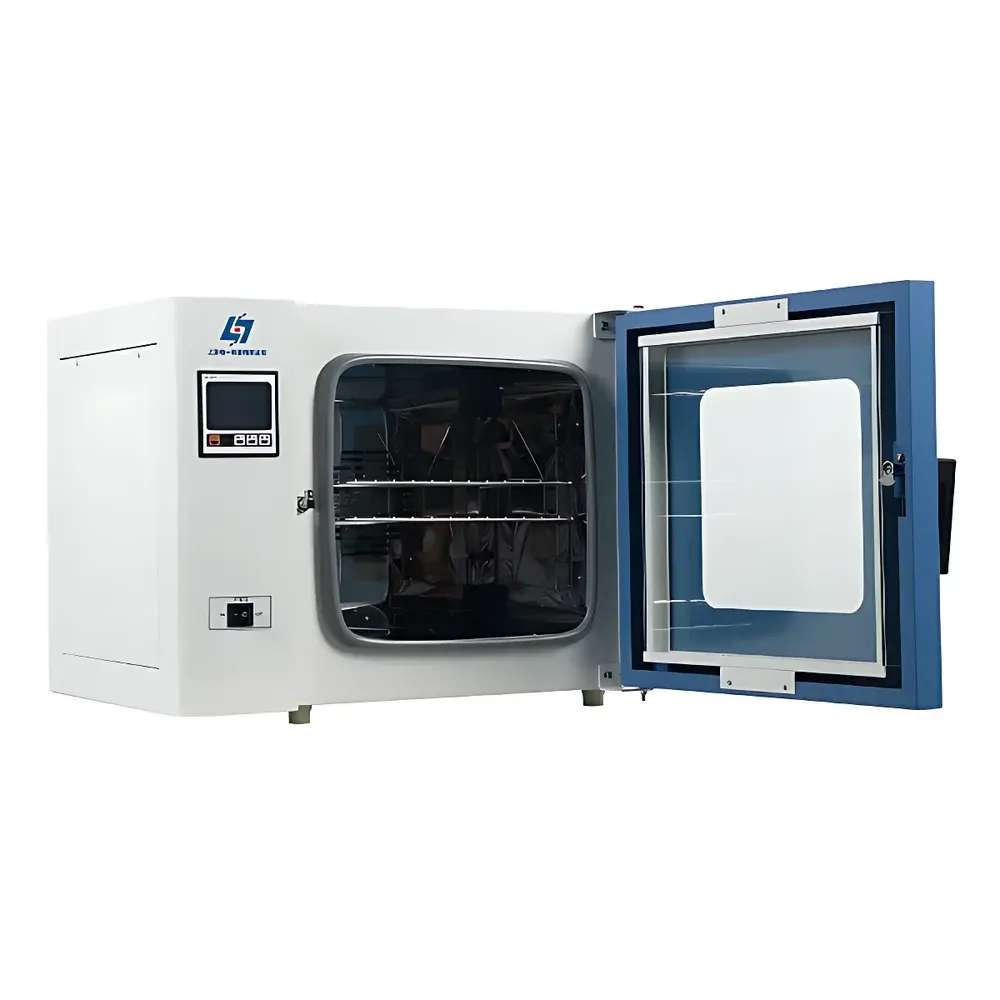
Yoyi DHG-9123A Forced-Air Constant-Temperature Drying Oven
| Brand | Yoyi |
|---|---|
| Origin | Shanghai, China |
| Manufacturer Type | Direct Manufacturer |
| Model | DHG-9123A |
| Temperature Range | RT+10°C to 280°C |
| Temperature Uniformity | ±2.5% (at 100°C) |
| Temperature Fluctuation | ±1°C |
| Temperature Resolution | 0.1°C |
| Internal Dimensions (W×D×H) | 550×450×550 mm |
| External Dimensions (W×D×H) | 835×670×730 mm |
| Interior Material | Mirror-Finish Stainless Steel |
| Heating Method | Electric Resistive Heating |
| Power Consumption | 2050 W |
| Standard Shelving | 2 Adjustable Stainless Steel Trays |
| Air Circulation | Forced Convection via Rear-Mounted Centrifugal Blower with Automatic Intake/Exhaust Dampers |
Overview
The Yoyi DHG-9123A is a precision-engineered forced-air constant-temperature drying oven designed for reproducible thermal processing in regulated laboratory and industrial quality control environments. It operates on the principle of convective heat transfer, utilizing a rear-mounted centrifugal blower to generate uniform airflow across the chamber—ensuring consistent temperature distribution and minimizing thermal stratification. Engineered for stability under continuous operation, the unit maintains setpoint accuracy within ±1°C fluctuation and achieves ±2.5% uniformity (measured at 100°C per ISO 15502 and GB/T 30435–2013), making it suitable for applications requiring strict thermal compliance—including moisture loss determination, pre-conditioning of polymeric samples, sterilization validation support, and residual solvent removal in pharmaceutical excipients.
Key Features
- Microprocessor-based PID temperature controller with intuitive LCD menu interface—displays real-time chamber temperature, setpoint, elapsed time, and remaining hold duration simultaneously
- Intelligent power-loss recovery function: automatically resumes prior operating parameters (set temperature, timer, alarm thresholds) following unexpected shutdowns or grid interruptions
- Dual-layer tempered glass observation window with integrated anti-fog heating element—enables unobstructed visual monitoring without compromising thermal integrity
- Robust enclosure fabricated from cold-rolled steel with electrostatic epoxy-polyester coating; interior constructed from electropolished 304 stainless steel for corrosion resistance and easy decontamination
- High-efficiency air circulation system featuring adjustable intake/exhaust dampers and rear-mounted blower—dynamically manages internal humidity by expelling condensate-laden air without manual vent adjustment
- Independent over-temperature cut-off circuit (optional)—mechanically isolated from main control board to comply with IEC 61010-1 safety requirements for Class II equipment
- Modular accessory architecture supporting field-installable options including RS485 communication port, embedded thermal printer, multi-segment programmable controller, and inert gas purging kit with calibrated rotameter
Sample Compatibility & Compliance
The DHG-9123A accommodates a broad range of sample types—including glassware, metal components, polymer films, biological substrates, ceramic powders, and electronic assemblies—within its 136 L working volume. Its stainless-steel interior and smooth-welded corners meet cleaning validation requirements for GLP and GMP environments. The oven conforms to GB/T 30435–2013 (Chinese national standard for electric hot-air ovens), and its construction aligns with key international benchmarks including ISO 15502 (laboratory ovens – performance criteria), ASTM E145 (standard specification for gravity convection and forced convection ovens), and EN 60529 (IP20 ingress protection rating). Optional accessories such as the RS485 interface support 21 CFR Part 11-compliant data logging when paired with validated third-party software.
Software & Data Management
While the base configuration features standalone microcontroller operation, optional RS485 connectivity enables integration into centralized lab management systems via Modbus RTU protocol. When equipped with the embedded thermal printer (optional), the unit generates time-stamped hardcopy records of temperature profiles—including start/stop timestamps, deviation alerts, and hold-phase confirmation—supporting audit-ready documentation per ISO/IEC 17025 clause 7.7. All parameter changes are logged internally with timestamp and user ID (when configured with external authentication), satisfying traceability requirements for QC laboratories undergoing FDA or CNAS accreditation.
Applications
- Moisture content analysis per AOAC 950.46 and USP <731> using gravimetric loss-on-drying methodology
- Pre-drying of filter papers, crucibles, and weighing vessels prior to ash content determination (ASTM D2974)
- Thermal conditioning of elastomers and thermoplastics before tensile or impact testing (ISO 291, ASTM D618)
- Stabilization of reference standards and calibration weights in metrology labs
- Baking of printed circuit boards (PCBs) to remove absorbed atmospheric moisture prior to solder reflow (IPC-J-STD-033)
- Accelerated aging studies for packaging materials under controlled thermal stress (ASTM F1980)
- Supporting microbiological media preparation workflows where dry-heat sterilization of glassware is required (ISO 11138-2)
FAQ
What is the maximum safe operating temperature for continuous use?
The DHG-9123A is rated for sustained operation up to 280°C. For extended dwell times above 200°C, ensure adequate ventilation and verify compatibility of loaded materials with prolonged exposure to elevated temperatures.
Does the oven support ramp-hold programming?
Standard firmware supports single-setpoint operation with timer-based hold. Multi-segment ramp-soak profiles require the optional programmable controller module (PN: DHG-PC100), which provides up to 30 segments with independent rate and dwell settings.
Can the unit be validated for IQ/OQ/PQ protocols?
Yes—the oven’s mechanical design, sensor layout, and control architecture support formal qualification. Documentation packages—including factory calibration certificates, sensor traceability reports (NIST-traceable Pt100 probe), and empty-chamber mapping templates—are available upon request.
Is inert gas purging compatible with all temperature ranges?
The optional inert gas inlet kit is rated for use from ambient to 250°C. Above this threshold, flow regulation via the integrated rotameter remains functional, but users must confirm material compatibility of seals and tubing with both gas type and temperature.
How often should the temperature sensor be recalibrated?
Per ISO/IEC 17025 recommendations, annual calibration against a certified reference thermometer is advised. Field verification using a portable Class A Pt100 probe is recommended prior to critical runs or after physical relocation.



