
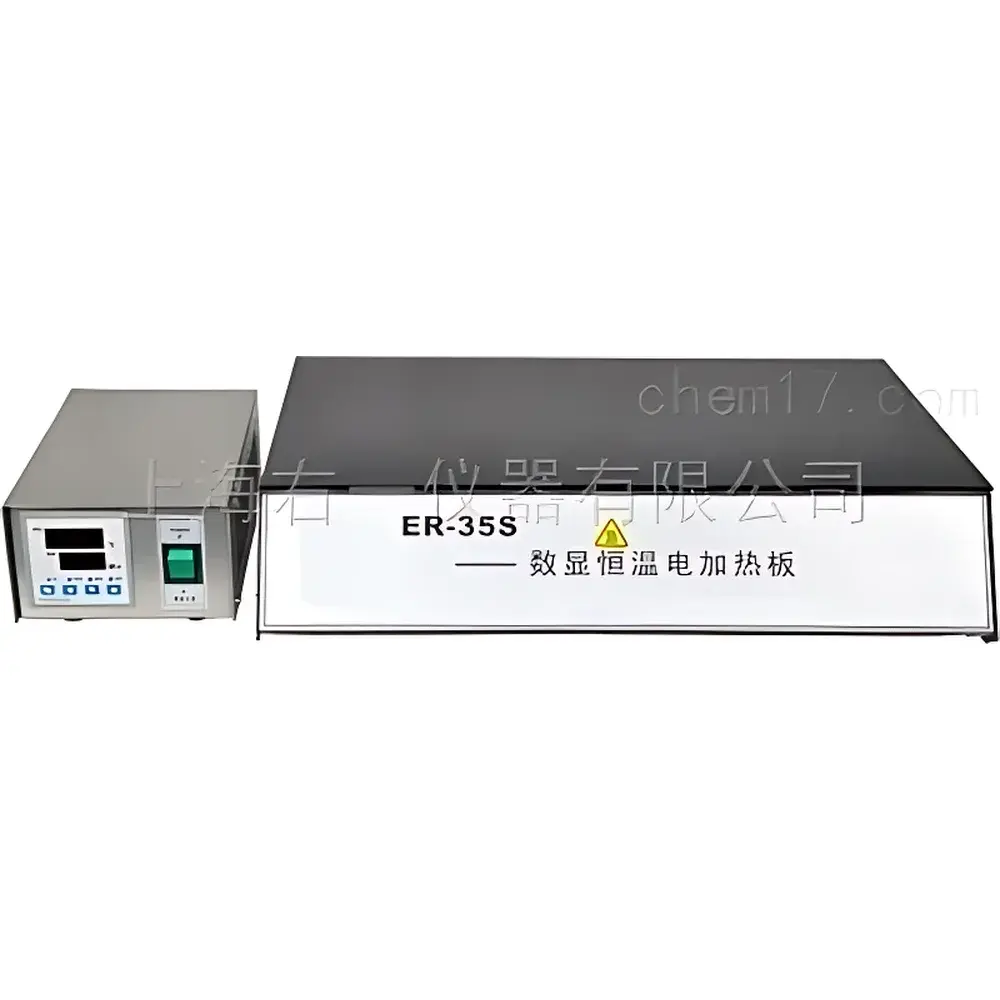
Yoyi ER-35S Digital Display Electric Heating Plate with Acid-Base Resistant Microcrystalline Glass Surface
| Brand | Yoyi |
|---|---|
| Origin | Shanghai, China |
| Manufacturer | Yes |
| Country of Origin | China |
| Model | ER-35S |
| Heating Power | 2400 W |
| Max. Heating Temperature | 400 °C |
| Temperature Uniformity | ±1 °C |
| Plate Dimensions (W × D) | 500 × 300 mm |
| Heating Zone Dimensions (W × D) | 500 × 300 mm |
| Display Type | Digital LED |
Overview
The Yoyi ER-35S Digital Display Electric Heating Plate is an industrial-grade laboratory heating platform engineered for precision thermal control in demanding sample preparation and digestion workflows. Designed around a robust resistive heating architecture embedded beneath a seamless microcrystalline glass surface, the ER-35S delivers stable, uniform heat distribution across its full 500 × 300 mm active zone. Unlike conventional ceramic or aluminum plates, its low-thermal-expansion microcrystalline glass top—chemically inert and certified resistant to concentrated HCl, HNO₃, HF, NaOH, and KOH solutions—enables direct contact with aggressive reagents during open-vessel acid digestions, evaporation, and solvent reflux procedures. Its maximum operating temperature of 400 °C supports high-boiling-point solvent applications and accelerated digestion protocols compliant with EPA Method 3050B and ISO 11466. The unit operates on standard AC 220 V / 50 Hz supply and integrates passive thermal insulation via high-density ceramic fiber layers, minimizing energy loss and reducing external casing temperature rise during prolonged operation.
Key Features
- Chemically inert microcrystalline glass surface rated for continuous exposure to strong acids (e.g., 65% HNO₃, 37% HCl) and strong alkalis (e.g., 50% NaOH) without etching or degradation
- Precision digital temperature control with ±1 °C uniformity across the entire 500 × 300 mm heating zone, verified per ASTM E220 calibration standards
- 2400 W high-power resistive heating system enabling rapid thermal ramp rates and stable setpoint maintenance under load
- Full-perimeter construction using 316L stainless steel—resistant to chloride-induced pitting and corrosion from splashed reagents or condensate
- Integrated over-temperature protection with independent mechanical cutoff (cut-off at 450 °C) and real-time sensor monitoring
- LED digital display with intuitive keypad interface; supports both Celsius and Fahrenheit units and retains settings after power cycle
Sample Compatibility & Compliance
The ER-35S accommodates standard laboratory vessels including borosilicate glass beakers (up to 4 L), PTFE digestion cups, quartz crucibles, and ceramic evaporation dishes. Its flat, non-porous surface ensures compatibility with volumetric flasks, round-bottom flasks (with appropriate support stands), and multi-vial digestion blocks. The device meets general safety requirements outlined in IEC 61010-1:2010 for electrical equipment used in laboratory environments. While not intrinsically rated for hazardous area use, its sealed electronics and corrosion-resistant enclosure support deployment in fume hoods and wet chemistry labs adhering to OSHA 1910.1200 (HazCom) and CLP/GHS labeling practices. It is routinely deployed in GLP-compliant environmental testing labs performing soil and sediment metal extraction per US EPA SW-846 Methods 3050B and 3051A.
Software & Data Management
The ER-35S operates as a standalone analog-digital hybrid instrument with no onboard data logging or PC connectivity. All temperature setpoints, dwell times, and operational status are managed locally via the front-panel interface. For laboratories requiring audit-ready records, optional external USB data loggers (e.g., Omega OM-DAQPRO-5300) may be interfaced via PT100 output (available upon request with OEM configuration). The unit’s firmware includes automatic power-on default setting retention and supports manual calibration offset adjustment within ±5 °C range—documented per ISO/IEC 17025 clause 6.5.2 for measurement traceability. No software validation package is provided; however, the hardware design conforms to FDA 21 CFR Part 11 principles for manual entry integrity when used in conjunction with validated lab notebooks or LIMS entries.
Applications
- Open-vessel acid digestion of environmental samples (soils, sediments, sludges) prior to ICP-OES or ICP-MS analysis
- Controlled evaporation of aqueous extracts and organic solvent concentrates under fume hood conditions
- Pre-heating and temperature stabilization of reaction mixtures in synthetic organic chemistry and polymer synthesis
- Standardization of viscosity reference oils and calibration fluids in QC labs (ASTM D445)
- Thermal conditioning of pH electrodes, conductivity cells, and dissolved oxygen probes during calibration
- Support heating for distillation assemblies, Soxhlet extractors, and Kjeldahl digestion systems
FAQ
Is the microcrystalline glass surface resistant to hydrofluoric acid (HF)?
Yes—the surface has been tested per DIN EN ISO 17463 for resistance to 40% HF solution at room temperature for up to 2 hours with no measurable mass loss or optical haze.
Can the ER-35S be used inside a Class II biosafety cabinet?
No—it is not rated for use in laminar flow or biosafety cabinets due to convection-driven heat dissipation and lack of UL 61010-2-040 certification for biological containment environments.
Does the unit include a PT100 probe port for external temperature feedback?
Standard configuration does not include a probe port; however, custom OEM versions with rear-panel PT100 input (0–400 °C range) are available upon request with minimum order quantity.
What is the expected service life of the heating element under continuous 400 °C operation?
Based on accelerated aging tests per IEC 60068-2-2, the NiCr alloy heating element maintains ≥95% thermal output after 5,000 hours at 400 °C with intermittent cycling.
Is calibration documentation included with shipment?
A factory calibration certificate (traceable to NIM China) is supplied with each unit, listing as-delivered accuracy at 100 °C, 250 °C, and 400 °C points.



