
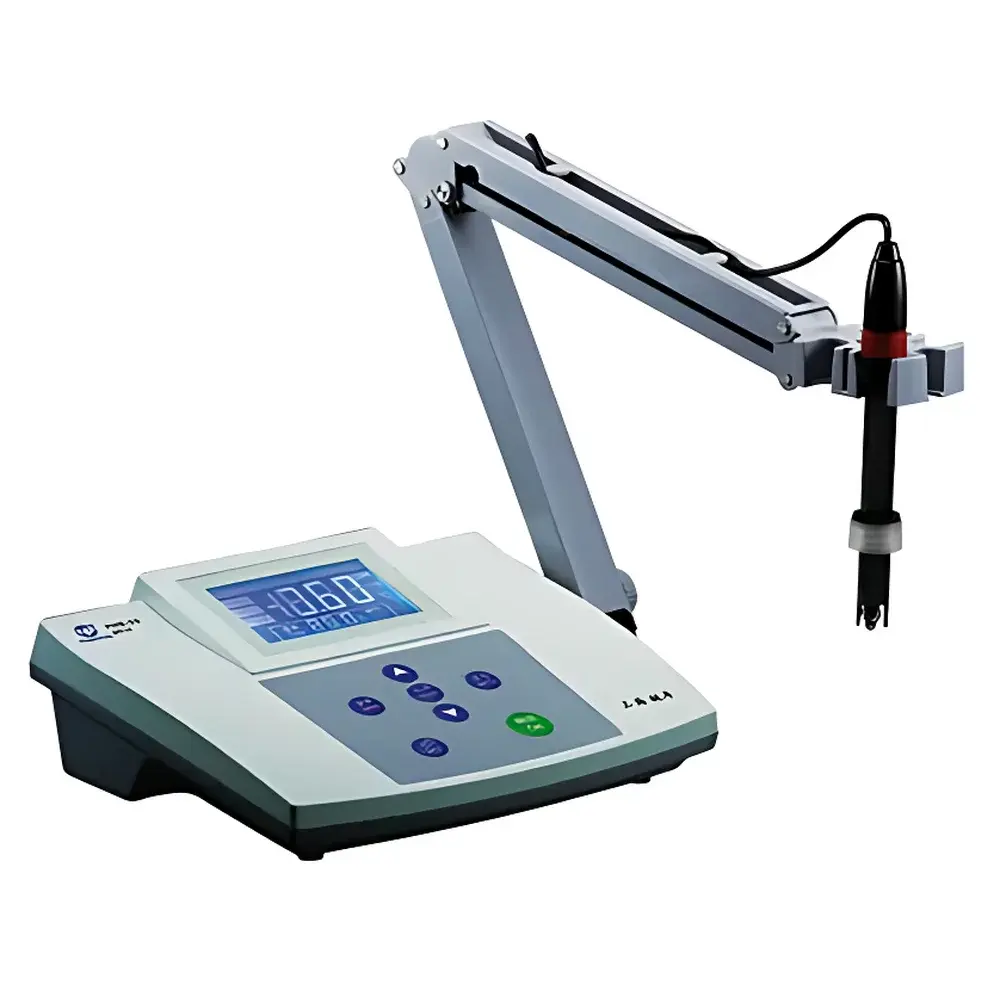
SHYP PHS-3C Benchtop pH Meter with Automatic Temperature Compensation
| Brand | SHYP (Shanghai Yueping Scientific Instrument Co., Ltd.) |
|---|---|
| Origin | Shanghai, China |
| Model | PHS-3C |
| Instrument Type | Benchtop pH Meter |
| Parameter Type | Single-parameter (pH & mV) |
| Measurement Range | 0.00–14.00 pH |
| Resolution | 0.01 pH |
| Accuracy | ±0.02 pH ±1 digit |
| mV Range | ±1999 mV |
| mV Resolution | 1 mV |
| mV Accuracy | ±1% FS |
| Input Impedance | ≥1 × 10¹² Ω |
| Input Current | ≤1 × 10⁻¹² A |
| Stability | (±0.05 pH ±1 digit)/3 h |
| Temperature Compensation | Manual or Automatic (0.0–60.0 °C) |
| Power Supply | DC 12 V, 1.0 A |
| Dimensions | 220 × 160 × 65 mm |
| Weight | 1.5 kg |
Overview
The SHYP PHS-3C is a benchtop single-parameter electrochemical analyzer engineered for precise, repeatable pH and millivolt (mV) measurements in routine laboratory, quality control, and educational environments. It operates on the principle of potentiometric measurement—detecting the potential difference between a pH-sensitive glass electrode and a stable reference electrode immersed in an aqueous sample. This voltage, governed by the Nernst equation, is converted into a pH reading with high linearity across the full 0.00–14.00 pH range. Designed to meet Class 0.01 pH instrument specifications per GB/T 11165–2005 (equivalent to ISO 7888:1993 for general-purpose pH meters), the PHS-3C delivers traceable accuracy of ±0.02 pH ±1 digit under standard calibration conditions. Its integrated temperature compensation circuit—switchable between manual and automatic modes—corrects for solution temperature-dependent electrode response within 0.0–60.0 °C, ensuring thermally adjusted readings without external calculation.
Key Features
- Benchtop form factor with compact footprint (220 × 160 × 65 mm) and lightweight aluminum-chassis construction (1.5 kg), optimized for space-constrained lab benches and mobile QC stations.
- High-input-impedance amplifier (≥1 × 10¹² Ω) minimizes loading error when paired with standard E-201-C combination pH electrodes, preserving signal integrity during low-conductivity or high-resistance sample measurements.
- Dual-mode temperature compensation: users may select either manual entry or automatic sensing via integrated Pt1000 RTD probe input—enabling compliance with procedures requiring documented thermal correction (e.g., ASTM D1293 for water pH).
- Calibration flexibility: supports both one-point (single-buffer) and two-point (two-buffer, slope & offset) calibration protocols per IUPAC recommendations, with visual on-screen prompts guiding users through buffer recognition and electrode validation.
- LCD display with 0.01 pH resolution and simultaneous dual-parameter readout (pH/mV), allowing real-time redox potential monitoring alongside acidity assessment—critical for titration endpoint verification and corrosion studies.
Sample Compatibility & Compliance
The PHS-3C is validated for use with aqueous and mildly buffered solutions across environmental, pharmaceutical, food, and academic applications. It accommodates standard BNC-input pH electrodes—including SHYP’s E-201-C composite electrode—and is compatible with alternative reference systems (e.g., Ag/AgCl double-junction electrodes) for samples containing sulfides, proteins, or high concentrations of heavy metals. While not certified for GMP-regulated production environments, its stability performance ((±0.05 pH ±1 digit)/3 h) and reproducible calibration behavior support GLP-aligned documentation workflows. The instrument complies with electromagnetic compatibility requirements per GB/T 18268.1–2010 (IEC 61326-1:2012) and safety standards per GB 4793.1–2007 (IEC 61010-1:2010).
Software & Data Management
The PHS-3C operates as a standalone analog-digital hybrid system with no embedded data logging or PC connectivity. All measurements are displayed in real time; however, users may manually record values in laboratory notebooks or external LIMS-compatible spreadsheets. For auditability, calibration timestamps, buffer IDs (e.g., pH 4.01, 7.00, 10.01), and electrode status indicators (slope %, asymmetry potential) are retained on-screen during active calibration sessions—supporting traceability in ISO/IEC 17025-accredited labs where procedural documentation is required. No firmware updates or proprietary software drivers are provided; operation remains fully deterministic and immune to version drift.
Applications
- Environmental testing: monitoring pH of surface water, wastewater effluents, and soil extracts per EPA Method 150.1 and ISO 10523.
- Pharmaceutical QC: verifying pH of injectables, ophthalmic solutions, and buffer preparations in accordance with USP and Ph. Eur. 2.2.3.
- Food & beverage analysis: assessing acidity in dairy products, fruit juices, and fermented foods to ensure microbial stability and regulatory compliance (e.g., FDA 21 CFR Part 117).
- Academic instruction: teaching fundamental electrochemistry principles—including Nernstian behavior, liquid junction potentials, and calibration uncertainty—using a cost-effective, serviceable platform.
- Industrial process support: rapid field checks of rinse water pH in electroplating lines or cleaning validation steps in medical device manufacturing.
FAQ
What calibration buffers are recommended for routine use with the PHS-3C?
Standard NIST-traceable buffers at pH 4.01, 7.00, and 10.01 are recommended. Two-point calibration using pH 7.00 and one additional buffer (either 4.01 or 10.01) is sufficient for most applications.
Can the PHS-3C measure non-aqueous samples such as ethanol or glycerol solutions?
No. The instrument is designed exclusively for aqueous electrolyte systems. Non-aqueous solvents alter junction potentials and glass membrane hydration, invalidating Nernstian response and voiding accuracy specifications.
Is the E-201-C electrode included with the PHS-3C unit?
The E-201-C pH composite electrode is sold separately unless explicitly bundled in a configured kit; confirm inclusion with your authorized SHYP distributor prior to purchase.
Does the PHS-3C support RS-232 or USB output for data export?
No. The PHS-3C has no digital communication interface. Data capture requires manual transcription or integration with third-party analog-to-digital acquisition systems via its mV output port (if equipped on specific variants).
How often should the PHS-3C be recalibrated during daily use?
Recalibration is required before each measurement series, after electrode replacement, and whenever ambient temperature changes exceed ±5 °C—per ISO 7888:1993 guidance for Class 0.01 instruments.
Related Products





