
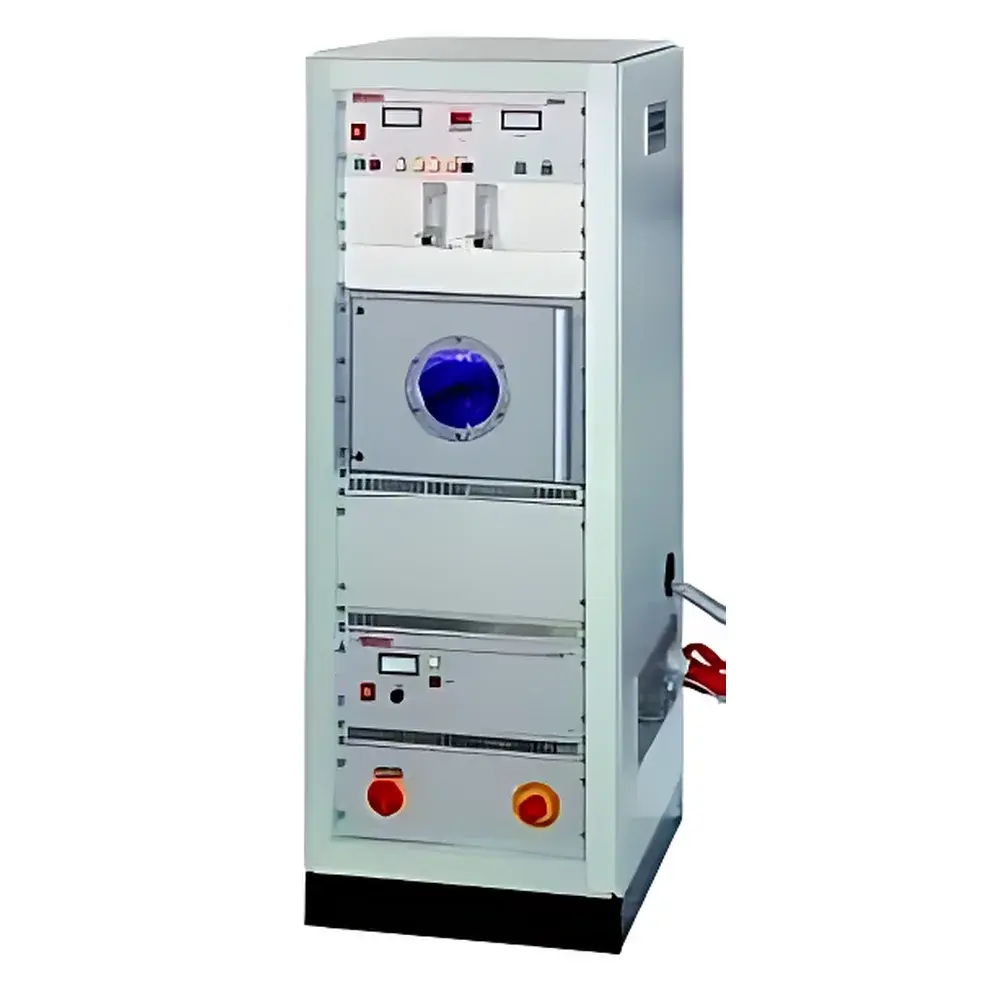
Diener Tetra30 Plasma Surface Treatment System
| Brand | Diener |
|---|---|
| Origin | Germany |
| Model | Tetra30 |
| RF Frequency | 13.56 MHz |
| Power Range | 0–600 W |
| Chamber Dimensions | 305 mm (W) × 625 mm (D) × 300 mm (H) |
| Chamber Volume | 50 L |
| Chamber Material | Stainless Steel |
| Gas Inlets | 3 Independent Mass Flow Controlled Channels |
| Control Interface | Touchscreen PC with Windows CE 5.0 (ARM) |
| Vacuum Pump Capacity | 16 m³/h |
| Pressure Control | Integrated Capacitive Pressure Sensor |
| Operating Modes | Manual & Fully Automated |
| Safety Features | Auto-reflection compensation, Overload/Short-circuit/Overheat Protection |
| Compliance | CE-marked, Designed for ISO/IEC 17025-aligned laboratories, Compatible with GLP/GMP documentation workflows |
Overview
The Diener Tetra30 Plasma Surface Treatment System is a benchtop-capable, high-reproducibility low-temperature plasma processing instrument engineered for precision surface modification under controlled vacuum conditions. Utilizing capacitively coupled radiofrequency (CCP) plasma generation at the industrial standard frequency of 13.56 MHz, the Tetra30 enables stable, uniform plasma discharge across diverse substrate geometries without thermal damage. Its core architecture follows the fundamental principles of glow discharge plasma physics—ionization of process gases (e.g., O₂, Ar, N₂, CF₄, or air) within a stainless-steel vacuum chamber to generate reactive species (ions, electrons, radicals, and UV photons) that interact physically and chemically with material surfaces. This facilitates non-destructive removal of organic contaminants, native oxides, photoresist residues, and weak boundary layers—critical for adhesion promotion, bonding preparation, and pre-deposition cleaning in R&D and pilot-scale manufacturing environments.
Key Features
- Modular CCP plasma source with automatic impedance matching: eliminates manual tuning and ensures consistent power coupling across variable gas compositions and pressures.
- Triple independent mass flow controllers (MFCs) for precise, repeatable gas dosing—enabling complex multi-step processes such as sequential etch/clean/passivation.
- 50-liter stainless-steel vacuum chamber (305 × 625 × 300 mm) optimized for high-volume throughput while maintaining field homogeneity via symmetric electrode geometry and aluminum/stainless-steel electrode construction.
- Wide RF power range (0–600 W) with continuous analog adjustment—supports both gentle surface activation (300 W).
- Integrated capacitive pressure sensor and programmable vacuum control—including forced-air inlet valve—enabling accurate pressure setpoints from 0.1 to 10 mbar with ±0.05 mbar repeatability.
- Windows CE 5.0 (ARM)-based touchscreen HMI with real-time graphical process monitoring: displays RF forward/reflected power, chamber pressure, gas flows, temperature trends, and elapsed time.
- Onboard recipe storage for ≥20 user-defined protocols, each supporting multi-segment parameter ramping (power, pressure, gas ratio, duration) with timestamped audit logs.
- Comprehensive safety architecture: hardware-level interlocks, overtemperature cutoff, RF arc detection, and reflected-power limiting to protect both operator and system integrity.
Sample Compatibility & Compliance
The Tetra30 accommodates substrates ranging from 2 mm-thick silicon wafers to irregularly shaped MEMS packages, polymer microfluidic chips, optical lenses, and biomedical implants—without requiring custom fixtures. Its chamber design supports horizontal and vertical loading configurations. All wetted materials comply with USP Class VI and ISO 10993-5 biocompatibility standards. The system meets CE Directive 2014/30/EU (EMC) and 2014/35/EU (LVD), and its control firmware supports 21 CFR Part 11-compliant electronic signatures and audit trails when integrated with validated laboratory information management systems (LIMS). It is routinely deployed in ISO 13485-certified medical device labs and ISO 9001-certified semiconductor packaging facilities for process validation per ASTM F2237 (plasma cleaning verification) and IEC 61215 (PV module surface prep).
Software & Data Management
The embedded Windows CE 5.0 OS provides deterministic real-time control with millisecond-level I/O response. Process data—including RF parameters, pressure transients, MFC outputs, and alarm events—are logged at 10 Hz and exportable in CSV or XML format. Optional Diener PlasmaControl™ software (PC-based) extends functionality with remote monitoring, SPC charting, DOE template libraries, and PDF report generation with digital signature fields. All stored recipes include metadata (user ID, timestamp, calibration status), satisfying GLP documentation requirements. Audit trail records are immutable and retain full history of parameter edits, start/stop commands, and system alerts—essential for FDA inspection readiness.
Applications
- Pre-bonding surface activation of polymeric substrates (e.g., PDMS, COC, PET) for microfluidic device assembly.
- Residue-free photoresist stripping from GaN LED wafers prior to metal deposition.
- Hydrophilization of PTFE tubing for improved fluidic performance in diagnostic cartridges.
- Removal of adventitious carbon contamination from TEM grids and XRD sample holders.
- Surface functionalization of titanium dental implants with amine or carboxyl groups to enhance osteoblast adhesion.
- Controlled ashing of SU-8 resist on glass substrates for micro-optics fabrication.
- Passivation of SiC power device surfaces to reduce interface trap density before gate oxide growth.
- Decontamination of reusable surgical instruments using low-power oxygen plasma (validated per ISO 14937).
FAQ
What vacuum level can the Tetra30 achieve, and how is it maintained?
The system achieves base pressures below 5 × 10⁻² mbar using its integrated 16 m³/h dry scroll pump. Pressure stability during plasma operation is actively regulated via feedback-controlled throttle valve and forced-air inlet—ensuring ±0.1 mbar deviation over 60-minute runs.
Is the Tetra30 compatible with corrosive process gases such as SF₆ or Cl₂?
Yes—when equipped with optional corrosion-resistant electrodes (anodized aluminum or nickel-plated stainless steel) and Viton-free sealing components, the Tetra30 supports halogen-based chemistries per ASTM D7252 guidelines for plasma etch validation.
Can process data be exported for regulatory submission?
All raw operational data—including timestamps, parameter values, and event logs—are stored in ASCII-formatted files compliant with ALCOA+ principles. Export formats include CSV (for Excel analysis) and XML (for LIMS ingestion), with optional digital certificate signing.
What maintenance intervals are recommended for long-term reliability?
Routine maintenance includes quarterly MFC calibration verification, annual RF generator performance testing (per IEC 61000-4-3), and biannual vacuum seal inspection. Diener provides certified service kits and factory-trained field engineers for global support.
Does the system support integration into automated production lines?
Yes—the Tetra30 offers RS-232, Ethernet/IP, and optional Profibus DP interfaces for PLC synchronization. SECS/GEM protocol support is available via firmware upgrade for semiconductor fab integration.



