
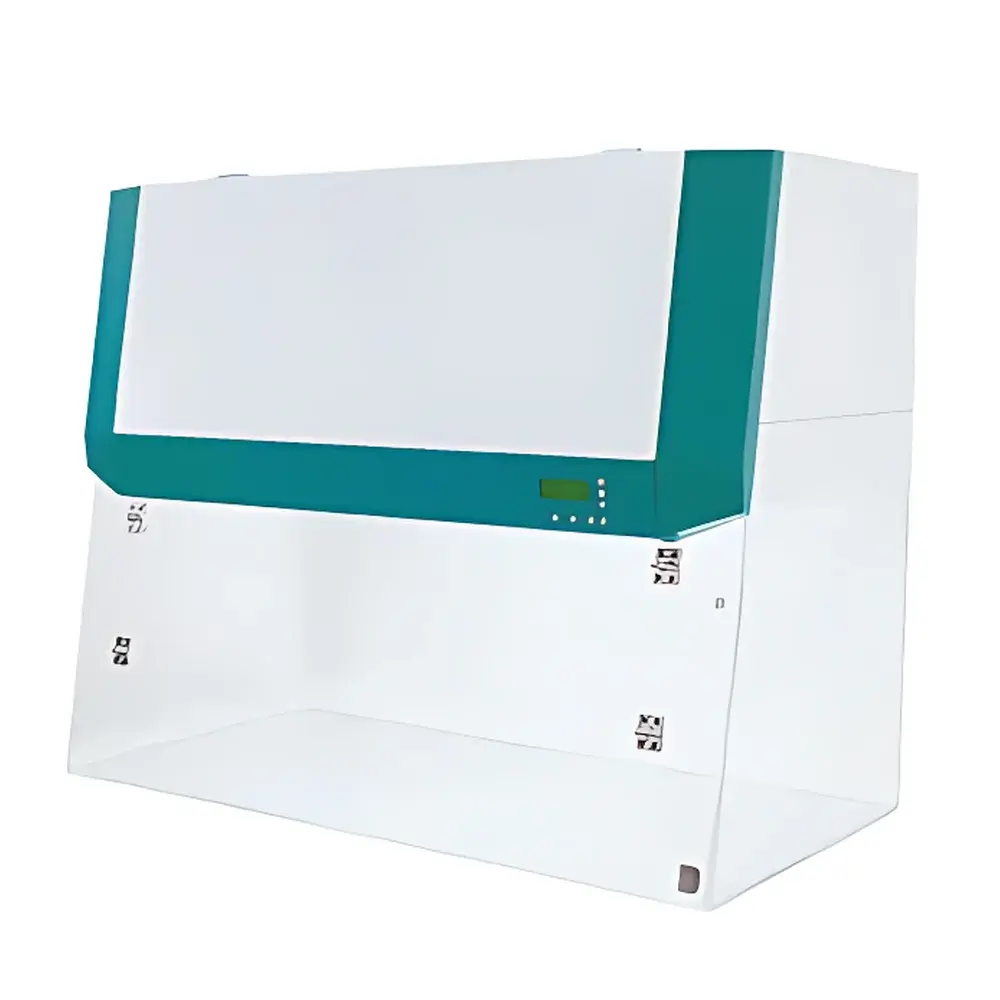
JEIO TECH PW-01/11/21 PCR Workstation
| Brand | JEIO TECH |
|---|---|
| Origin | South Korea |
| Model | PW-01 / PW-11 / PW-21 |
| Construction | Single-sided, fully steel cabinet |
| Airflow Type | Vertical laminar flow |
| Max Airflow | 557 / 697 / 929 cmh (327 / 408 / 546 cfm) |
| Min Airflow | 167 / 209 / 279 cmh (97 / 121 / 162 cfm) |
| Laminar Velocity | 0.3 m/s (60 fpm) |
| Filtration | ISO 14644-1 Class 4 (US FED STD 209E Class 10) HEPA filter (≥99.99% @ ≥0.3 µm) |
| Pre-filter | 85% efficiency per A.F.I. standard |
| UV Lamp | 254 nm, 15 / 20 / 30 W, 8000 h lifetime, digital timer (0–30 min), UV dose: 165 / 185 / 330 µW/cm² |
| Work Surface | 10 mm acrylic |
| Viewing Panels | 8 mm (front/side) / 10 mm (rear) acrylic |
| Illumination | >1000 lux fluorescent |
| Noise Level | <65 dB(A) |
| Power | 120V/230V, 50/60 Hz, 1.3–1.5 A (230V) or 2.2–2.9 A (120V) |
| Dimensions (W×D×H, mm) | 720×605×964 / 900×605×964 / 1200×605×964 (external) |
| Weight | 56.2 / 64.2 / 77.8 kg |
Overview
The JEIO TECH PW-01/11/21 PCR Workstation is an ISO 14644-1 Class 4 (US FED STD 209E Class 10) vertical laminar flow biosafety enclosure engineered specifically for contamination-sensitive molecular biology workflows—including plasmid preparation, cloning, qPCR setup, and NGS library construction. Unlike conventional fume hoods or general-purpose laminar flow cabinets, this workstation integrates dual-stage filtration (pre-filter + HEPA), germicidal UV-C irradiation with dose-controlled exposure, and interlocked safety logic to eliminate both airborne particulates and nucleic acid contaminants. Its vertical laminar airflow—maintained at a uniform 0.3 m/s across the work surface—ensures unidirectional particle-free air delivery, minimizing turbulent eddies that could reintroduce aerosolized DNA/RNA. The unit complies with core design principles outlined in ISO 14644-1 for cleanroom performance and aligns with laboratory best practices defined in CLSI EP29-A and ISO/IEC 17025 for controlled environment validation.
Key Features
- ISO Class 4-certified vertical laminar flow system delivering consistent 0.3 m/s airflow across the entire 700–1180 mm work surface, validated per ISO 14644-3 Annex B protocols.
- Dual-stage filtration: High-efficiency pre-filter (85% arrestance per A.F.I. test standard) extends HEPA service life; certified HEPA filter (≥99.99% @ ≥0.3 µm per MIL-STD-282) ensures compliant air cleanliness.
- Germicidal UV-C lamp (254 nm, 15–30 W output) with digital timer (0–30 min), real-time dose monitoring, and automatic shutoff upon sash opening—fully interlocked per IEC 61000-6-4 EMC and UL 61010-1 safety requirements.
- Microprocessor-based control panel with adjustable fan speed, UV timer display, and fault diagnostics—including UV lamp end-of-life warning and motor overcurrent protection.
- Full acrylic construction: 10 mm thick chemical-resistant work surface; 8 mm front/side and 10 mm rear viewing panels for full process visibility without compromising UV shielding.
- Integrated fluorescent lighting (>1000 lux at work surface), low-noise centrifugal blower (<65 dB[A] at 1 m), and robust all-steel structural frame rated for continuous operation under GLP-compliant conditions.
Sample Compatibility & Compliance
The PW series accommodates standard PCR consumables—including 0.2 mL tube racks, 96-well plates, pipette tips, and microcentrifuge tubes—within its ergonomic working envelope. All internal surfaces are non-porous and compatible with 70% ethanol, 10% bleach, and other common decontamination agents used in molecular labs. The workstation meets mechanical safety standards per EN 61010-1 and electrical safety per IEC 61000-6-2. While not classified as a biological safety cabinet (BSC) per NSF/ANSI 49, it is explicitly designed and validated for *non-hazardous*, *non-aerosol-generating* molecular procedures where operator protection is secondary to sample integrity. It supports compliance with ISO/IEC 17025 clause 5.3.2 (environmental conditions), USP (microbiological control of clean areas), and internal SOPs requiring DNA/RNA-free environments.
Software & Data Management
The PW-01/11/21 operates via embedded firmware with no external software dependency. All operational parameters—including fan speed, UV exposure duration, and runtime logs—are stored locally in non-volatile memory with timestamped records retained for ≥12 months. Audit trail functionality satisfies basic GLP documentation requirements: each UV cycle initiation and termination is logged with date/time, duration, and operator-initiated status (manual vs. auto-triggered). Though not FDA 21 CFR Part 11 compliant out-of-the-box, the device supports integration into validated lab information management systems (LIMS) via RS-232 serial interface (optional accessory), enabling automated log export for electronic record retention.
Applications
- Pre-PCR workspace decontamination prior to reaction setup to prevent carryover amplification artifacts.
- Handling of low-copy-number templates, CRISPR guide RNA complexes, and single-cell lysates where ambient nuclease or amplicon contamination poses critical risk.
- Preparation of sequencing libraries for Illumina, PacBio, and Oxford Nanopore platforms requiring ultra-low background noise.
- Cloning workflows involving restriction digestion, ligation, and transformation—particularly when using high-fidelity polymerases sensitive to trace inhibitors.
- Institutional core facility use where standardized, reproducible UV dosing (e.g., 165–330 µW/cm² × 30 min = 297–594 J/m²) is required for routine benchtop sterilization between users.
FAQ
What ISO class does the PW series meet, and how is it verified?
The PW-01/11/21 achieves ISO 14644-1 Class 4 (equivalent to US FED STD 209E Class 10) under steady-state laminar flow conditions. Certification is based on particle count testing per ISO 14644-2 using calibrated light-scattering particle counters sampling at ≥1 m³/min across nine designated locations.
Can this unit be used for handling infectious agents or toxic chemicals?
No. This is a laminar flow workstation—not a biological safety cabinet or chemical fume hood. It provides product protection only; it does not protect personnel or the environment from hazardous aerosols or vapors.
How often must the HEPA filter be replaced?
Under typical molecular lab conditions (20–25°C, ≤60% RH, no volatile organic solvents), JEIO TECH specifies a nominal service life of 3 years. Actual replacement interval depends on cumulative particulate loading and should be confirmed by differential pressure monitoring across the filter bank.
Is UV dose calibration traceable to NIST standards?
The UV intensity values (165/185/330 µW/cm²) are factory-measured using NIST-traceable radiometers (e.g., International Light IL1700) at the work surface center. Users may perform periodic verification using calibrated handheld UV-C meters compliant with ISO/IEC 17025.
Does the unit support external data logging or network connectivity?
The base model includes RS-232 port capability (hardware-enabled, firmware-ready). Optional communication modules allow integration with facility SCADA or LIMS platforms for centralized event logging and preventive maintenance scheduling.



