
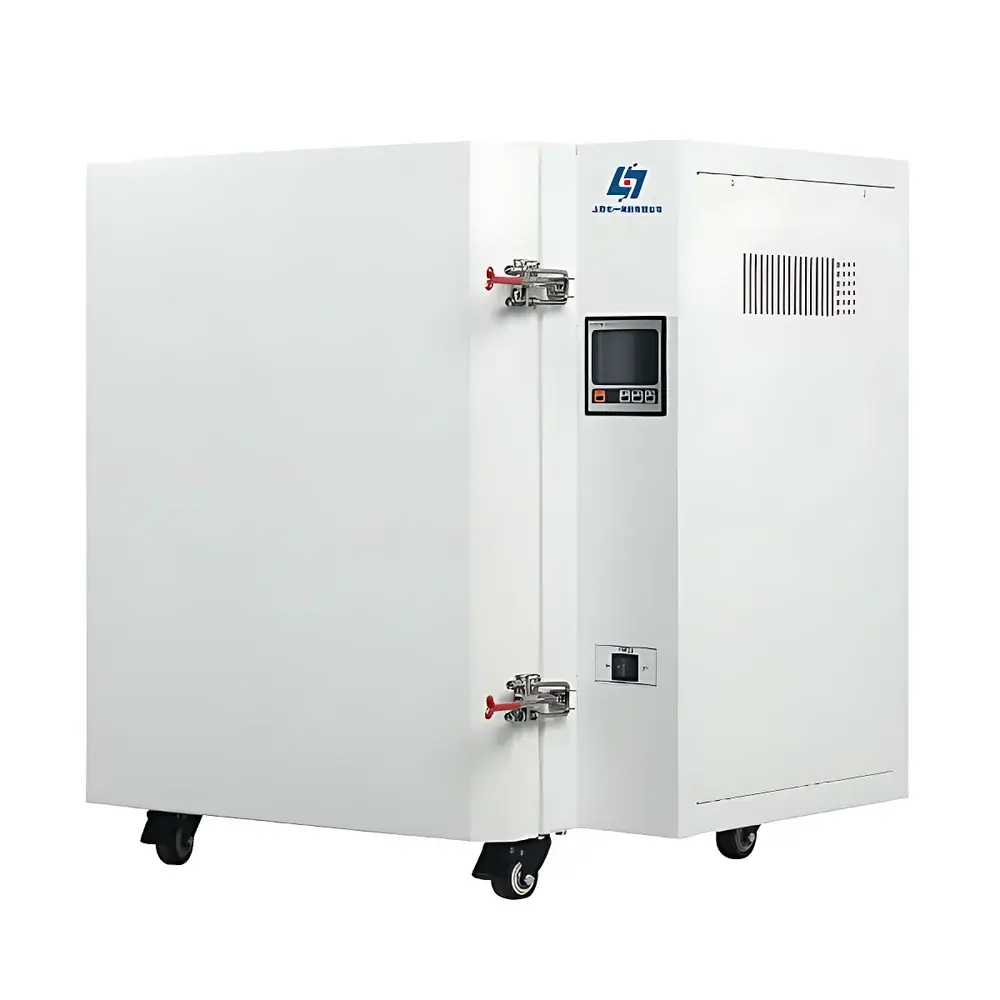
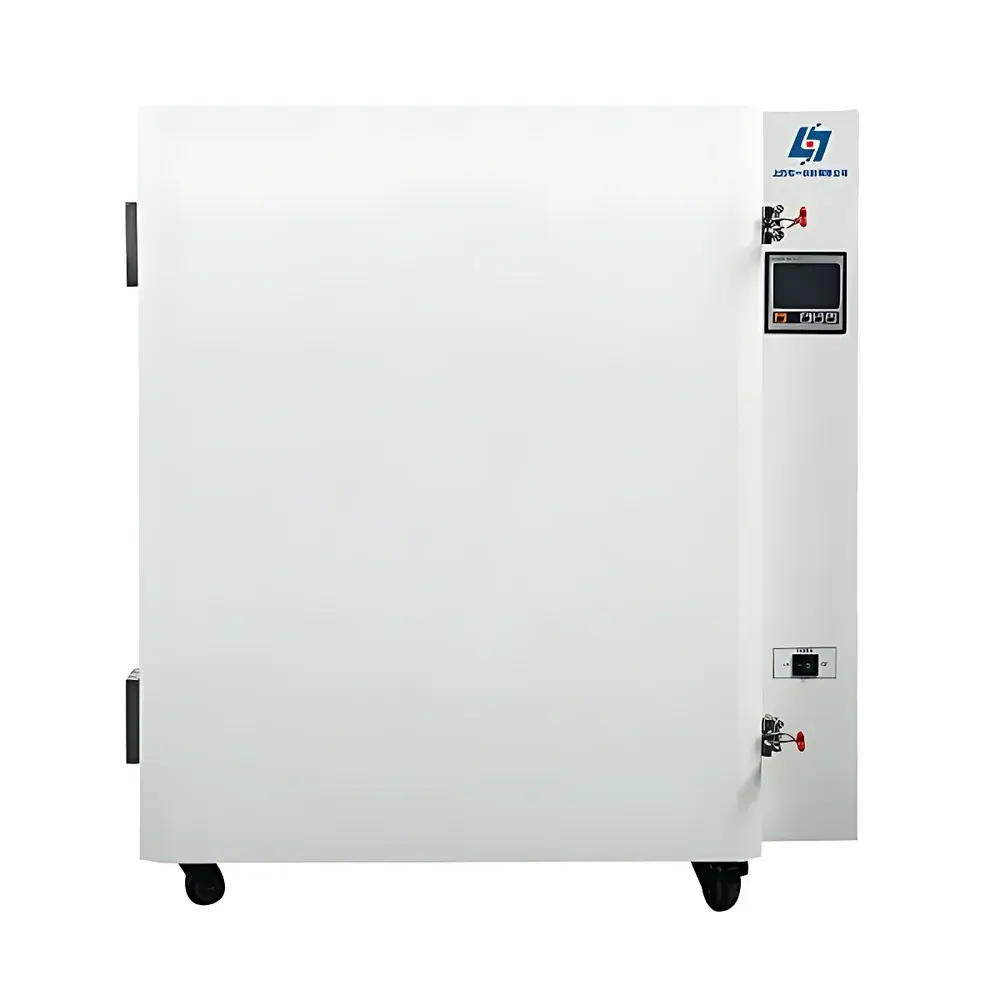
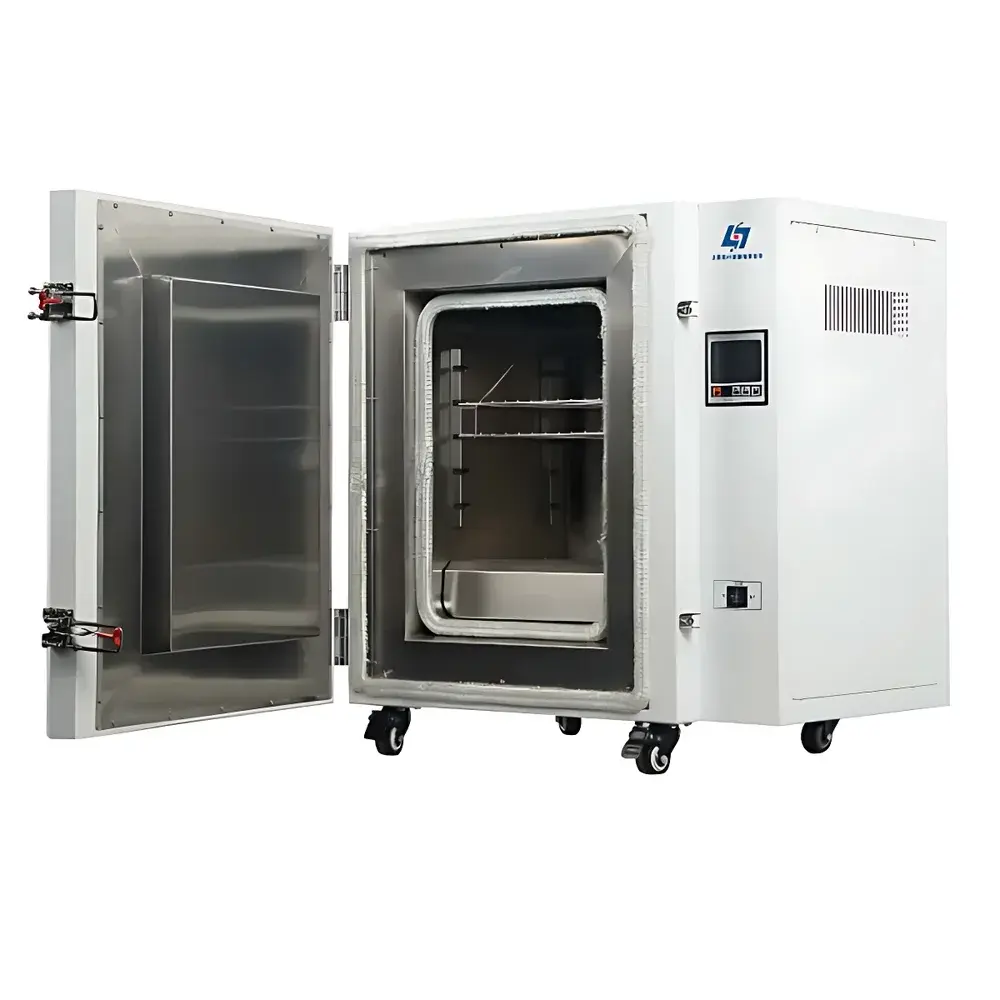
Yoyi DGG-308C High-Temperature Nitrogen-Purged Forced-Air Drying Oven
| Brand | Yoyi |
|---|---|
| Origin | Shanghai, China |
| Manufacturer Type | Direct Manufacturer |
| Equipment Category | Domestic |
| Model | DGG-308C |
| Instrument Type | High-Temperature Oven |
| Temperature Range | RT+20 °C to 400 °C |
| Temperature Resolution | 1 °C |
| Interior Chamber Material | Stainless Steel (Mirror-Finished) |
| Temperature Uniformity | ±2.5% (measured at 100 °C, non-purged condition) |
| Power Supply | AC 380 V, 50 Hz |
| Input Power | 6000 W |
| Chamber Dimensions (W×D×H) | 500×600×1000 mm |
| External Dimensions (W×D×H) | 840×995×1390 mm |
| Capacity | 300 L |
| Shelf Quantity | 2 pcs |
| Timer Range | 1–9999 min |
| Nitrogen Inlet Port | Φ10 mm |
| N₂ Flow Rate Range | 0–10 L/min |
| Operating Ambient Temperature | +5 °C to +40 °C |
| Insulation Material | Glass Fiber |
| Door Seal Material | Ceramic Fiber |
| Control System | Microcomputer-Based PID with LCD Display, Auto-Tuning, Power Limitation, and Multi-Stage Programmable Functionality |
Overview
The Yoyi DGG-308C is a high-temperature, nitrogen-purged forced-air drying oven engineered for precision thermal processing under inert atmospheres. Designed in accordance with GB/T 30435–2013 (General Technical Requirements for Industrial Electric Heating Ovens), it supports applications requiring oxygen-sensitive thermal treatment—including polymer curing, catalyst activation, metal oxide annealing, moisture-free drying of hygroscopic materials, and pre-sterilization of glassware in GLP-compliant laboratories. Its operational principle relies on convection-driven heat transfer enhanced by a shield-grade axial fan and optimized airflow ducting, ensuring rapid thermal equilibration and minimized thermal stratification. The chamber operates within a stable range of RT+20 °C to 400 °C, with microprocessor-controlled PID regulation enabling repeatable setpoint accuracy and minimal overshoot—critical for process validation and long-duration thermal protocols.
Key Features
- Robust dual-layer construction: mirror-polished 304 stainless steel interior chamber with seamless rounded corners for easy cleaning and contamination control; cold-rolled steel outer shell with electrostatic powder coating for corrosion resistance.
- High-efficiency thermal insulation using high-density glass fiber between chamber and casing, coupled with ceramic fiber door gasket rated for continuous operation up to 400 °C—reducing surface temperature rise and energy consumption.
- Dual-latch hinge door mechanism with compression seal design ensures consistent chamber integrity during nitrogen purging and maintains pressure stability during extended dwell cycles.
- Preheated air mixing chamber directs uniformly heated air directly into the working zone, improving thermal response time and spatial uniformity across the full 300 L volume.
- Integrated nitrogen inlet port (Φ10 mm) with calibrated float-type flowmeter (0–10 L/min range) enables precise inert gas dosing and rapid atmosphere exchange—compatible with standard lab-grade N₂ supply systems.
- Intelligent microcontroller system featuring LCD interface, multi-segment programmable temperature profiles, auto-tuning PID, power suppression mode, and real-time timer (1–9999 minutes) with auto-restart after power interruption.
Sample Compatibility & Compliance
The DGG-308C accommodates a wide variety of sample formats including crucibles, Petri dishes, quartz boats, ceramic trays, and standard laboratory glassware—up to 2 adjustable stainless steel shelves supporting loads ≤15 kg per shelf. Its inert-gas-compatible design meets requirements for ASTM E145 (Standard Specification for Gravity-Convection and Forced-Ventilation Ovens) and supports alignment with ISO/IEC 17025 clause 6.4.3 (environmental conditions for testing). While not certified for explosion-proof use, its nitrogen-purge capability renders it suitable for processing flammable solvents, reactive metal powders, and air-sensitive organometallics under controlled atmospheric conditions. All electrical components comply with IEC 61000-6-3 (EMC emission standards) and IEC 61000-6-2 (immunity).
Software & Data Management
The embedded controller logs timestamped temperature data internally and supports optional RS485 communication (MODBUS RTU protocol) for integration into centralized lab monitoring systems. When paired with the optional software package, users gain access to real-time graphing, event-triggered data export (CSV), audit trail generation, and electronic signature support—facilitating compliance with FDA 21 CFR Part 11 requirements where electronic records are mandated. Optional accessories include an embedded thermal printer (for hard-copy session reports), independent mechanical over-temperature limiter (fail-safe redundancy), and calibrated test port kits (25 mm or 50 mm diameter) for external sensor insertion without compromising chamber integrity.
Applications
- Thermal curing of epoxy resins, silicone elastomers, and composite prepregs under oxygen-free conditions to prevent surface oxidation and improve crosslink density.
- Drying of lithium-ion battery electrode slurries and cathode/anode materials prior to roll-pressing—minimizing residual solvent and preventing carbonate decomposition.
- Calcination of metal-organic frameworks (MOFs) and perovskite precursors where ambient oxygen induces phase segregation or carbon residue formation.
- Accelerated aging studies of aerospace-grade adhesives and sealants per MIL-STD-810G Method 507.6 (high-temperature exposure).
- Pre-conditioning of reference standards and calibration weights in metrology labs to stabilize thermal mass before gravimetric analysis.
FAQ
What safety certifications does the DGG-308C hold?
It complies with GB/T 30435–2013 and conforms to IEC 61000 electromagnetic compatibility standards. CE marking is available upon request for EU shipment, subject to customer-specified conformity assessment pathway.
Can the oven operate continuously at 400 °C?
Yes—the chamber, insulation, door seal, and heating elements are rated for uninterrupted operation at maximum temperature, provided ambient conditions remain within +5 °C to +40 °C and ventilation clearance meets minimum 100 mm rear/side spacing requirements.
Is nitrogen flow rate adjustable during operation?
Yes—via the front-panel calibrated float meter; no tools or external regulators are required. Flow remains stable across the full 0–10 L/min range under typical lab-line pressure (0.2–0.6 MPa).
How is temperature uniformity validated?
Uniformity is measured per GB/T 30435 Annex B using nine calibrated PT100 sensors placed at standardized locations (center + eight corners); results are documented in factory acceptance test reports supplied with each unit.
Does the system support GLP-compliant data archiving?
With the optional RS485 interface and dedicated software, full audit trails—including user login, parameter changes, alarm events, and temperature history—are generated and exportable in tamper-evident formats compliant with ALCOA+ principles.



