
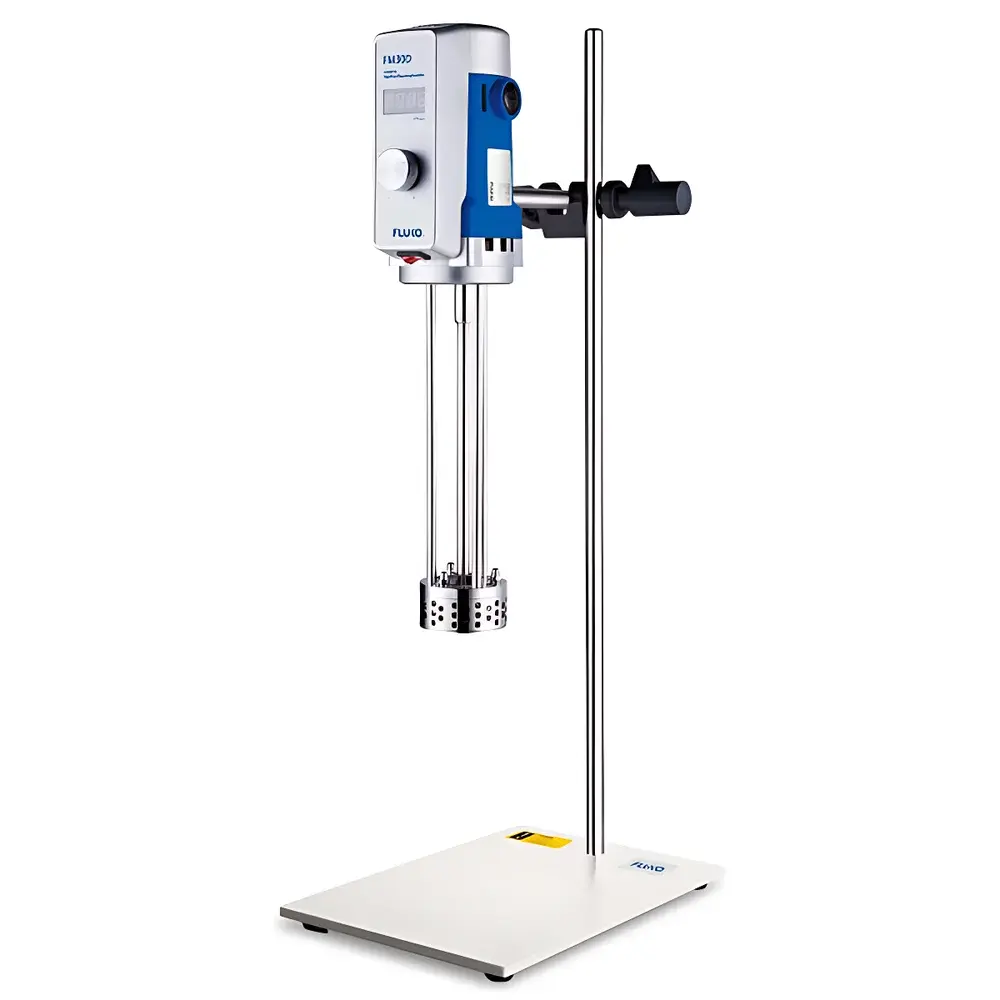
FLUKO FM30D-S-S Digital Display High-Shear Disperser & Homogenizer
| Brand | FLUKO |
|---|---|
| Origin | Shanghai, China |
| Model | FM30D-S-S |
| Instrument Type | Probe-type Rotor-Stator Homogenizer |
| Dimensions (W×D×H) | 360 × 260 × 760 mm |
| Processing Volume (H₂O) | 200–10,000 mL |
| Power | 500 W |
| Voltage/Frequency | 220 V, 50 Hz |
| Speed Range | 2000–14,000 rpm |
| Speed Display | Digital LED |
| Speed Control | Continuous (Infinitely Variable) |
| Torque Output | High |
| Rotor-Stator Configuration | Dual-Stator Design |
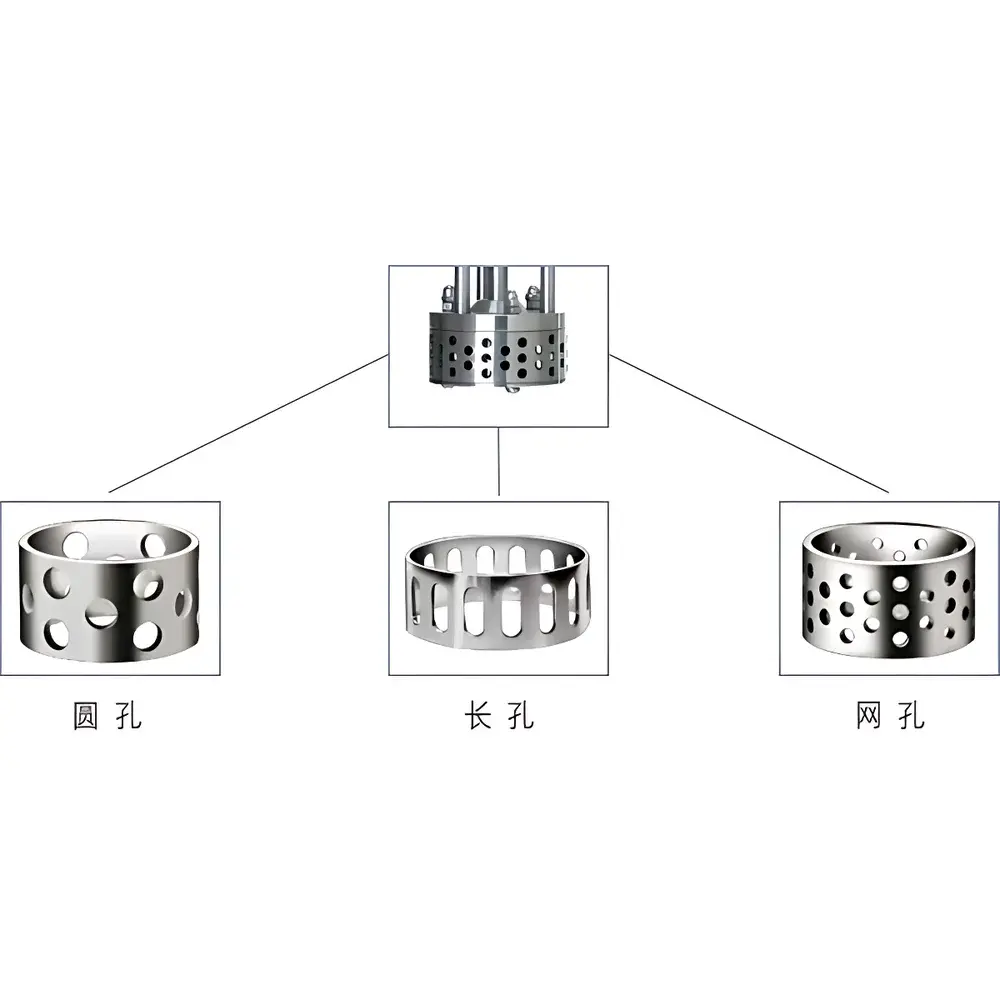
| Compatible Stator Types | Round-hole, Slit-type, Mesh-type |
| Wetted Materials | SS304 Stainless Steel |
| Shaft Sleeve Material | Copper Alloy |
| Ambient Operating Temperature | 5–40 °C |
| Max. Relative Humidity | 80 % RH |
| Process Mode | Batch |
| Weight | ~10 kg |
Overview
The FLUKO FM30D-S-S is a benchtop high-shear rotor-stator disperser and homogenizer engineered for precision batch processing of moderate-viscosity liquids and heterogeneous suspensions. It operates on the principle of controlled hydrodynamic cavitation and intense mechanical shear generated at the interface between a rapidly rotating probe (rotor) and one or more fixed concentric stators. This design enables efficient particle size reduction, droplet breakup, and uniform dispersion of solids, immiscible liquids, or viscous phases—critical for formulation development in pharmaceuticals, cosmetics, food science, and advanced materials research. Unlike ultrasonic or magnetic stirrer-based systems, the FM30D-S-S delivers reproducible, scalable shear stress profiles across its full speed range (2000–14,000 rpm), making it suitable for process transfer from lab-scale optimization to pilot-scale validation.
Key Features
- Infinitely variable speed control with digital LED display ensures precise, repeatable setpoint adjustment and real-time monitoring of rotational speed—essential for method documentation and regulatory compliance.
- Dual-stator configuration significantly enhances shear intensity and flow recirculation within the vessel, improving homogenization efficiency compared to single-stator equivalents—particularly beneficial for high-solid-load dispersions and viscous emulsions.
- Interchangeable stator heads (round-hole, slit-type, and mesh-type) allow adaptation to diverse material rheologies and target particle/droplet size distributions without hardware modification.
- Robust mechanical architecture features a high-torque 500 W motor, SS304 wetted components compliant with general Good Manufacturing Practice (GMP) handling requirements, and a copper-alloy shaft sleeve for thermal stability and wear resistance.
- Integrated dual safety mechanisms include electronic overload protection and a mechanical safety clutch that disengages under excessive load—preventing probe deformation and safeguarding operator and equipment integrity.
- Benchtop footprint (360 × 260 × 760 mm) and lightweight (~10 kg) design support flexible placement in fume hoods, laminar flow cabinets, or shared instrumentation labs without dedicated infrastructure.
Sample Compatibility & Compliance
The FM30D-S-S accommodates aqueous and organic media with viscosities up to 5000 cP and solid contents up to 40 wt% (depending on particle morphology and dispersion stability). Its SS304 contact surfaces meet ASTM F899 standards for stainless steel in laboratory equipment and are compatible with common cleaning agents used in GLP- and GMP-regulated environments. While not intrinsically certified for hazardous area use, the unit complies with IEC 61010-1 for electrical safety in laboratory instruments. Its batch-mode operation aligns with USP and ISO 13320 guidelines for emulsion characterization when paired with orthogonal analytical techniques (e.g., laser diffraction or dynamic light scattering).
Software & Data Management
The FM30D-S-S operates as a standalone instrument with no embedded software or data logging capability. All operational parameters—including speed setpoint, runtime, and manual start/stop—are manually controlled and observed via front-panel digital display. For traceability in regulated workflows, users may integrate external timers or programmable power controllers. The absence of onboard memory or network interfaces simplifies 21 CFR Part 11 compliance in environments where audit trails must be externally documented and secured—eliminating risks associated with unvalidated firmware or undocumented data handling pathways.
Applications
- Pharmaceutical: Preparation of nanoemulsions, liposomal suspensions, and polymer nanoparticle dispersions for drug delivery screening.
- Materials Science: Exfoliation of 2D nanomaterials (e.g., graphene oxide, MXenes) in aqueous or solvent-based media.
- Food & Beverage: Development of stable oil-in-water emulsions (e.g., dressings, sauces) and functional ingredient suspensions (e.g., dietary fibers, probiotics).
- Coatings & Inks: Dispersion of pigments, fillers, and nanocellulose into resin matrices to achieve narrow particle size distribution and reduced agglomeration.
- Academic Research: Kinetic studies of emulsification efficiency, shear-thinning behavior, and colloidal stability under controlled mechanical stress.
FAQ
What is the maximum recommended viscosity for consistent performance?
The FM30D-S-S is validated for continuous operation up to 5000 cP with appropriate stator selection and adequate cooling; higher viscosities may require reduced speed or intermittent duty cycles.
Can this unit be used with corrosive solvents such as chlorinated hydrocarbons or strong acids?
SS304 offers limited resistance to halogenated solvents and low-pH acidic media; extended exposure is not advised. For aggressive chemistries, consult FLUKO’s chemical compatibility chart or consider optional Hastelloy-C276 probe upgrades.
Is the FM30D-S-S suitable for sterile processing?
While the probe and stators can be autoclaved (121 °C, 20 min), the base unit is not designed for Class A/B cleanroom integration or SIP (steam-in-place) protocols due to non-hermetic electronics and lack of ISO 14644-certified housing.
How does the dual-stator design improve dispersion efficiency over single-stator models?
Dual stators increase the number of shear zones per rotation and promote axial re-circulation, reducing dead-volume effects and enabling more uniform energy input—especially critical for viscous or high-density slurries.
Does FLUKO provide IQ/OQ documentation support for this model?
Yes—standard IQ/OQ templates aligned with ISO/IEC 17025 and ASTM E2500 are available upon request for laboratory qualification under GLP or internal quality systems.



