
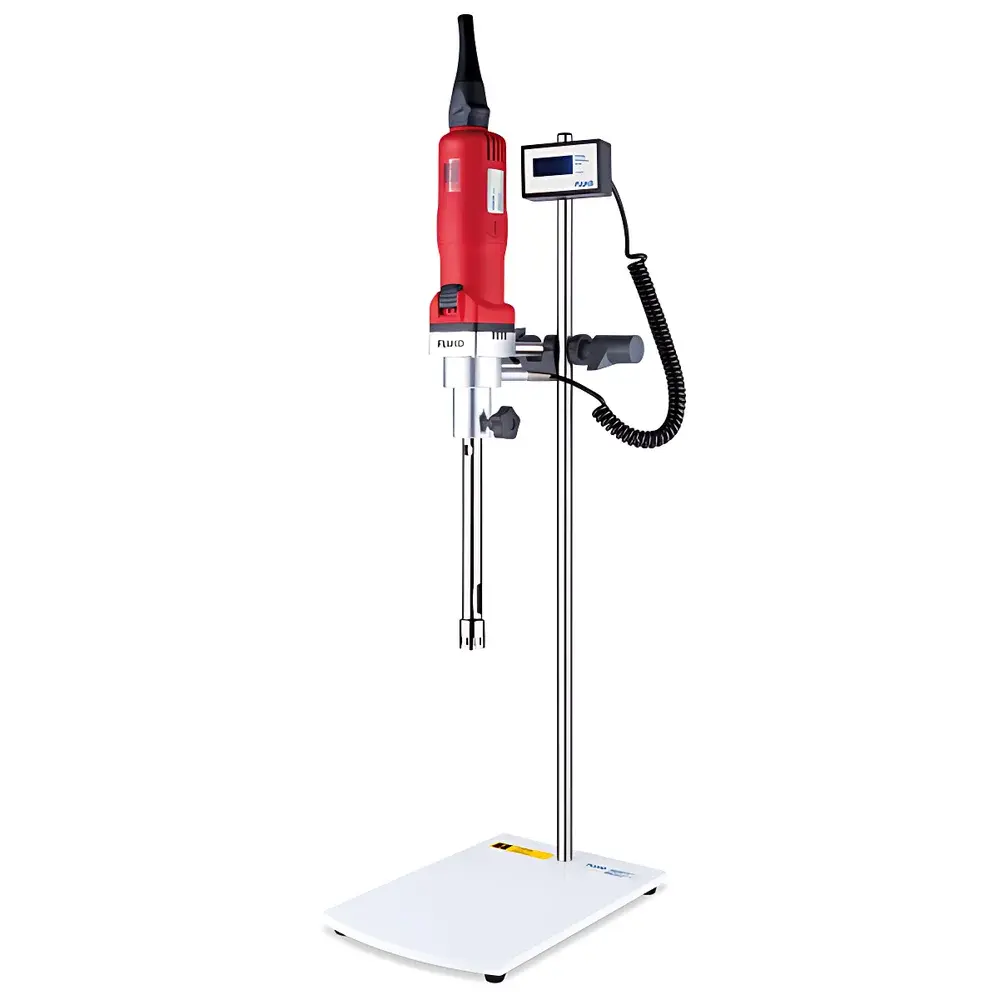
FLUKO FA25D High-Shear Dispersion & Homogenization System
| Brand | FLUKO |
|---|---|
| Origin | Shanghai, China |
| Model | FA25D-011-S |
| Instrument Type | Probe-type rotor-stator homogenizer |
| Dimensions (W×D×H) | 215 × 310 × 730 mm |
| Processing Volume | 0.2–7000 mL |
| Power | 500 W |
| Voltage/Frequency | 220 V, 50 Hz |
| Speed Range (no-load) | 10,000–28,000 rpm |
| Max. Tip Speed | 27 m/s |
| Viscosity Handling | up to 8,000 cP |
| Material Contact | SS316L |
| Shaft Sleeve Material | PTFE |
| Display | Digital speed readout |
| Speed Control | Continuously variable |
| Operating Temperature | 5–40 °C |
| Relative Humidity Limit | ≤80% |
| Duty Cycle | Continuous operation |
| Weight | ~7.1 kg |
Overview
The FLUKO FA25D is a high-performance, benchtop high-shear dispersion and homogenization system engineered for precision laboratory-scale processing of heterogeneous mixtures. Based on the rotor-stator principle—where a rapidly rotating probe (rotor) shears material against a stationary concentric sleeve (stator)—this system generates intense hydrodynamic cavitation, turbulent flow, and extensional stresses essential for particle size reduction, emulsion stabilization, cell disruption, and uniform phase dispersion. Unlike low-shear mixers or magnetic stirrers, the FA25D delivers controlled mechanical energy input at the microscale, enabling reproducible sub-micron emulsions, nanosuspensions, and homogenized biological lysates. Its modular architecture supports rapid interchange of probe geometries to match process requirements—from low-volume tissue homogenization (<1 mL) to high-throughput batch dispersion (up to 7 L), making it suitable for R&D labs in pharmaceuticals, cosmetics, food science, materials chemistry, and life sciences.
Key Features
- High-speed motor delivering up to 28,000 rpm with digital speed feedback and continuously variable control for precise shear rate modulation
- Interchangeable stainless steel (SS316L) rotor-stator probes—including 6G (0.2–10 mL), 8G (1–60 mL), 10G (30–150 mL), 18F (50–1500 mL), and 25F (100–5000 mL) configurations—to optimize shear intensity, flow pattern, and dead-volume minimization per application
- Robust mechanical design with PTFE shaft sleeve ensuring chemical resistance and low-friction operation under high-torque conditions
- Compact footprint (215 × 315 × 730 mm) and lightweight chassis (~7.1 kg) facilitate integration into fume hoods, biosafety cabinets, or shared lab workstations
- Thermally stable motor housing rated for continuous-duty operation within ambient temperatures of 5–40 °C and ≤80% relative humidity
- Standard inclusion of universal mounting stand, adjustable clamp, and vertical positioning base for ergonomic sample vessel alignment and vibration damping
Sample Compatibility & Compliance
The FA25D accommodates aqueous, organic, and semi-viscous media across a broad rheological spectrum—from Newtonian fluids to non-Newtonian systems with viscosities up to 8,000 cP. It is routinely employed for homogenizing soft animal tissues (liver, brain), plant extracts, bacterial pellets, lipid nanoparticles, polymer dispersions, pigment suspensions, and oil-in-water/water-in-oil emulsions. All wetted parts comply with ISO 8507 and ASTM D2196 standards for material compatibility in laboratory equipment. While the unit itself is not certified to FDA 21 CFR Part 11, its digital speed logging capability (via optional RS232/USB interface) supports audit-ready data capture when integrated into GLP/GMP-aligned workflows. Documentation packages—including factory calibration reports, material certifications (EN 10204 3.1), and CE conformity declarations—are available upon request for regulatory submissions.
Software & Data Management
The FA25D operates as a standalone instrument with real-time digital RPM display and analog speed control; no proprietary software is required for basic operation. For traceable process development, an optional serial communication module enables connection to external PCs running custom LabVIEW, Python, or MATLAB scripts for time-stamped speed logging, protocol automation, and export to CSV or Excel formats. This facilitates method transfer validation, SOP documentation, and retrospective analysis of shear history—critical for formulation optimization and quality-by-design (QbD) initiatives. All firmware versions are backward-compatible, and calibration verification can be performed using NIST-traceable tachometers.
Applications
- Cell lysis and subcellular fractionation in molecular biology and proteomics
- Preparation of nanoemulsions, liposomes, and polymeric micelles for drug delivery
- Dispersion of carbon nanotubes, graphene oxide, and metal oxide nanoparticles in solvents or polymer matrices
- Rapid homogenization of food matrices (e.g., dairy blends, sauces, nutraceutical suspensions) for sensory and stability testing
- Stabilization of cosmetic emulsions (creams, lotions) and pigment dispersion in color cosmetics
- Viscosity reduction and deagglomeration of battery electrode slurries and ceramic pastes
FAQ
What is the maximum recommended viscosity for continuous operation?
The FA25D is rated for media up to 8,000 cP at lower speeds (≤12,000 rpm); operation above this limit requires intermittent duty cycling and probe cooling intervals.
Can the FA25D be used for sterile processing?
Yes—SS316L probes and PTFE components are autoclavable (121 °C, 20 min, standard cycle); however, the motor head must be isolated from sterilization environments.
Is speed calibration traceable to national standards?
Factory calibration uses optical tachometry traceable to NIST; users may perform field verification with handheld laser tachometers.
How does probe geometry affect shear rate distribution?
Smaller-diameter probes (e.g., 6G, 8G) generate higher localized shear rates and narrower flow zones—ideal for small volumes and high-intensity disruption—while larger probes (18F, 25F) prioritize bulk circulation and heat dissipation in larger batches.
Does FLUKO provide application support for method development?
Yes—FLUKO’s technical applications team offers free protocol consultation, probe selection guidance, and comparative shear mapping data upon submission of material properties and target outcomes.



