
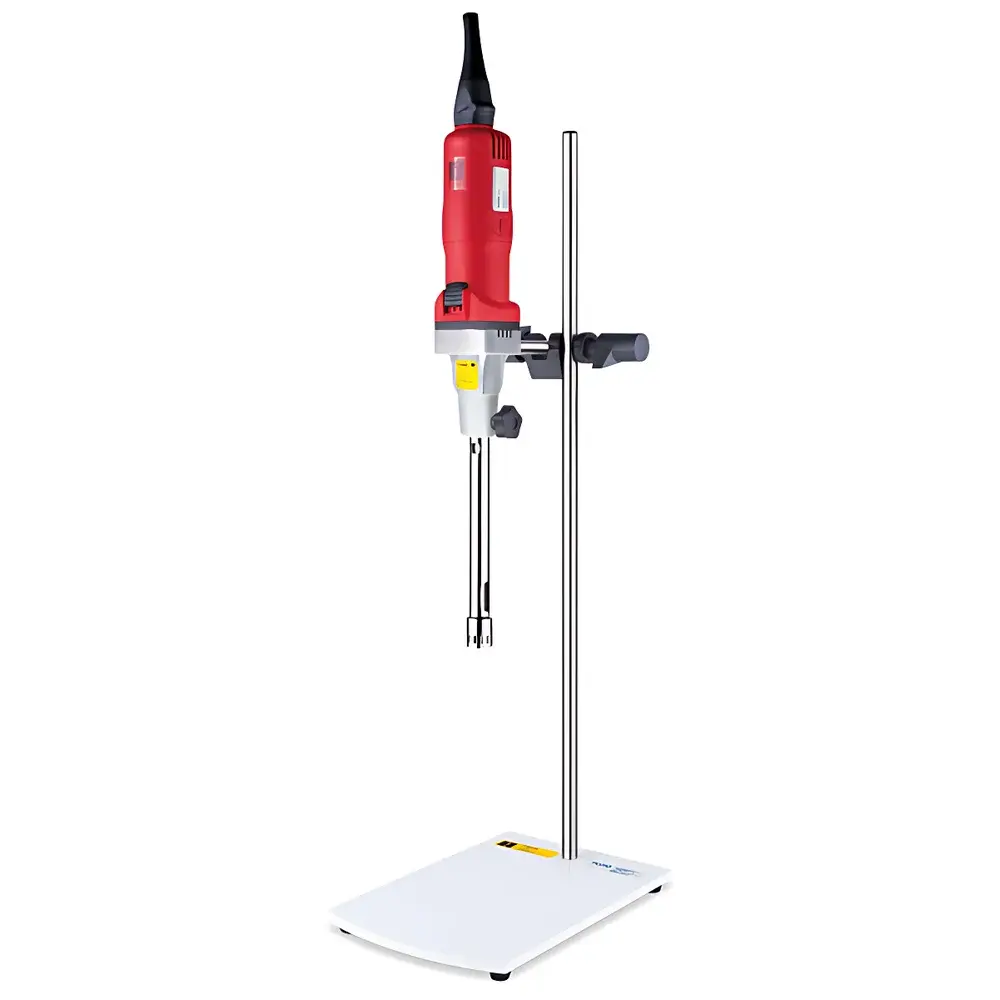
FLUKO FA25 High-Shear Dispersing Homogenizer
| Brand | FLUKO |
|---|---|
| Origin | Shanghai, China |
| Model | FA25-021-S |
| Instrument Type | Probe-type rotor-stator homogenizer |
| Dimensions (W×D×H) | 215 × 310 × 730 mm |
| Processing Volume | 0.2–7000 mL |
| Power | 500 W |
| Voltage/Frequency | 220 V, 50 Hz |
| Speed Range (no-load) | 10,000–28,000 rpm |
| Max. Tip Speed | 27 m/s |
| Viscosity Handling | up to 8,000 cP |
| Display | Digital speed readout |
| Speed Control | Continuous variable |
| Wetted Materials | SS316L |
| Shaft Sleeve Material | PTFE |
| Ambient Temperature | 5–40 °C |
| Relative Humidity | ≤80% |
| Duty Cycle | Continuous operation |
| Weight | ~7.1 kg |
Overview
The FLUKO FA25 High-Shear Dispersing Homogenizer is an engineered laboratory-scale rotor-stator system designed for reproducible, scalable high-shear processing of liquid and semi-liquid samples. Operating on the principle of controlled hydrodynamic cavitation and intense mechanical shear within a narrow gap between rotating and stationary elements, the FA25 delivers consistent particle size reduction, emulsion stabilization, cell disruption, and homogeneous dispersion across diverse sample matrices. Its modular architecture supports rapid interchange of probe assemblies—enabling adaptation from low-volume micro-homogenization (0.2 mL) to batch processing up to 7 L—while maintaining precise control over energy input via continuously adjustable rotational speed (10,000–28,000 rpm). The system is widely deployed in pharmaceutical formulation development, nanomaterial synthesis, food R&D, cosmetic emulsion testing, and life science applications requiring robust, repeatable mechanical lysis or dispersion under non-thermal conditions.
Key Features
- High-performance 500 W brushless motor delivering stable torque across the full speed range (10,000–28,000 rpm), with digital speed feedback and real-time RPM display for process documentation.
- Modular probe design compatible with six standardized rotor-stator configurations (6G, 8G, 10G, 18F, 25F, and pneumatic FAR25 variants), each optimized for specific volume ranges, viscosity profiles, and shear intensity requirements.
- SS316L wetted components ensure chemical resistance and compliance with ISO 8573-1 for cleanroom-compatible operation; PTFE shaft sleeves provide low-friction sealing and thermal stability.
- Compact footprint (215 × 310 × 730 mm) and integrated support stand with universal clamp facilitate benchtop integration and ergonomic operation without external fixtures.
- Engineered for continuous duty cycling at rated load—validated for uninterrupted operation up to 8 hours—supporting extended batch processing and method development workflows.
- No external cooling required for standard aqueous or low-viscosity organic systems; optional jacketed probes available for temperature-sensitive applications.
Sample Compatibility & Compliance
The FA25 accommodates a broad spectrum of sample types, including aqueous suspensions, oil-in-water and water-in-oil emulsions, polymer solutions, colloidal dispersions, biological tissues (e.g., liver, muscle, plant leaves), microbial cultures, and high-viscosity pastes up to 8,000 cP. Its probe-based geometry enables direct immersion into sealed vessels or open beakers, minimizing cross-contamination risk and supporting GLP-aligned documentation practices. While not certified to IEC 61000-6-2/6-4 or UL 61010-1 out-of-the-box, the unit meets CE marking requirements for laboratory equipment when operated per manufacturer specifications. It supports audit-ready workflows compliant with FDA 21 CFR Part 11 when paired with validated third-party data logging software and electronic signature protocols.
Software & Data Management
The FA25-D digital series includes built-in speed logging capability with timestamped RPM output via RS-232 interface (optional USB adapter available). Raw speed data can be exported to CSV for integration into LIMS or ELN platforms. While the base unit does not include proprietary control software, FLUKO provides protocol templates aligned with ASTM D4290 (standard practice for evaluating dispersing efficiency) and ISO 13320 (laser diffraction particle sizing methodology), facilitating method transfer and regulatory reporting. For GMP environments, users may implement external programmable logic controllers (PLCs) or LabVIEW-based automation to enforce SOP-defined speed ramps, dwell times, and endpoint criteria.
Applications
- Pharmaceutical: Preparation of nanoemulsions, liposomes, and polymeric micelles; active pharmaceutical ingredient (API) micronization; sterile suspension homogenization.
- Biotechnology: Mechanical lysis of mammalian, bacterial, and yeast cells; nuclear extraction; organelle isolation.
- Materials Science: Exfoliation of graphene and MXenes; dispersion of carbon nanotubes and metal oxide nanoparticles in solvents or polymer matrices.
- Food & Beverage: Development of stable dressings, sauces, and dairy alternatives; viscosity modification of starch-based systems.
- Cosmetics: Emulsion stability testing; pigment dispersion in foundations and sunscreens; rheological profiling of thickened gels.
- Academic Research: Method optimization for shear-dependent reaction kinetics; benchmarking against ultrasonic or high-pressure homogenization techniques.
FAQ
What is the minimum and maximum recommended processing volume for the FA25-021-S configuration?
The 10G probe (FA25-021-S) is optimized for volumes between 30 mL and 150 mL. Volumes below 30 mL risk insufficient submergence and cavitation instability; volumes above 150 mL require larger-diameter probes (e.g., 18F or 25F) to maintain uniform energy distribution.
Can the FA25 be used for sterile applications?
Yes—SS316L probes are autoclavable at 121 °C for 20 minutes. Users must verify seal integrity post-sterilization and avoid thermal shock during cooldown. PTFE components remain stable but should be inspected for deformation after repeated cycles.
Is speed calibration traceable to national standards?
Factory calibration is performed using NIST-traceable tachometers. End-users may perform field verification with handheld optical tachometers; FLUKO provides calibration certificates upon request for QA/QC documentation.
How does the FA25 compare to ultrasonic homogenizers in terms of shear intensity?
Rotor-stator systems generate shear rates exceeding 10⁶ s⁻¹ near the probe tip—comparable to high-intensity sonication—but with superior scalability, lower heat generation per unit mass, and no acoustic wave attenuation in opaque or viscous media.
Does FLUKO offer validation support for regulated environments?
Yes—IQ/OQ documentation templates, probe wear guidelines, and preventive maintenance schedules are available under NDA. Installation qualification may require site-specific vibration and electrical grounding assessment per ISO 14644-1 Class 8 cleanroom specifications.



