
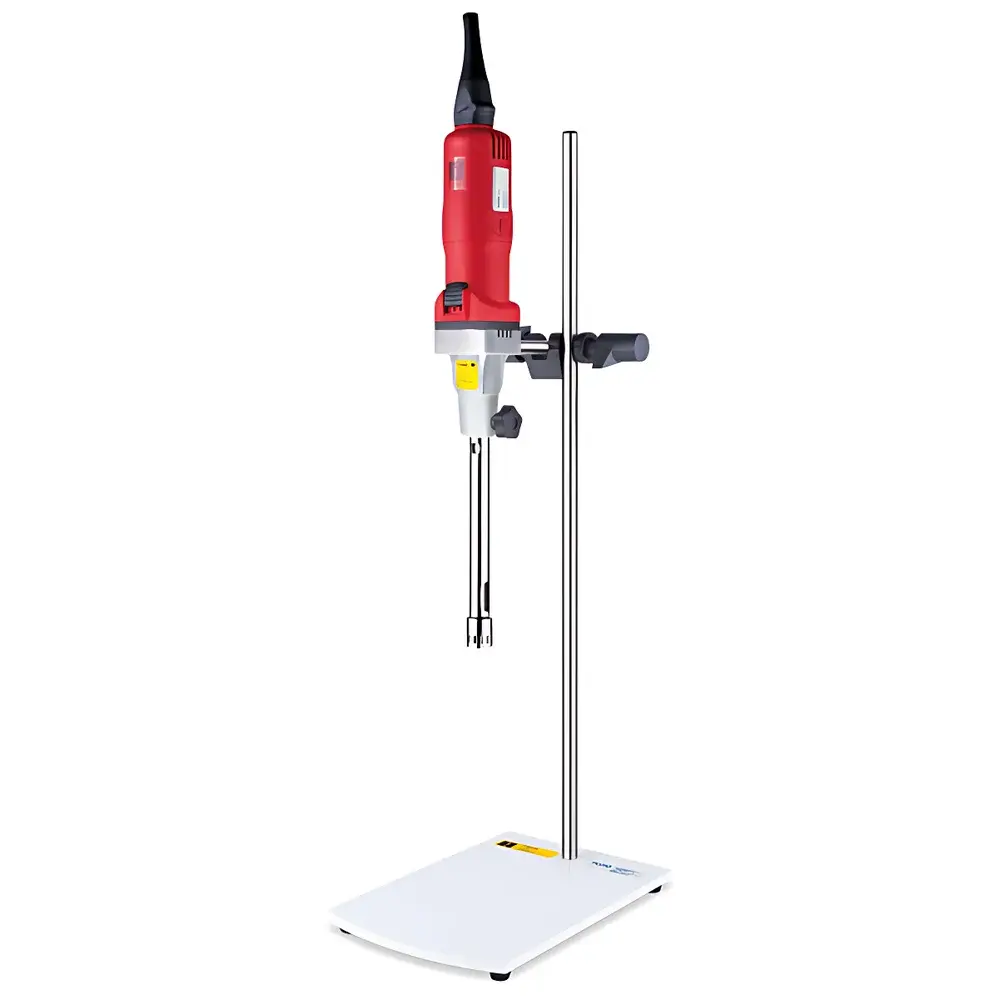
FLUKO FA25 High-Shear Dispersion Homogenizer
| Brand | FLUKO |
|---|---|
| Origin | Shanghai, China |
| Model | FA25-011-S |
| Instrument Type | Probe-type rotor-stator homogenizer |
| Dimensions (W×D×H) | 215 × 310 × 730 mm |
| Processing Volume | 0.2–7000 mL |
| Power | 500 W |
| Voltage/Frequency | 220 V, 50 Hz |
| Speed Range (no-load) | 10,000–28,000 rpm |
| Max. Tip Speed | 27 m/s |
| Display | Digital speed readout |
| Speed Control | Continuously variable |
| Contact Material | SS316L |
| Shaft Sleeve Material | PTFE |
| Ambient Temperature Range | 5–40 °C |
| Relative Humidity Limit | ≤80% |
| Operation Mode | Batch processing |
| Weight | ~7.1 kg |
Overview
The FLUKO FA25 High-Shear Dispersion Homogenizer is an engineered laboratory-scale rotor-stator system designed for reproducible high-intensity mechanical dispersion, emulsification, homogenization, and cell disruption. Operating on the principle of controlled fluid shear within a narrow gap between a rapidly rotating probe (rotor) and a stationary shearing element (stator), the FA25 generates intense hydrodynamic forces—including cavitation, turbulent flow, and extensional stress—that efficiently reduce particle or droplet size in liquid-phase systems. Its modular architecture supports scalable process development from microliter-scale tissue homogenization to liter-scale formulation work, making it suitable for R&D laboratories in pharmaceuticals, biotechnology, food science, cosmetics, and advanced materials research. The device complies with fundamental safety and electromagnetic compatibility requirements per IEC 61000-6-2/6-3 and meets general electrical safety standards for Class I laboratory equipment.
Key Features
- High-performance 500 W brushless motor delivering stable torque across the full speed range (10,000–28,000 rpm), enabling consistent shear input regardless of viscosity or load fluctuations.
- Digital speed display with real-time feedback ensures precise operational repeatability—critical for method transfer and regulatory documentation.
- Modular probe interchangeability: Compatible with six standardized rotor-stator geometries (6G, 8G, 10G, 18F, 25F, and optional air-driven FAR25 variants), each optimized for specific volume ranges and rheological profiles.
- SS316L wetted components provide corrosion resistance and compliance with USP Class VI and FDA-relevant material compatibility expectations for non-sterile lab use.
- PTFE shaft sleeves minimize friction-induced heat generation and support operation with temperature-sensitive samples under ambient conditions (5–40 °C).
- Compact footprint (215 × 310 × 730 mm) and integrated support stand with universal clamping mechanism facilitate benchtop integration and ergonomic sample handling.
- No external cooling required for standard batch durations; thermal management relies on passive dissipation and duty-cycle awareness—recommended for ≤5 min continuous operation per cycle at maximum speed.
Sample Compatibility & Compliance
The FA25 accommodates aqueous, organic, and semi-viscous media up to 8,000 cP, including suspensions, emulsions, polymer solutions, cell lysates, plant/animal tissue homogenates, and nanoparticle dispersions. Its probe-based design enables direct immersion into sealed or open vessels (e.g., beakers, centrifuge tubes, jacketed reactors), supporting both sterile and non-sterile workflows. While not certified for GMP manufacturing environments, the FA25 aligns with GLP-aligned documentation practices through traceable speed settings, defined probe geometry selection, and consistent operational parameters. It supports validation protocols per ISO 21501-4 (particle size distribution) and ASTM D3418 (viscoelastic characterization of polymer melts) when coupled with calibrated analytical instrumentation.
Software & Data Management
The FA25 operates as a standalone instrument without proprietary software dependency. Speed settings are manually configured via analog dial or digital interface (FA25-D series), with no onboard data logging or USB connectivity. For audit-trail compliance in regulated labs, users integrate the device into validated SOPs that record: probe type (e.g., 8G), speed setpoint, duration, vessel geometry, and ambient conditions. When used in conjunction with LIMS or ELN platforms, metadata entry follows ALCOA+ principles—ensuring attributable, legible, contemporaneous, original, and accurate records. Optional third-party timer modules or foot-switch controls may be employed to standardize activation timing across operators.
Applications
- Cell lysis and subcellular fractionation in molecular biology workflows, including bacterial, yeast, and mammalian tissue homogenization.
- Preparation of oil-in-water and water-in-oil emulsions for topical formulations, functional foods, and delivery system development.
- Nanomaterial dispersion stabilization—e.g., carbon nanotubes, graphene oxide, or metal oxide nanoparticles—in polymer matrices or aqueous carriers.
- Homogenization of viscous cosmetic bases (e.g., creams, gels) and pigment dispersion in inkjet or coating formulations.
- Rapid deagglomeration of ceramic or pharmaceutical powders prior to particle size analysis (e.g., laser diffraction or dynamic light scattering).
- Process simulation for scale-up studies targeting industrial rotor-stator homogenizers (e.g., FLUKO F Series or similar high-shear inline systems).
FAQ
What is the minimum and maximum recommended sample volume for the FA25-011-S configuration?
The 8G probe (FA25-011-S) is optimized for volumes between 1 mL and 60 mL. Volumes below 1 mL risk inadequate submersion and cavitation instability; volumes above 60 mL reduce shear intensity due to insufficient energy density.
Can the FA25 be used for sterile applications?
The unit itself is not autoclavable. However, all SS316L probes and PTFE sleeves can be sterilized separately via ethanol immersion, UV exposure, or ethylene oxide treatment—subject to user validation per ISO 14937.
Is speed calibration traceable to national standards?
FLUKO provides factory calibration certificates upon request. End-users may perform periodic verification using a NIST-traceable tachometer; deviation tolerance is ±2% of setpoint across the operating range.
Does the FA25 meet FDA 21 CFR Part 11 requirements?
No. As a non-networked, non-auditable device with no electronic record generation, it does not fall under Part 11 scope. It may be used in Part 11 environments only when procedural controls ensure manual documentation integrity.
How often should maintenance be performed?
Inspect rotor-stator alignment and bearing play every 200 operating hours. Replace PTFE shaft sleeves after 500 hours or if visible wear or increased vibration occurs. Lubrication is not required—bearings are sealed for life.



