
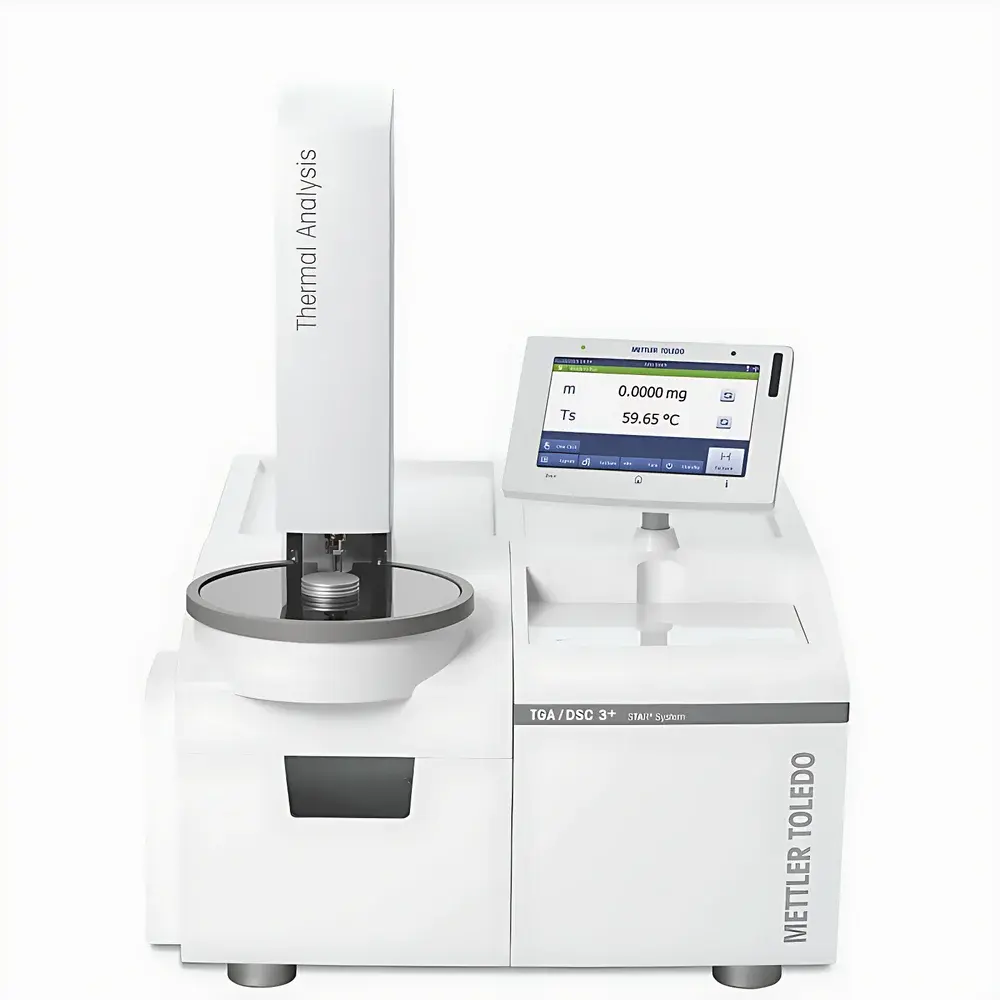
METTLER TOLEDO TGA/DSC 3+ Simultaneous Thermal Analyzer – Standard Model
| Brand | METTLER TOLEDO |
|---|---|
| Origin | Switzerland |
| Model | TGA/DSC 3+ Standard |
| Temperature Range | RT to 1100 °C / 1600 °C |
| Temperature Accuracy | ±0.05 K |
| Balance Sensitivity | 0.1 µg |
| Heating/Cooling Rate | 0.02 to 150 K/min / 0.02 to 250 K/min |
| DSC Sensor | 6-pair Pt/Pt–Rh thermocouples |
| Simultaneous Measurement Capability | Yes |
| Modular Configuration | Yes |
| Compliance Ready | ASTM E1131, ISO 11358, USP <1227>, FDA 21 CFR Part 11 (with optional software module) |
Overview
The METTLER TOLEDO TGA/DSC 3+ Simultaneous Thermal Analyzer – Standard Model is an engineered platform for concurrent thermogravimetric analysis (TGA) and differential scanning calorimetry (DSC), delivering high-fidelity thermal event detection under rigorously controlled atmospheric conditions. Based on the Couette-type microbalance architecture and dual-sensor thermal flux measurement principle, this instrument quantifies mass change (via ultra-microgravimetric detection) and heat flow (via symmetrical 6-pair platinum/platinum–rhodium thermocouple arrays) in real time within a single sample run. Its design traces lineage to METTLER TOLEDO’s first commercial TGA/DTA system introduced in 1964—refined over five decades into a robust, reproducible, and metrologically traceable platform compliant with international thermal analysis standards. The system operates across two selectable high-temperature ranges (RT–1100 °C and RT–1600 °C), enabling characterization of refractory ceramics, metallic alloys, and advanced composites alongside polymers and pharmaceuticals.
Key Features
- Ultra-microbalance with 0.1 µg sensitivity and active drift compensation, ensuring long-term baseline stability over extended heating cycles
- Six-pair Pt/Pt–Rh thermocouple DSC sensor derived from star-pattern multi-junction technology—optimized for signal-to-noise ratio and thermal resolution down to 0.00003 °C (as measured on certified metal standards)
- Modular furnace assembly supporting interchangeable crucibles (alumina, platinum, gold-plated, or hermetic) and rapid exchange of gas modules (inert, oxidative, reducing, or humidified atmospheres)
- Programmable heating and cooling rates spanning 0.02–150 K/min (standard) and up to 250 K/min (high-speed configuration), enabling kinetic modeling per ASTM E698 and ISO 11358-1
- Hermetically sealed measurement chamber with integrated vacuum capability (<10−2 mbar) and pressure-controlled gas dosing—critical for decomposition pathway validation under defined partial pressures
- Native interface for hyphenated techniques: direct coupling to quadrupole mass spectrometers (MS), Fourier-transform infrared (FTIR) spectrometers, or combined MS/FTIR systems via heated transfer lines (150–300 °C)
Sample Compatibility & Compliance
The TGA/DSC 3+ accommodates solid, powder, and thin-film samples (0.1–100 mg) in standardized crucible geometries compatible with GMP-compliant workflows. Its hardware and optional software modules support full audit trail generation, electronic signatures, and data integrity controls aligned with FDA 21 CFR Part 11 requirements. Method validation documentation conforms to ICH Q5C (stability testing), USP (validation of compendial procedures), and ISO/IEC 17025 (testing laboratory competence). Instrument qualification packages—including IQ/OQ/PQ protocols—are available for regulated environments in pharmaceutical, biotech, and medical device manufacturing.
Software & Data Management
STARe Evaluation Software (v18.x or later) provides fully integrated acquisition, processing, and reporting capabilities. It supports multi-step temperature programs with dynamic gas switching, automatic peak deconvolution using Gaussian fitting algorithms, and quantitative residue analysis based on stoichiometric mass balance models. All raw data are stored in vendor-neutral .tdf format; export options include CSV, Excel, and XML for LIMS integration. Optional STARe GLP Module enables role-based access control, electronic lab notebook (ELN) synchronization, and automated report generation compliant with regulatory submission formats (e.g., CTD Module 3).
Applications
This analyzer serves as a primary tool in R&D, QC, and failure analysis laboratories across sectors requiring thermal stability profiling and compositional decomposition mapping. In polymer science, it quantifies filler content, residual solvent, degradation onset temperatures (Td), and oxidative induction time (OIT) per ASTM D3895. For pharmaceuticals, it verifies polymorphic transitions, hydrate/dehydrate behavior, and excipient compatibility during accelerated stability studies. In materials engineering, it characterizes phase transformations in Ni-based superalloys, carbon oxidation kinetics in C/C composites, and sintering profiles in battery cathode precursors. Food science applications include moisture loss kinetics, Maillard reaction onset, and lipid oxidation monitoring.
FAQ
What distinguishes the TGA/DSC 3+ from earlier METTLER TOLEDO simultaneous analyzers?
The TGA/DSC 3+ integrates a redesigned microbalance with improved mechanical isolation, a 6-pair thermocouple DSC sensor replacing legacy single-junction designs, and enhanced thermal shielding—resulting in higher signal fidelity, reduced noise floor, and improved reproducibility across wide dynamic ranges.
Can the instrument operate under controlled humidity conditions?
Yes—when equipped with the optional humidity generator module, the system delivers precise water vapor partial pressures (0–90% RH) for adsorption/desorption isotherm determination per ISO 15106-3.
Is calibration traceable to national standards?
All temperature and mass calibrations are performed using NIST-traceable reference materials (e.g., Ni, In, Zn, Al for DSC; CaC2O4·H2O for TGA), with documented uncertainty budgets available upon request.
Does the system support automated unattended operation?
With the optional 48-position robotic autosampler, the instrument executes sequential runs—including crucible cleaning, purge gas conditioning, and baseline stabilization—without manual intervention.
How is data security managed in regulated environments?
When configured with STARe GLP software, the system enforces user authentication, immutable audit trails, version-controlled method storage, and encrypted database backups meeting ALCOA+ principles.
Related Products



