
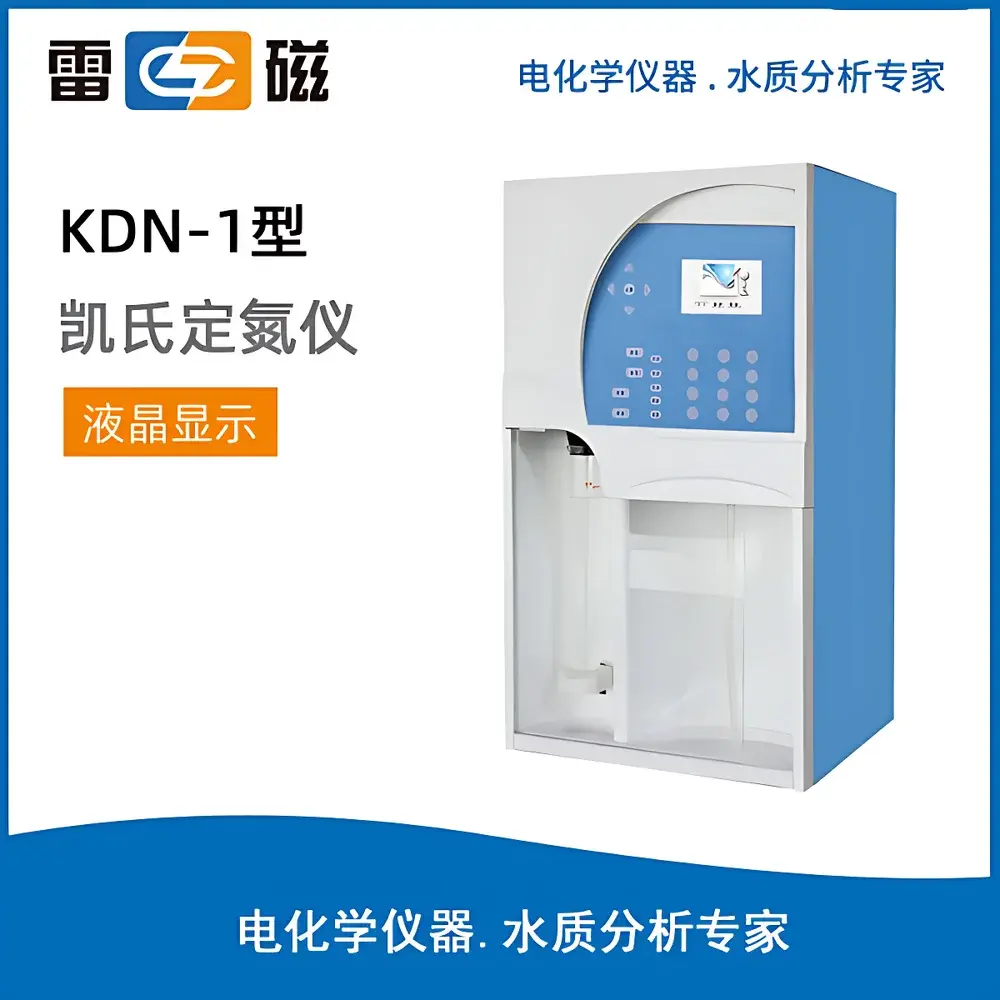
Leici KDN-1 Automatic Kjeldahl Nitrogen Determinator with Dual Manual/Automatic Operation Mode
| Brand | Leici |
|---|---|
| Origin | Shanghai, China |
| Manufacturer Type | Authorized Distributor |
| Regional Classification | Domestic (China) |
| Model | KDN-1 |
| Instrument Type | Kjeldahl Nitrogen Determinator |
| Automation Level | Fully Automatic |
| Nitrogen Measurement Range | 0.1 mg – 240 mg |
| Adjustable Distillation Time | Up to 60 minutes |
| Dimensions (L×W×H) | 400 × 385 × 735 mm |
| Recovery Rate | ≥99.5% |
| Sample Capacity | ≤6 g (solid) or ≤16 mL (liquid) |
| Distillation Speed | 3–6 min per sample |
| Cooling Water Consumption | 1.5 L/min |
| Display | 4.3-inch high-resolution color LCD |
| Power Supply | 220 VAC ±10%, 50 Hz |
| Rated Power | 1.3 kW |
| Net Weight | 30 kg |
Overview
The Leici KDN-1 Automatic Kjeldahl Nitrogen Determinator is a benchtop analytical instrument engineered for precise and reproducible quantification of total nitrogen content in organic and inorganic samples via the classical Kjeldahl digestion and steam distillation method. Designed in accordance with internationally recognized principles outlined in ISO 8968, AOAC 981.10, and ASTM D1193, the system supports both routine quality control and research-grade nitrogen analysis across food, feed, agricultural, environmental, and pharmaceutical laboratories. Its dual-mode architecture—seamlessly switching between fully automated and manual operation—ensures operational flexibility without compromising method integrity. The instrument integrates controlled alkaline digestion, quantitative reagent dosing, programmable steam distillation, and automatic boracic acid absorption, delivering consistent recovery rates ≥99.5% under validated conditions.
Key Features
- 4.3-inch high-resolution color LCD interface with intuitive Chinese-language navigation and real-time parameter monitoring
- Dual-operation capability: automatic sequence execution or granular manual override at each step (digestion, alkali addition, dilution, distillation, rinsing)
- Automated reagent delivery: precise metering of NaOH solution and boric acid absorbent via calibrated peristaltic pumps
- Programmable distillation duration (0–60 minutes), with audible/visual end-of-cycle alert and automatic steam cutoff
- Intelligent rinse cycle: post-distillation automatic flushing of condenser outlet tubing to prevent cross-contamination and enhance measurement repeatability
- Digestion tube presence detection and thermal safety interlock: halts operation if digestion vessel is misaligned or absent
- Real-time heating element temperature monitoring with overtemperature protection circuitry
- Integrated flow sensor for continuous cooling water status verification—prevents dry-run conditions during condensation
- Emergency stop button with immediate power cutoff and system lockout for operator safety
- Self-diagnostic firmware with fault logging and visual/audible alarm activation for common error states (e.g., low coolant, reagent depletion, sensor timeout)
Sample Compatibility & Compliance
The KDN-1 accommodates standard 100–500 mL Kjeldahl digestion tubes and accepts solid samples up to 6 g or liquid samples up to 16 mL. It is compatible with conventional sulfuric acid–catalyst digestion protocols using CuSO₄/K₂SO₄ or selenium-based catalysts. Method validation data confirm compliance with regulatory requirements for nitrogen determination in foodstuffs (Codex Alimentarius CAC/GL 27-1997), animal feed (ISO 5983-1:2009), and wastewater (EPA Method 351.2). While not natively 21 CFR Part 11 compliant, the instrument’s deterministic workflow, audit-ready error logs, and hardware-level safety interlocks support GLP/GMP-aligned laboratory practices when paired with documented SOPs and user access controls.
Software & Data Management
The KDN-1 operates via embedded firmware with no external PC dependency. All method parameters—including distillation time, reagent volumes, and rinse cycles—are stored in non-volatile memory with timestamped modification history. The display provides live feedback on critical variables: condenser water flow rate, heating jacket temperature, distillation progress bar, and system status flags. Data export is performed manually via USB flash drive (FAT32 formatted), generating CSV files containing sample ID, start/end timestamps, nitrogen mass (mg), and calculated protein equivalents (using standard conversion factors: 6.25 for general food, 5.7 for cereals, 6.38 for dairy). Audit trails are retained for ≥1000 cycles and include operator-initiated mode changes and emergency interventions.
Applications
- Protein content determination in dairy products, meat, soy, and cereal-based foods per AOAC Official Method 981.10
- Nitrogen balance studies in agricultural soil and fertilizer formulations
- Quality assurance testing of animal feed and pet food for crude protein compliance
- Environmental monitoring of total Kjeldahl nitrogen (TKN) in municipal wastewater and sludge
- Pharmaceutical excipient characterization where nitrogen-bearing compounds require quantification
- Educational laboratories conducting standardized Kjeldahl methodology training
FAQ
What is the minimum and maximum nitrogen mass detectable by the KDN-1?
The instrument delivers reliable quantification across a linear dynamic range of 0.1 mg to 240 mg nitrogen per sample.
Does the KDN-1 support digestion module integration?
No—the KDN-1 is a dedicated distillation and titration-ready unit; digestion must be performed separately using a compatible block digester or open-flame system.
Can distillation time be adjusted per sample batch?
Yes—users may define a custom distillation duration (in 1-second increments) for each run, up to 60 minutes.
Is the system compatible with automatic titrators?
The KDN-1 outputs distilled ammonia into boric acid solution; endpoint detection requires external titration (e.g., auto-titrator or manual back-titration with standardized HCl).
What safety certifications does the instrument meet?
It conforms to GB 4793.1–2018 (Chinese equivalent of IEC 61010-1) for electrical safety in laboratory equipment, including insulation resistance, leakage current, and mechanical stability testing.





