
TESCAN CoreTOM, DynaTOM & UniTOM HR Industrial Micro-CT Systems
| Brand | TESCAN |
|---|---|
| Origin | Czech Republic |
| Model Series | CoreTOM, DynaTOM, UniTOM HR |
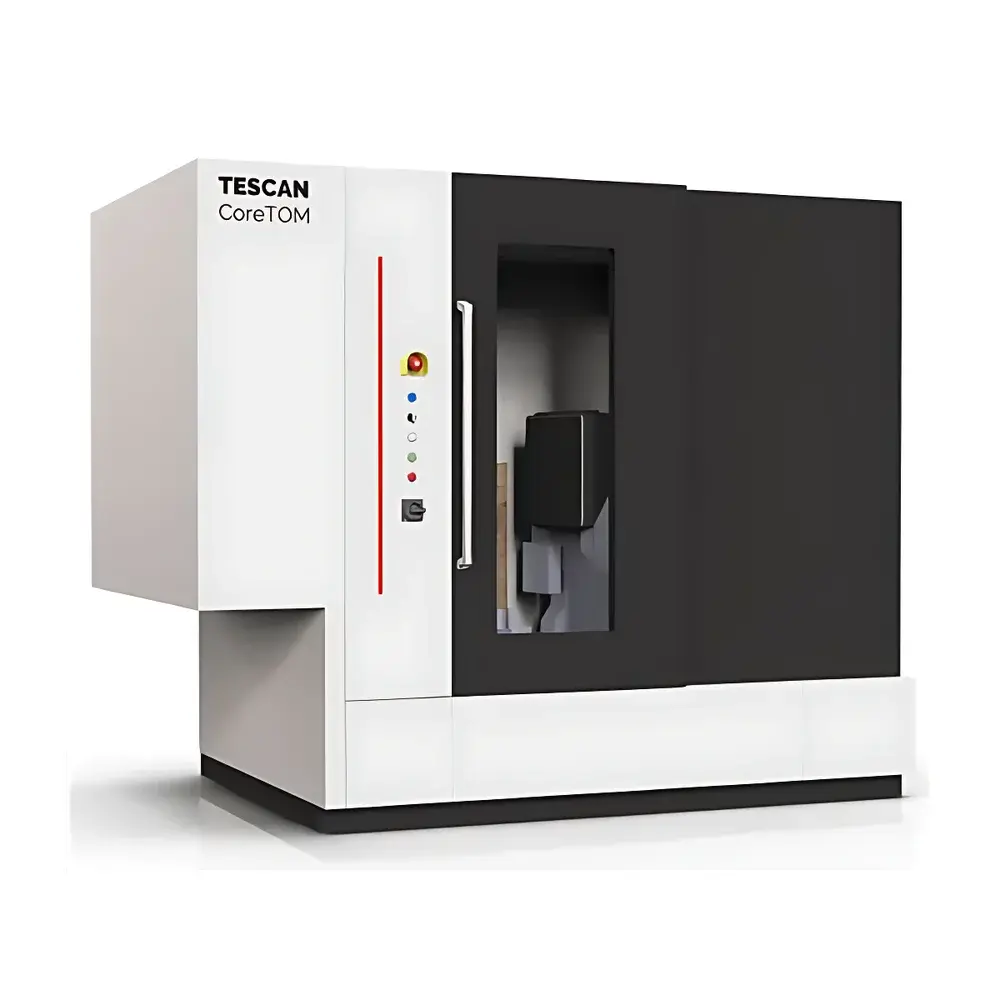
| Spatial Resolution (CoreTOM) | ≥3 µm (JIMA mode) |
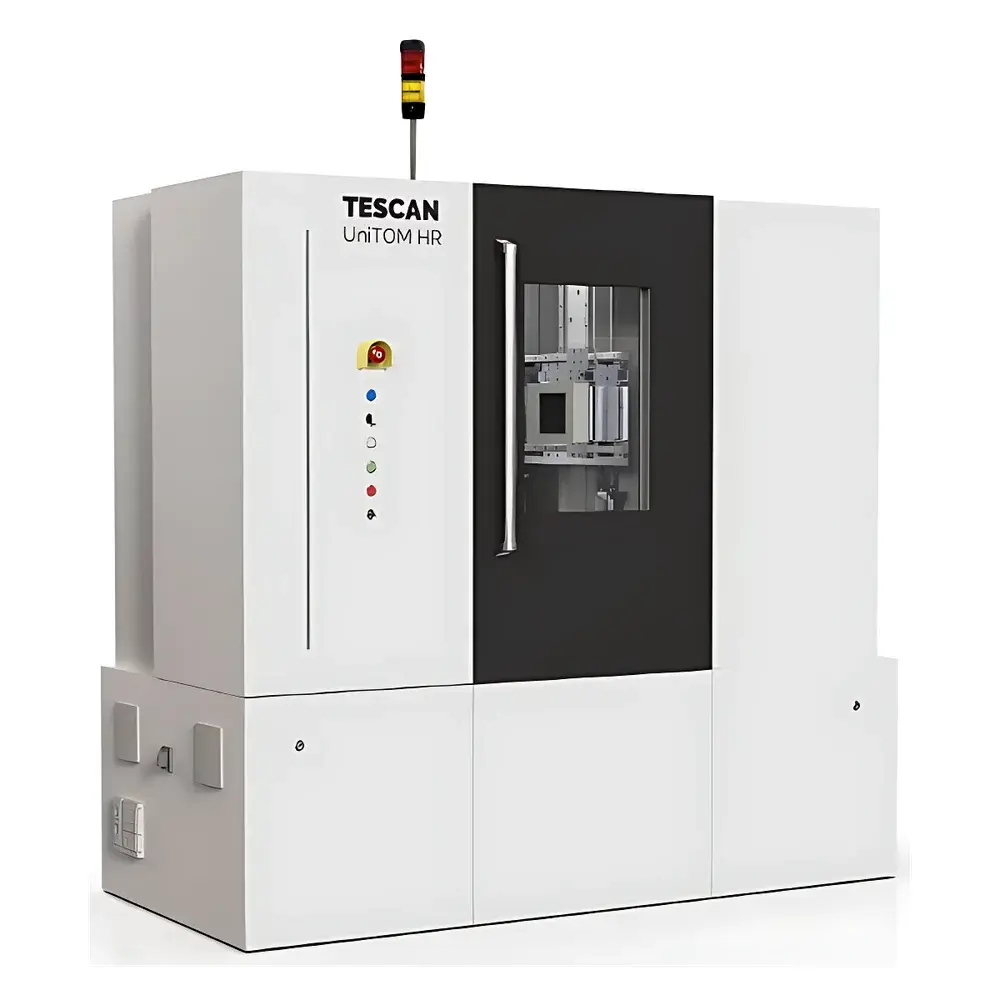
| Spatial Resolution (UniTOM HR) | ≤600 nm |
| Max Sample Dimensions (UniTOM HR) | Ø300 mm × H500 mm |
| Max Sample Height (CoreTOM) | 1150 mm |
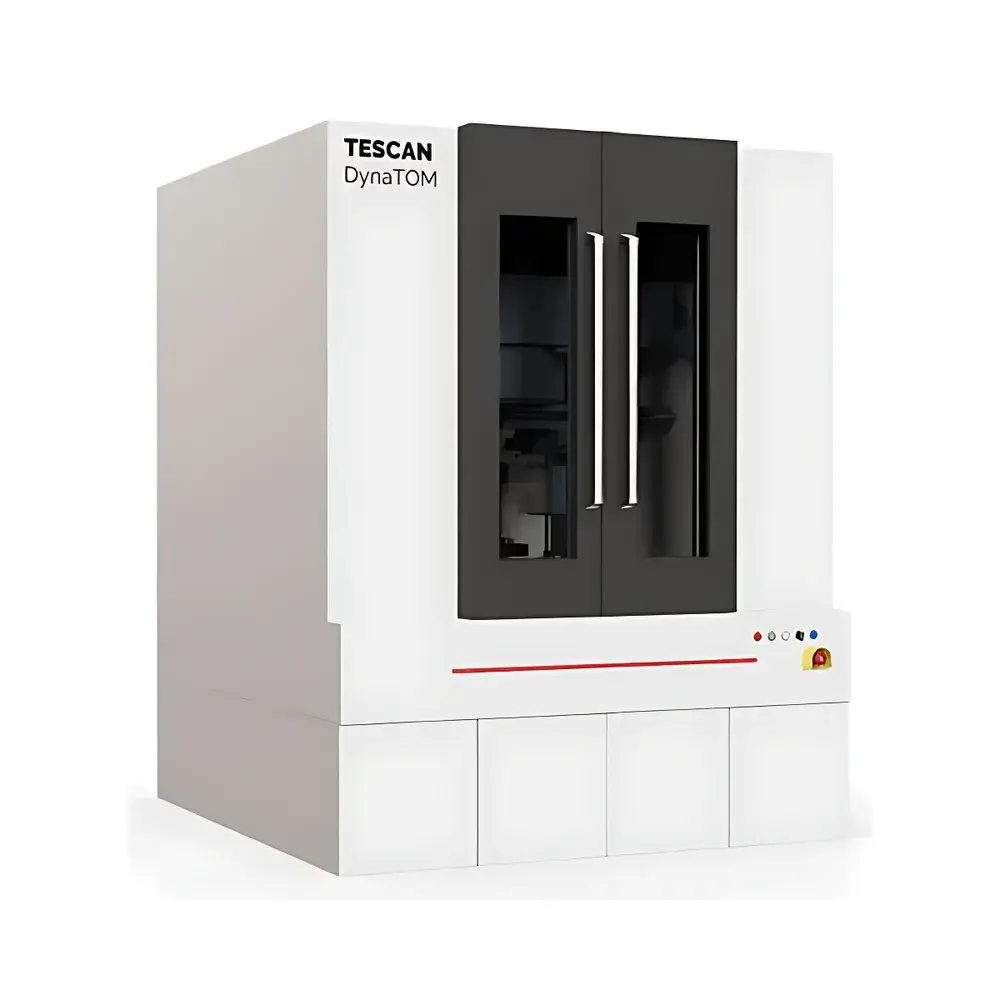
| Acquisition Speed (DynaTOM) | Full tomogram in seconds |
| Geometry | Fixed-sample (DynaTOM, UniTOM HR), Sample-stage rotation (CoreTOM) |
| Compliance | Designed for ASTM E1441, ISO 15747, and GLP/GMP-aligned workflows |
Overview
TESCAN Industrial Micro-CT Systems represent a family of laboratory-based X-ray computed tomography platforms engineered for non-destructive, quantitative 3D and 4D structural analysis across materials science, geoscience, metallurgy, and advanced manufacturing. These systems operate on the principle of cone-beam or parallel-beam X-ray tomography—reconstructing volumetric internal morphology from hundreds to thousands of 2D projection images acquired at incremental angular increments. Unlike synchrotron facilities, TESCAN’s benchtop micro-CT platforms deliver synchrotron-comparable resolution and temporal fidelity without requiring beamtime access. The CoreTOM, DynaTOM, and UniTOM HR models are architecturally differentiated to address distinct experimental priorities: multi-scale imaging of large-volume specimens (CoreTOM), high-speed dynamic process monitoring (DynaTOM), and sub-micron morphological quantification under flexible configuration (UniTOM HR). All systems integrate high-brightness microfocus or nanofocus X-ray sources, high-DQE flat-panel detectors, precision air-bearing rotational stages, and thermally stabilized mechanical enclosures—ensuring long-term dimensional stability and measurement repeatability.
Key Features
- Multi-resolution scalability: CoreTOM enables seamless transition from centimeter-scale whole-core imaging (up to 1150 mm height) to micron-level pore-network analysis (≥3 µm JIMA resolution) via hardware-optimized magnification modes and real-time ROI zoom.
- True 4D capability: DynaTOM implements source–detector orbital rotation around a stationary sample—eliminating stage-induced motion artifacts and enabling direct integration with in situ rigs (e.g., triaxial cells, electrochemical cells, thermal chambers) while acquiring full-volume tomograms in under 10 seconds.
- Sub-600 nm spatial resolution: UniTOM HR achieves verified isotropic resolution down to 600 nm using optimized nanofocus source–detector geometry, phase-retrieval algorithms, and vibration-damped optical path design—validated per ISO 15747 Annex B guidelines.
- Modular hardware architecture: UniTOM HR supports field-upgradable components—including dual-source configurations, multi-angle detector arrays, and custom collimation optics—allowing functional expansion without system replacement.
- Quantitative metrology pipeline: Integrated reconstruction engine (NRecon) and segmentation suite (Dragonfly Pro) support ISO/IEC 17025–aligned workflows, including uncertainty propagation modeling, traceable voxel size calibration, and automated porosity/percolation network analysis.
Sample Compatibility & Compliance
The TESCAN Micro-CT platform accommodates heterogeneous samples ranging from intact geological cores (rock, shale, concrete) and additively manufactured metal parts to polymer composites, battery electrodes, and biological tissue scaffolds. CoreTOM accepts cylindrical specimens up to Ø150 mm × 1150 mm; DynaTOM supports fixed-position samples up to Ø100 mm × 100 mm within environmental chambers; UniTOM HR handles objects up to Ø300 mm × 500 mm with optional vacuum or helium-path configurations for low-Z material contrast enhancement. All systems comply with IEC 61000-6-3 (EMC), IEC 61000-6-4 (emission), and EN 61000-6-2 (immunity). Software modules meet FDA 21 CFR Part 11 requirements for audit trail, electronic signature, and role-based access control—supporting GLP and GMP validation protocols in regulated R&D environments.
Software & Data Management
Acquisition, reconstruction, and analysis are unified within the TESCAN Integrated Platform (TIP), which includes CT Control (acquisition), NRecon (FDK/SART reconstruction), and Dragonfly Pro (AI-assisted segmentation, morphometry, and lattice modeling). Raw projections are stored in DICOM-compliant format with embedded metadata (kV, µA, exposure, geometry, calibration coefficients). Reconstruction pipelines support batch processing with parameter inheritance, GPU-accelerated iterative algorithms, and dose-efficient low-dose protocols. Data provenance is maintained through hierarchical project folders, timestamped log files, and version-controlled processing scripts. Export options include STL, OBJ, VTK, and HDF5—enabling interoperability with ANSYS, Thermo-Calc, and MATLAB-based simulation frameworks.
Applications
- Petroleum & Geoscience: Pore-throat network quantification, fluid displacement tracking during imbibition/drainage, digital rock physics simulations (permeability, capillary pressure).
- Materials Engineering: Defect detection (porosity, inclusions, cracking) in castings and AM parts; grain boundary mapping in polycrystalline metals; fiber orientation analysis in CFRP.
- Battery & Energy Research: In situ electrode degradation monitoring, lithium dendrite growth visualization, separator integrity assessment under cycling conditions.
- Life Sciences & Biomaterials: Bone microarchitecture (BV/TV, Tb.Th, Conn.D), scaffold pore interconnectivity, vascular network reconstruction in decellularized tissues.
- Electronics & Packaging: Solder joint void analysis, wire bond integrity verification, encapsulant delamination detection in QFN and BGA packages.
FAQ
What distinguishes CoreTOM from UniTOM HR in terms of resolution and use case?
CoreTOM prioritizes large-volume, multi-scale imaging with resolution down to 3 µm—ideal for geological core analysis where statistical representativeness across cm-scale volumes is critical. UniTOM HR targets sub-micron (<600 nm) resolution on smaller, high-value samples requiring maximum structural fidelity, such as catalyst particles or thin-film electrodes.
Can DynaTOM perform time-resolved tomography without moving the sample?
Yes. DynaTOM uses a rotating source–detector gantry around a fixed sample—enabling true in situ/operando experiments with external stimuli (load, temperature, voltage) applied continuously during acquisition.
Is software validation documentation available for regulated industries?
Yes. TESCAN provides IQ/OQ documentation templates, 21 CFR Part 11 compliance reports, and traceable calibration certificates for all hardware and software modules—supporting internal validation and external audit readiness.
How is spatial resolution verified and reported?
Resolution is measured per ISO 15747 using tungsten wire phantoms and validated via line-pair test patterns. JIMA (Just-Identifiable-Minimum-Artifact) resolution is reported as the smallest resolvable feature under defined SNR and contrast thresholds—not theoretical spot size.
What training and support options are included with system delivery?
Installation includes on-site commissioning, 5-day operator training covering acquisition, reconstruction, and basic segmentation, plus 12 months of remote technical support and software updates. Extended service agreements cover preventive maintenance, source replacement, and application-specific workflow development.



