
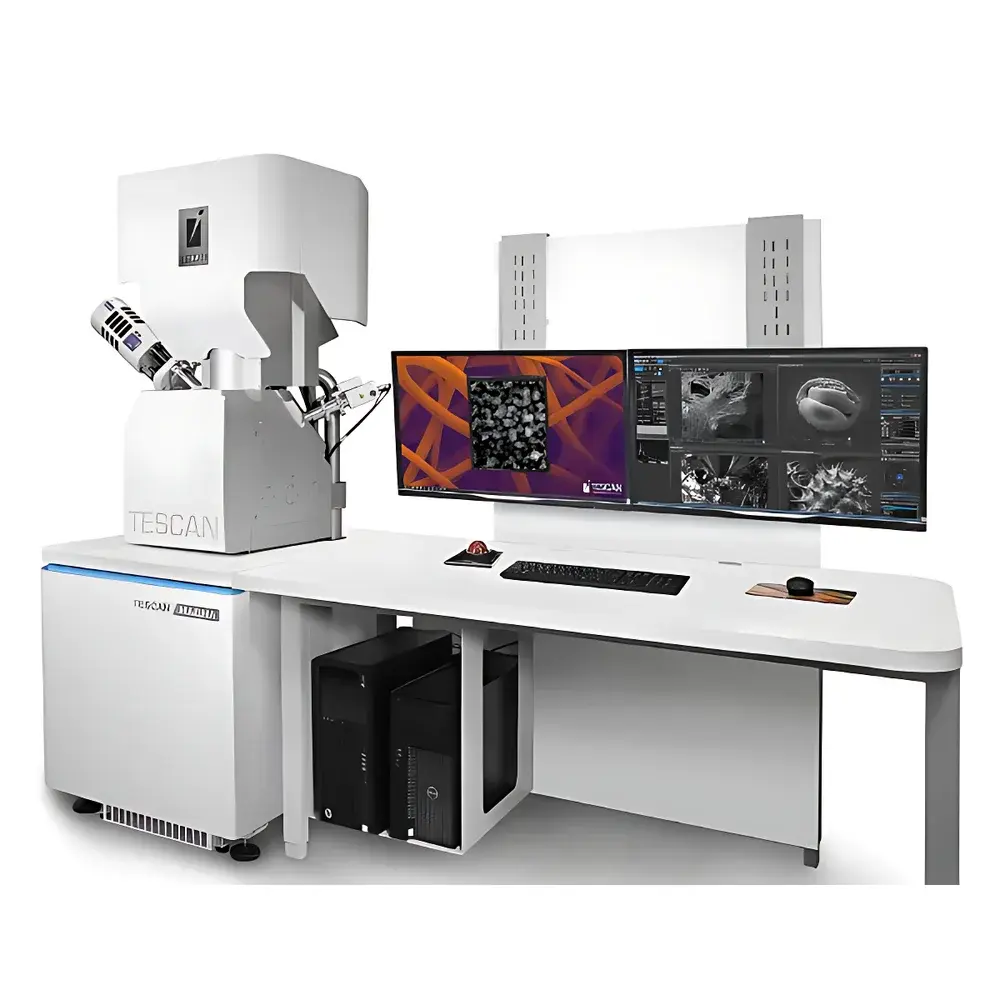
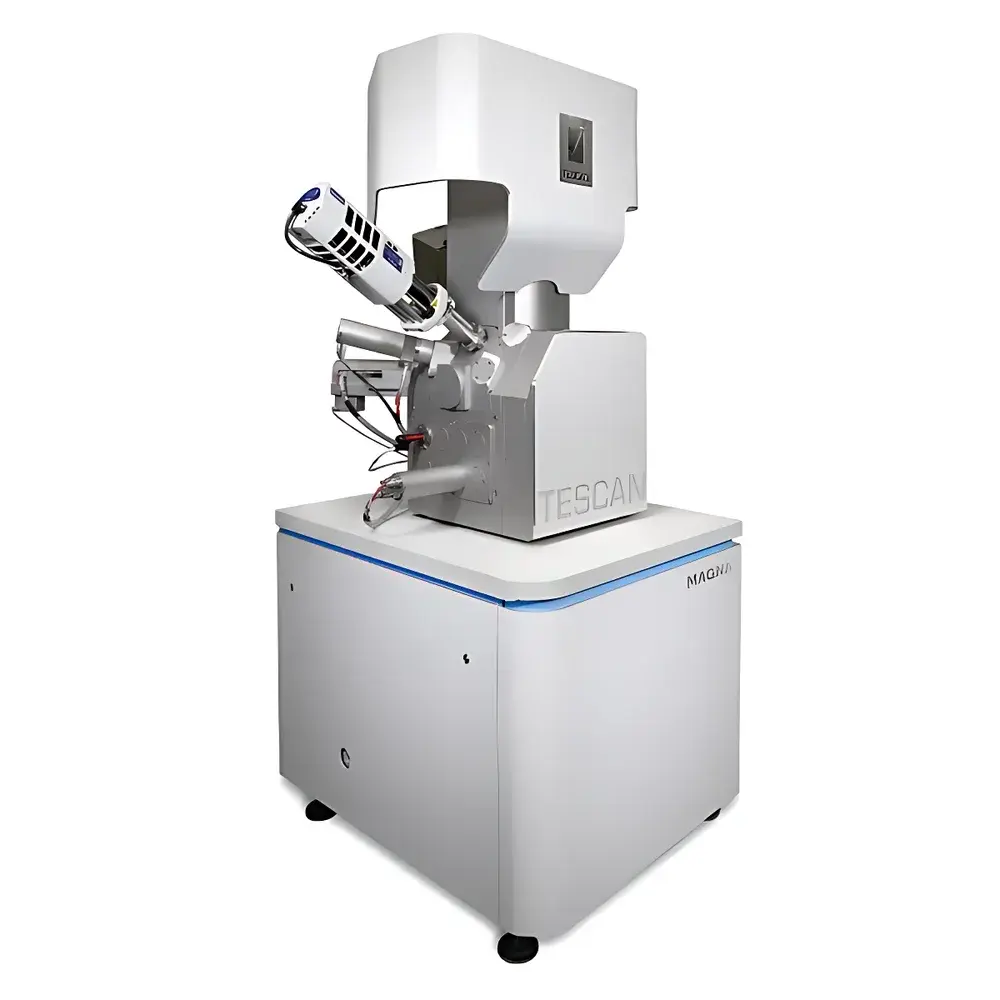
TESCAN MAGNA Field Emission Scanning Electron Microscope
| Brand | TESCAN |
|---|---|
| Origin | Czech Republic |
| Model | TESCAN-MAGNA |
| Instrument Type | Floor-standing SEM |
| Electron Gun | Schottky Field Emission |
| SEM Class | Ultra-High-Resolution FE-SEM |
| Secondary Electron Resolution | 0.6 nm @ 15 kV |
| Magnification Range | 7× to 2,000,000× |
| Accelerating Voltage | 200 V – 30 kV (down to 50 V in deceleration mode) |
| Backscattered Electron Resolution | 1.6 nm @ 15 kV |
Overview
The TESCAN MAGNA is an ultra-high-resolution field emission scanning electron microscope (FE-SEM) engineered for nanoscale surface characterization and advanced microanalysis under demanding scientific and industrial conditions. Built around the proprietary Triglav™ SEM column—a tri-lens optical architecture—the MAGNA delivers exceptional imaging fidelity across a wide voltage range, with particular strength at low accelerating voltages (down to 50 V in beam deceleration mode). This capability enables high-contrast, charging-free imaging of non-conductive specimens—including uncoated biological tissues, ceramics, polymers, and photosensitive semiconductor materials—without compromising spatial resolution or signal-to-noise ratio. The system integrates a high-brightness Schottky field emission electron source capable of delivering up to 400 nA probe current, ensuring sufficient signal intensity for extended-duration analytical sessions such as energy-dispersive X-ray spectroscopy (EDS), wavelength-dispersive X-ray spectroscopy (WDS), and electron backscatter diffraction (EBSD). Its robust mechanical and thermal stability supports reproducible long-term acquisitions required in GLP-compliant laboratories and regulated R&D environments.
Key Features
- Triglav™ Tri-Lens Column Architecture: Combines three functionally distinct objective lenses—UH-resolution lens for sub-nanometer topographic imaging, Analytical lens with zero magnetic field at the sample for artifact-free EBSD/EDS of magnetic materials, and Versatile lens optimized for multi-modal signal collection and beam shaping.
- TriBE™ Backscattered Electron Detection System: Three BSE detectors—In-Beam f-BSE (axial), Mid-Angle BSE, and Chamber-Mounted Wide-Angle BSE—enable simultaneous acquisition of atomic number (Z)-contrast, crystallographic contrast, and topographic contrast via energy- and angle-selective signal filtering.
- TriSE™ Secondary Electron Detection System: Comprises In-Beam SE (for ultra-short working distance imaging), BDM-SE (optimized for high-resolution decelerated-beam operation), and Chamber SE (for optimal morphological contrast)—all operable concurrently or selectively.
- Enhanced Signal Efficiency: Optimized in-column detector geometry increases total BSE and SE detection efficiency by >3× compared to prior-generation columns; axial BSE energy filtering improves surface sensitivity and material contrast.
- Adaptive Probe Optimization: Real-time beam convergence control maintains optimal probe size and current density across varying magnifications and beam currents—critical for quantitative microanalysis and high-throughput mapping.
Sample Compatibility & Compliance
The MAGNA accommodates diverse specimen geometries—from bulk metallurgical cross-sections and wafer fragments to fragile cryo-prepared biological sections—via its large chamber (≥180 mm diameter) and motorized 5-axis stage (X/Y/Z/tilt/rotation). Low-voltage imaging (<1 kV) eliminates surface charging on insulating samples without conductive coating, satisfying ASTM E1558 and ISO 16700 requirements for non-destructive evaluation of dielectric materials. For regulated environments, the system supports audit-trail-enabled operation under FDA 21 CFR Part 11 when paired with TESCAN Essence™ software configured with electronic signatures and user-role permissions. Routine calibration procedures align with ISO/IEC 17025 guidelines for metrological traceability in accredited testing laboratories.
Software & Data Management
TESCAN Essence™ is a modular, multi-user platform designed for both novice and expert operators. Its Layout Manager allows persistent, application-specific UI configurations—e.g., dedicated workflows for particle analysis, grain boundary mapping, or automated defect review. Integrated scripting (Python API) enables custom automation of stage navigation, image acquisition, and spectral processing. All raw image data, spectrum files (EDS/WDS), and EBSD patterns are stored in vendor-neutral HDF5 format with embedded metadata (acquisition parameters, stage coordinates, detector settings), ensuring FAIR (Findable, Accessible, Interoperable, Reusable) data principles. Export options include TIFF, PNG, CSV, and standardized formats compatible with third-party analysis suites (e.g., DTSA-II, OIM Analysis, HyperSpy).
Applications
- Nanomaterial morphology and dispersion analysis in battery cathodes, catalyst supports, and 2D material heterostructures
- Failure analysis of advanced packaging interconnects and EUV lithography masks
- Mineral phase identification and texture quantification in geoscience thin sections
- Cell membrane topology and extracellular matrix architecture in cryo-SEM workflows
- High-resolution metrology of sub-10 nm semiconductor features using voltage-contrast and edge-enhancement modes
FAQ
What is the minimum working distance for high-resolution imaging?
The In-Beam SE and f-BSE detectors support stable imaging at working distances as short as 1.5 mm—enabling maximum signal collection efficiency and resolution at low kV.
Does the MAGNA support automated particle analysis?
Yes—Essence™ includes integrated ParticleMetric™ module compliant with ISO 13322-2, supporting threshold-based segmentation, morphometric classification, and statistical reporting with uncertainty estimation.
Can EBSD and EDS be acquired simultaneously without compromising resolution?
Yes—the Analytical lens provides magnetically clean conditions at the sample position, allowing concurrent high-fidelity EBSD pattern indexing and EDS elemental mapping at <10 nm probe sizes.
Is remote operation supported for multi-site labs?
The system offers secure TLS-encrypted remote desktop access and web-based instrument status monitoring via TESCAN’s LabManager™ server infrastructure.
How is beam alignment maintained during long-duration acquisitions?
The MAGNA employs active drift compensation using real-time stage feedback and beam shift correction algorithms, achieving positional stability better than ±2 nm over 2-hour sessions.




