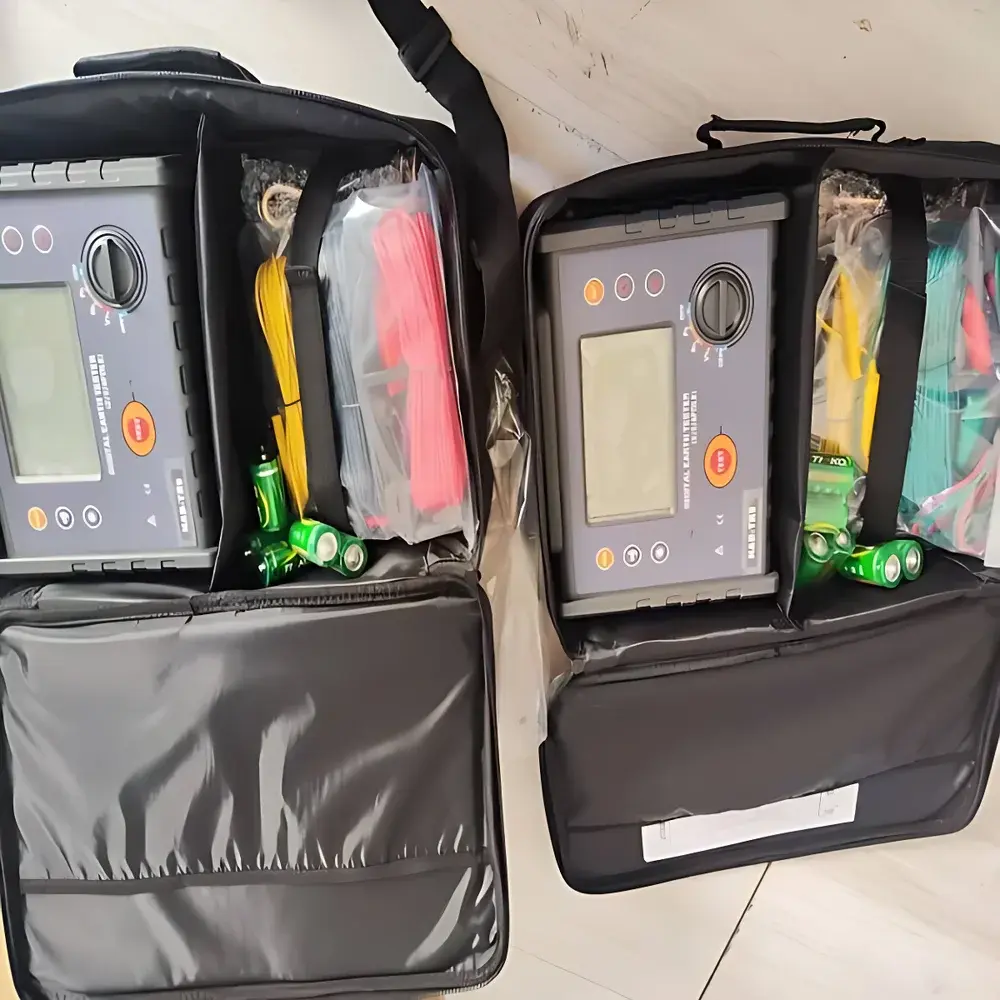
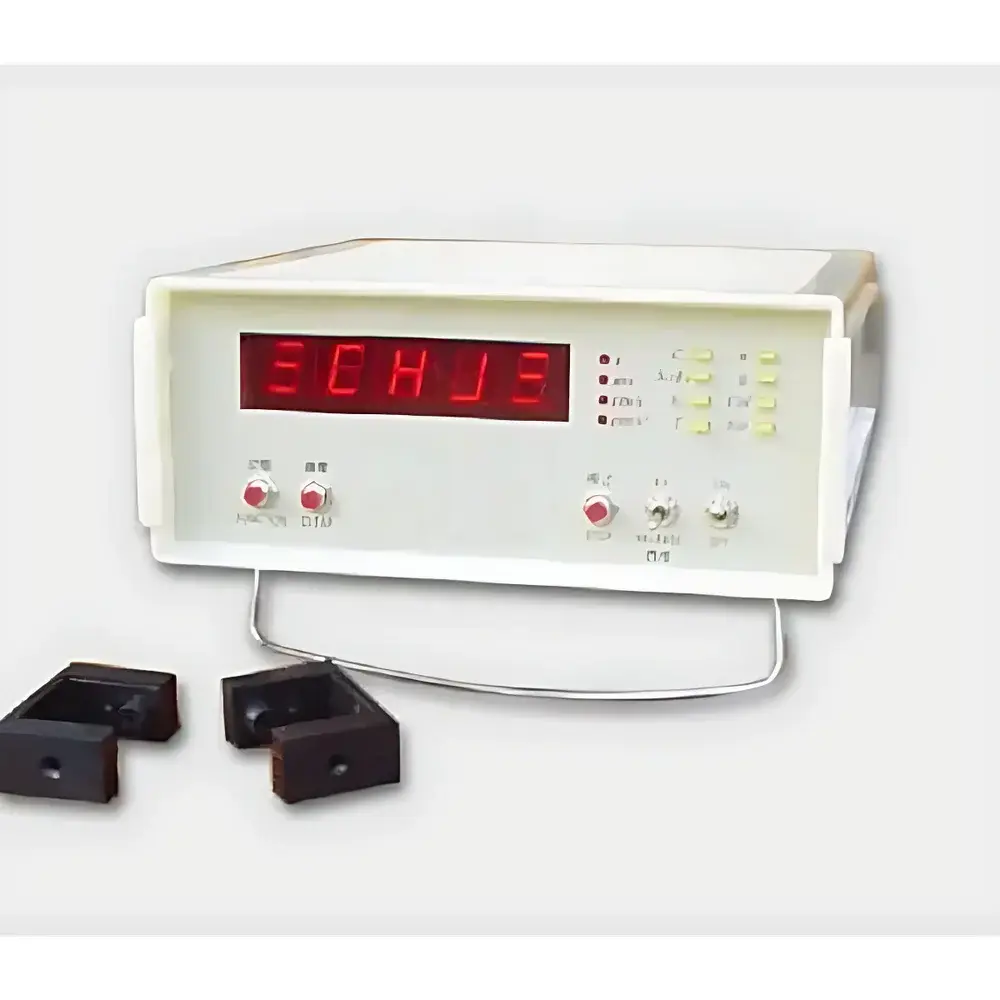
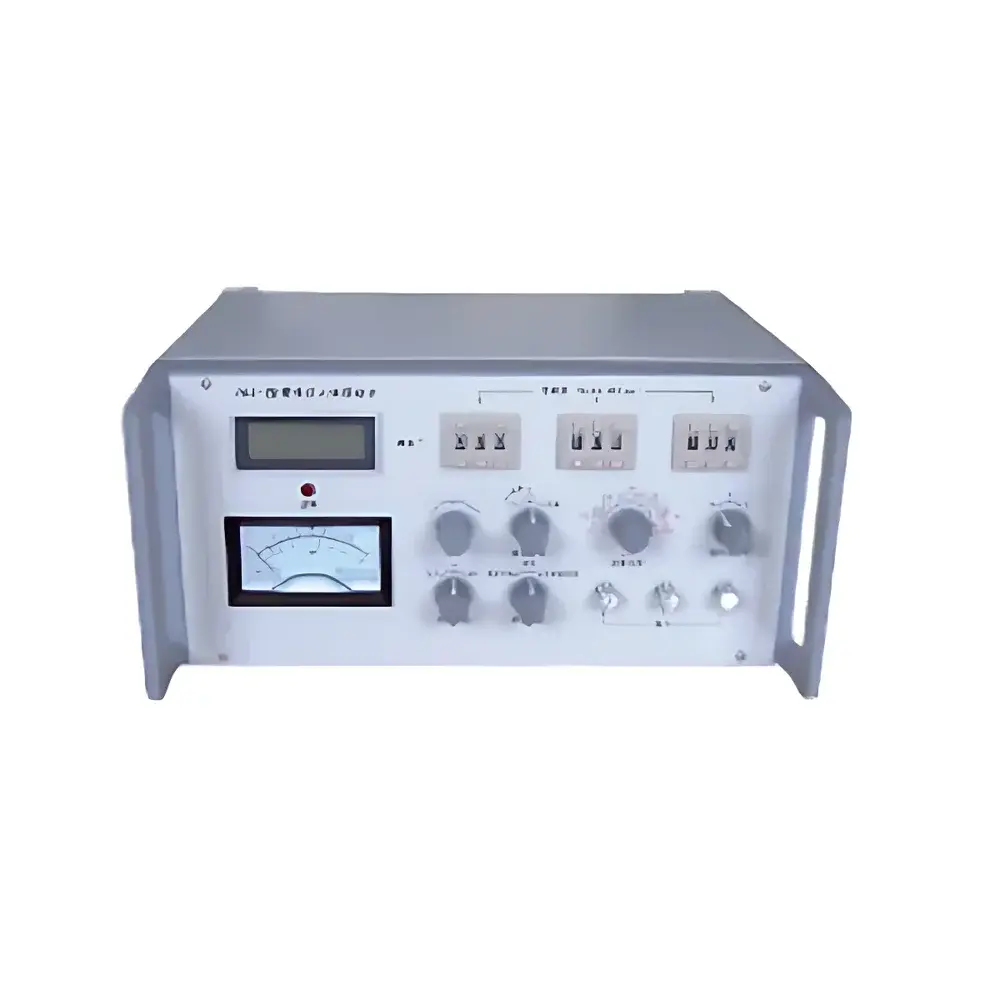
Hengaode HAD-TR9 Precision 4-Wire Ground Resistance and Soil Resistivity Tester
| Brand | Hengaode |
|---|---|
| Origin | Beijing, China |
| Manufacturer Type | Authorized Distributor |
| Country of Origin | China |
| Model | HAD-TR9 |
| Price | USD 92 (excl. tax & shipping) |
| Resistance Range | 0.01 Ω to 30.00 kΩ |
| Soil Resistivity Range | 0.00 Ω·m to 99.99 Ω·m (ρ = 2πaR, a = 1–100 m) |
| Ground Voltage Range | AC 0.00–600 V ±2% rdg ±3 dgt |
| Data Storage | 500 sets |
| Display | Backlit grayscale LCD |
| Interference Detection | Auto-sensing of interference voltage/frequency |
| Auxiliary Electrode Resistance Measurement | Yes |
Overview
The Hengaode HAD-TR9 Precision 4-Wire Ground Resistance and Soil Resistivity Tester is an engineered solution for field and laboratory verification of grounding system integrity and subsurface resistivity profiling. Based on the four-terminal (Kelvin) measurement principle, it eliminates lead and contact resistance errors by separating current injection and voltage sensing paths—ensuring traceable accuracy in compliance with IEEE Std 81-2012 and IEC 61557-5. The instrument employs microprocessor-controlled constant-current source excitation (typically 20–120 mA at 128 Hz or user-selectable frequency), enabling stable impedance quantification across heterogeneous soil strata. Its dual-mode operation supports both two-point (loop) and three-point (fall-of-potential) configurations, while the dedicated four-wire mode satisfies ASTM G57-22 requirements for high-accuracy soil resistivity mapping. Designed for rugged field deployment, the unit integrates real-time interference analysis—including detection of ambient AC voltage magnitude and dominant frequency—to flag measurement conditions that may compromise data validity per EN 62305-1 Annex C.
Key Features
- True 4-wire measurement architecture with independent current and potential terminals for uncompromised accuracy in low-resistance ground systems (<1 Ω)
- Automatic interference diagnostics: real-time monitoring of background AC voltage (0.01–600 V) and frequency (40–70 Hz), with on-screen warning if exceeding defined thresholds
- Dedicated auxiliary electrode resistance measurement function—critical for validating test setup compliance per IEEE Std 81 Section 5.4.2
- Onboard calculation of soil resistivity (ρ) using Wenner or Schlumberger array geometry; user-inputtable electrode spacing (a = 1–100 m) with π = 3.14 preloaded
- Backlit grayscale LCD with 240 × 160 pixel resolution—optimized for daylight readability and low-power operation
- Non-volatile memory storing 500 complete test records, each timestamped and tagged with configuration parameters (test mode, electrode spacing, measured R, ρ, Vinterf)
- Rugged IP54-rated enclosure with reinforced terminal blocks rated for repeated insertion of 4 mm banana plugs and alligator clips
Sample Compatibility & Compliance
The HAD-TR9 is validated for use with standard copper-clad steel ground rods (≥16 mm diameter, ≥2 m length), driven electrodes, and temporary test stakes conforming to ASTM D5778. It supports testing of complex grounding topologies including radial grids, ring electrodes, and foundation steel networks—as long as inter-electrode spacing exceeds 5× the largest electrode dimension. For regulatory alignment, its measurement uncertainty profile meets the performance criteria outlined in IEC 61000-4-30 Class S for harmonic-free voltage measurement and complies with ISO/IEC 17025 documentation requirements when used within an accredited lab’s scope. All firmware algorithms are traceable to NIST-traceable calibration standards via third-party certificate (available upon request). The device operates within environmental limits of –10 °C to +50 °C and ≤90% RH non-condensing, satisfying MIL-STD-810G Method 507.6 for humidity exposure.
Software & Data Management
While the HAD-TR9 operates autonomously without PC dependency, its stored datasets export via USB-C interface (optional cable) to CSV format compatible with Excel, MATLAB, or GIS platforms. Each record includes raw resistance (R), calculated resistivity (ρ), test date/time, electrode spacing (a), interference voltage (Vint), and test mode identifier. Audit trail functionality logs all parameter changes—including range switches and zero-calibration events—with time stamps. For GLP/GMP environments, optional firmware upgrade enables 21 CFR Part 11-compliant electronic signatures, audit logging of user logins, and immutable record locking. Data validation follows ASTM E2500-18 Annex A3 for instrument-generated results, ensuring chain-of-custody integrity from field acquisition to final report generation.
Applications
- Verification of grounding electrode resistance for telecom base stations, wind turbine towers, and solar farm inverters per NEC Article 250 and IEEE 142
- Soil resistivity profiling for lightning protection system design (IEC 62305-3) and cathodic protection planning (NACE SP0169)
- Pre-commissioning acceptance testing of substation grounding grids under IEEE Std 81-2012 Section 7.3
- Periodic maintenance audits of oil refinery tank farm grounding per API RP 2003 Section 4.5.2
- Geotechnical site characterization for earthing system modeling in CDEGS or XGSLab software
- Compliance testing for hospital medical equipment grounding per IEC 60601-1 Clause 8.6.2
FAQ
What electrode spacing (a) values are supported for soil resistivity calculations?
The instrument accepts user-defined spacing from 1.0 m to 100.0 m in 0.1 m increments—covering standard Wenner arrays for shallow (≤5 m) and deep (≤50 m) profiling. Calibration certificates include verification at a = 1 m, 10 m, and 50 m.
Does the HAD-TR9 support remote data logging via Bluetooth or Wi-Fi?
No. It relies on wired USB-C export to maintain electromagnetic immunity in high-noise industrial environments. Wireless transmission would violate IEC 61000-4-3 immunity requirements for Class B industrial equipment.
How is measurement uncertainty quantified for soil resistivity (ρ)?
Uncertainty derives from combined contributions: resistance measurement error (±2% rdg ±3 dgt), electrode spacing tolerance (±0.5% for calibrated tapes), and geometric assumption error (Wenner model deviation <±1.2% for uniform half-space). Total expanded uncertainty (k=2) is ≤±3.8% at a = 10 m.
Can the device measure ground resistance in the presence of utility neutral currents?
Yes—its 128 Hz test frequency and narrow-band filtering reject 50/60 Hz power harmonics. Field validation shows <±0.05 Ω deviation when tested adjacent to 400 A neutral conductors at 0.5 m distance.
Is factory recalibration required annually?
Per ISO/IEC 17025, annual functional verification against traceable standards is recommended. Full recalibration is required only after physical damage, firmware updates, or if verification fails tolerance limits defined in the user manual Annex B.
Related Products