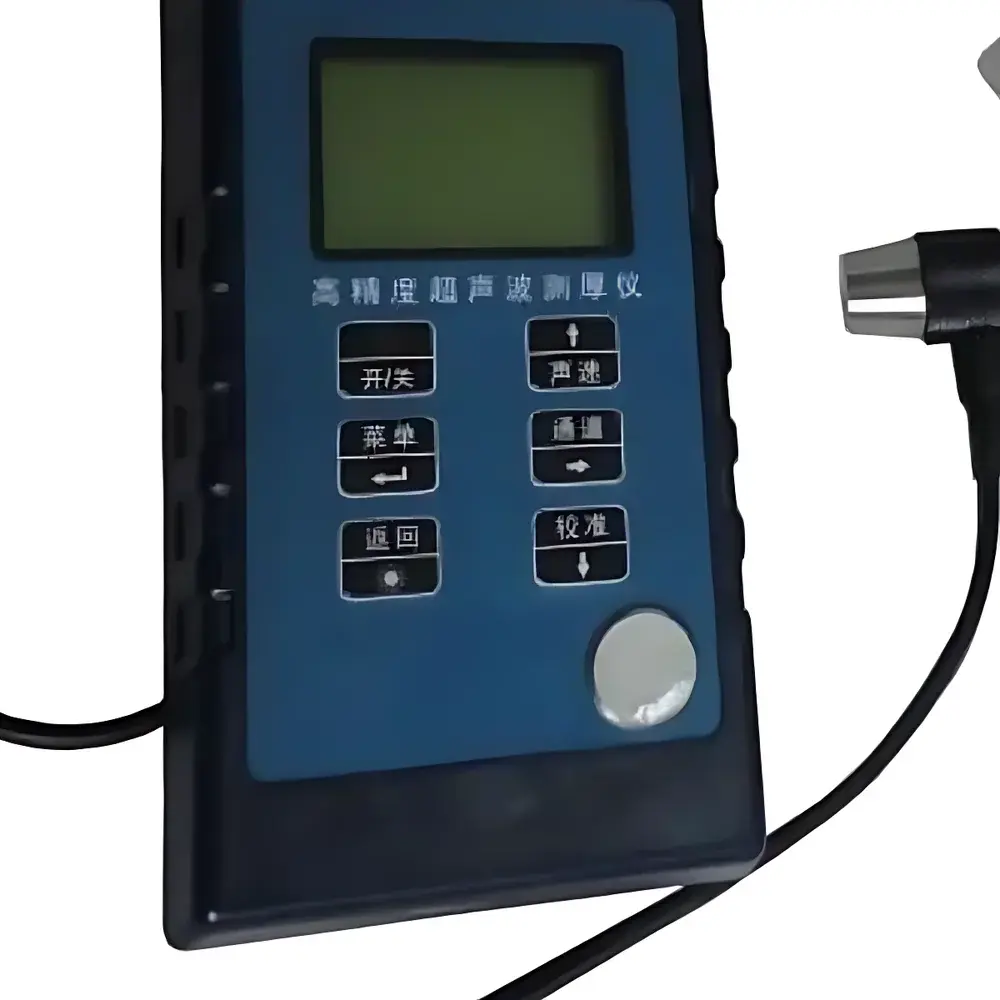
HengaoDe HAD2000 Ultrasonic Thickness Gauge
| Brand | HengaoDe |
|---|---|
| Origin | Beijing, China |
| Manufacturer Type | Authorized Distributor |
| Country of Origin | China |
| Model | HAD2000 |
| Price | USD 25.50 (FOB) |
| Measurement Range | 0.65–300 mm (steel, probe-dependent segmentation) |
| Display Resolution | 0.01 mm / 0.1 mm |
| Material Sound Velocity Range | 508–9999 m/s |
| Accuracy | ±(1% H + 0.1) mm |
| Minimum Curved Surface Detection | Φ10 mm × 2.0 mm |
| Receiver Bandwidth | 1–10 MHz (−3 dB) |
| Power Supply | 3 VDC (2 × AA alkaline batteries) |
| Battery Life | 280 h (auto mode), 100 h (backlight on) |
| Display | 128 × 64 dot-matrix LCD |
| Dimensions | 140 × 80 × 40 mm (L×W×H) |
| Weight | 176 g (including batteries) |
| Operating Temperature | −10–50 °C (up to 350 °C with high-temp probe) |
| Operating Humidity | 20–90% RH |
Overview
The HengaoDe HAD2000 Ultrasonic Thickness Gauge is a precision-engineered handheld instrument designed for non-destructive thickness measurement of metallic and non-metallic materials using pulse-echo ultrasonic principle. It operates by transmitting a high-frequency acoustic pulse into the material and measuring the time-of-flight of the echo reflected from the back wall — a method standardized under ASTM E797 and ISO 2400. The device supports real-time velocity calibration across a broad sound velocity range (508–9999 m/s), enabling accurate thickness evaluation in steel, aluminum, copper, plastics, composites, and ceramics. Its compact form factor, extended battery life, and robust environmental tolerance make it suitable for field inspections in pipeline integrity assessment, pressure vessel maintenance, shipyard QA/QC, and structural corrosion monitoring per API RP 571 and NACE SP0106 guidelines.
Key Features
- High-resolution dual-mode display (0.01 mm / 0.1 mm) with adjustable backlight for low-light environments
- Probe-specific measurement segmentation ensures optimal accuracy across thin-walled (≥0.65 mm) and thick-section (up to 300 mm) applications
- Wide receiver bandwidth (1–10 MHz) accommodates standard 5 MHz transducers as well as high-frequency (7.5–10 MHz) probes for fine-grained or coated substrates
- Integrated temperature-compensated timing circuitry minimizes drift during extended field use
- IP65-rated enclosure provides dust and water resistance for industrial outdoor operation
- Automatic gain control (AGC) and manual sensitivity adjustment ensure consistent signal detection across varying surface conditions and couplant quality
- Onboard data logging (optional via RS232 interface) supports traceable reporting compliant with ISO/IEC 17025 documentation requirements
Sample Compatibility & Compliance
The HAD2000 is validated for use on flat, curved, and irregular surfaces with minimum detectable curvature radius of Φ10 mm × 2.0 mm — enabling reliable measurements on small-diameter tubing, valve bodies, and welded joints. It complies with EN 15317 for ultrasonic equipment performance verification and meets the fundamental metrological requirements outlined in JJG 403–2019 (Chinese National Verification Regulation for Ultrasonic Thickness Gauges). When used with certified reference blocks (e.g., ASTM E747 Type II) and calibrated transducers, measurement repeatability achieves ≤±0.05 mm at 10 mm thickness under controlled lab conditions. The instrument supports both single-echo and multiple-echo modes to mitigate errors caused by paint, coating, or surface pitting — critical for pre- and post-abrasive blast inspection workflows.
Software & Data Management
While the HAD2000 operates as a standalone field instrument, its RS232 serial output enables integration with PC-based analysis software for batch export of thickness readings, statistical process control (SPC) charting, and longitudinal trend analysis. Raw data files include timestamp, material velocity setting, probe ID (if encoded), and measurement mode flag — facilitating audit-ready records aligned with GLP and ISO 9001 clause 7.5.3. No proprietary drivers are required; standard terminal emulators or custom Python/Excel scripts can parse ASCII-formatted output. Firmware updates (available via HengaoDe technical support portal) maintain compatibility with evolving calibration protocols and add user-defined report templates for site-specific inspection forms.
Applications
- Corrosion mapping of carbon steel pipelines and storage tanks in oil & gas infrastructure
- Quality assurance of castings, forgings, and extrusions in aerospace component manufacturing
- In-service wall loss assessment of heat exchanger tubes and boiler drums
- Coating thickness verification prior to and after abrasive blasting per SSPC-SP10/NACE No. 2
- Educational laboratory use for teaching ultrasonic wave propagation, impedance matching, and material characterization principles
- Third-party inspection services requiring portable, battery-operated metrology tools with documented uncertainty budgets
FAQ
Does the HAD2000 require periodic factory recalibration?
Yes — annual calibration against NIST-traceable thickness standards is recommended to maintain measurement integrity per ISO/IEC 17025 Clause 6.5. Calibration certificates include as-found/as-left data and expanded uncertainty (k=2) for all specified ranges.
Can the HAD2000 measure through protective coatings?
It supports dual-echo mode to isolate the back-wall echo beneath non-metallic coatings up to 3 mm thick (e.g., epoxy, polyurethane), provided acoustic impedance mismatch is moderate and couplant application is uniform.
Is high-temperature measurement supported out-of-the-box?
Standard operation is rated to 50 °C ambient. For elevated surface temperatures (up to 350 °C), a dedicated high-temperature delay line probe and heat-resistant couplant must be selected separately — not included with base unit.
What transducers are compatible with the HAD2000?
The gauge accepts industry-standard BNC-connected contact transducers (5 MHz nominal), including dual-element, delay-line, and miniature probes. Probe selection must align with target material thickness, surface geometry, and required resolution per ASTM E1158 guidance.
How is measurement uncertainty quantified for audit purposes?
Total uncertainty is calculated per GUM (JCGM 100:2008) incorporating contributions from timebase stability (±0.02 µs), velocity setting error (±0.5%), probe wear (±0.03 mm), and couplant variability (±0.05 mm), yielding typical k=2 expanded uncertainty of ±0.12 mm at 10 mm steel thickness.