
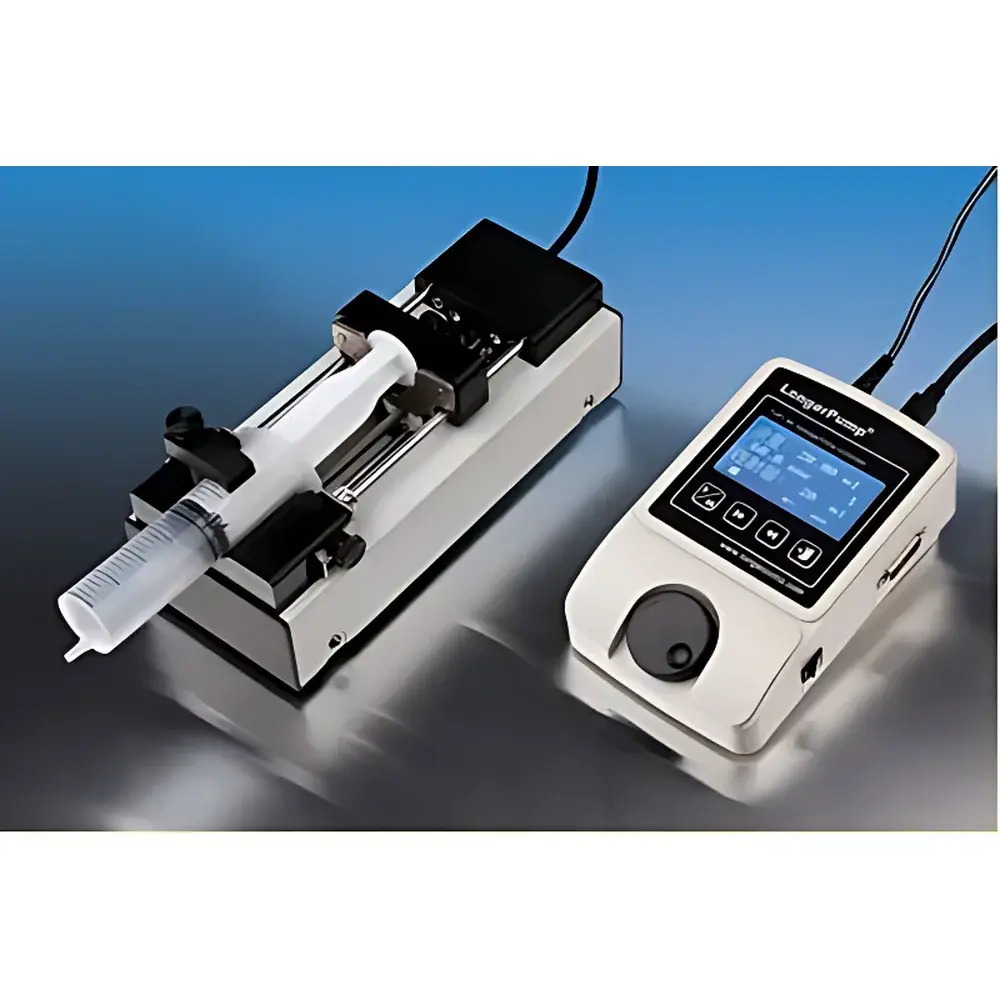
LongerPump TJ-3A / W0109-1B Single-Channel Micro-Syringe Pump
| Brand | LongerPump |
|---|---|
| Origin | Hebei, China |
| Manufacturer Type | Direct Manufacturer |
| Instrument Type | Micro-Syringe Pump |
| Flow Rate Range | 0.138 µL/min – 52.94 mL/min |
| Accuracy | ≤ ±0.5% (when stroke ≥ 30% of max stroke) |
| Max Stroke | 90 mm |
| Stroke Resolution | 0.165 µm |
| Linear Speed Range | 7.94 µm/min – 79.4 mm/min |
| Linear Force Output | >90 N |
| Communication Interface | RS485 |
| Power Supply | AC 90–260 V, 10 W |
| Operating Temperature | 0–40 °C |
| Relative Humidity | <80% |
| Controller Dimensions | 170 × 108 × 65 mm |
| Controller Weight | 0.5 kg |
| Actuator Dimensions | 245 × 100 × 95 mm |
| Actuator Weight | 1.3 kg |
Overview
The LongerPump TJ-3A / W0109-1B is a precision-engineered, single-channel micro-syringe pump designed for high-reproducibility fluid delivery in research laboratories, analytical instrumentation integration, and controlled process development. It operates on the principle of linear displacement-driven volumetric metering: a stepper motor drives a lead screw to translate a syringe plunger at precisely defined speeds and distances, enabling deterministic control over liquid volume, flow rate, and timing. Its modular, split-architecture design—comprising a compact controller unit and a dedicated actuator—facilitates flexible mounting in confined spaces, custom rack integration, or multi-pump synchronization via RS485 bus. The system supports both forward (infusion) and reverse (withdrawal) operation, as well as programmable multi-phase sequences (e.g., infusion → pause → withdrawal), making it suitable for applications requiring bidirectional fluid handling with temporal fidelity.
Key Features
- Modular split-body architecture: Independent controller and actuator units enable installation flexibility, vibration isolation, and scalable system expansion.
- High-resolution linear motion control: 0.165 µm stroke resolution and 7.94 µm/min minimum linear speed support ultra-low-flow applications such as nanoliter-scale reagent dosing or microfluidic priming.
- Robust mechanical output: Sustained linear force >90 N ensures reliable actuation across syringes up to 60 mL capacity—even with high-viscosity fluids or backpressure conditions typical in HPLC sample introduction or capillary filling.
- Comprehensive syringe compatibility: Built-in database includes standard syringes from major global manufacturers (e.g., BD, Hamilton, SGE); users may define and store up to four custom syringe inner diameters for accurate cross-sectional area calculation.
- Dual-mode calibration: Factory-calibrated flow accuracy (≤±0.5% error when stroke ≥30% of 90 mm) can be further refined via user-executed flow rate calibration using gravimetric or timed-volume verification.
- Industrial-grade I/O interface: Two open-collector status outputs (start/stop, direction) and three TTL-level inputs (start/stop, fast-forward, fast-reverse) support seamless integration into automated lab workflows and PLC-controlled environments.
Sample Compatibility & Compliance
The TJ-3A/W0109-1B accommodates glass, plastic, and metal syringes ranging from 10 µL to 60 mL nominal volume, provided they conform to ISO 7886-1 dimensional standards for Luer-lock or Luer-slip interfaces. Its non-contact plunger engagement mechanism minimizes wear and avoids contamination of sensitive samples. While not certified for clinical use under FDA 510(k) or CE IVD directives, the device meets general laboratory equipment safety requirements per IEC 61010-1:2010 and electromagnetic compatibility (EMC) criteria per IEC 61326-1:2020. Its parameter logging,掉电记忆 (power-loss recovery), and deterministic execution model align with GLP-compliant documentation practices when used in regulated QC/QA settings—particularly when paired with validated software platforms that enforce audit trails and electronic signatures.
Software & Data Management
The pump operates autonomously via its front-panel interface but is fully programmable via RS485 serial communication using ASCII-based command protocols. Third-party software—including LabVIEW VIs, Python (pyserial), MATLAB, and custom SCADA systems—can configure all operational parameters: target volume, infusion/withdrawal time, cycle count, inter-step delay, and startup synchronization mode (individual, staggered, or simultaneous). All setpoints, real-time status (current position, direction, speed), and event logs (start/stop timestamps, fault codes) are accessible through the serial interface. No proprietary driver or cloud dependency is required; configuration persistence is retained across power cycles via non-volatile memory.
Applications
- Chromatography sample introduction: Precise, pulseless loading of analytes into GC, HPLC, or UHPLC autosamplers.
- Microfluidic device actuation: Controlled reagent injection, gradient generation, and chip priming in organ-on-chip and droplet-based platforms.
- Electrophysiology and patch-clamp rigs: Low-noise, sub-microliter perfusion for localized drug application or bath solution exchange.
- Chemical synthesis automation: Metered addition of catalysts, initiators, or monomers in reactor control loops.
- Calibration standard delivery: Traceable volume transfer for gravimetric calibration of analytical balances or pipette verification systems.
- Material science testing: Controlled dispensing of polymer precursors, nanosuspensions, or conductive inks onto substrates.
FAQ
What syringe sizes are supported?
The pump accepts standard Luer-lock and Luer-slip syringes from 10 µL to 60 mL. Inner diameter values for common models are preloaded; users may enter and save up to four custom diameters.
Can multiple TJ-3A units be synchronized?
Yes—via RS485 daisy-chaining and master-slave addressing, enabling coordinated start/stop and phase-aligned operation across up to 32 units on a single bus.
Is flow rate recalibration required after changing syringes?
Recalibration is recommended when switching between syringes with significantly different inner diameters or when operating at flow extremes (30 mL/min) to maintain ≤±0.5% volumetric accuracy.
Does the pump support continuous infusion mode?
Yes—continuous mode allows indefinite operation at a fixed linear speed until manually halted or interrupted by an external signal.
How is positional accuracy maintained during long-duration runs?
The closed-loop stepper motor drive, combined with mechanical hard stops and configurable soft limits, ensures repeatable positioning within ±0.165 µm per step—no encoder feedback is required due to inherent step-loss immunity at rated load.



