
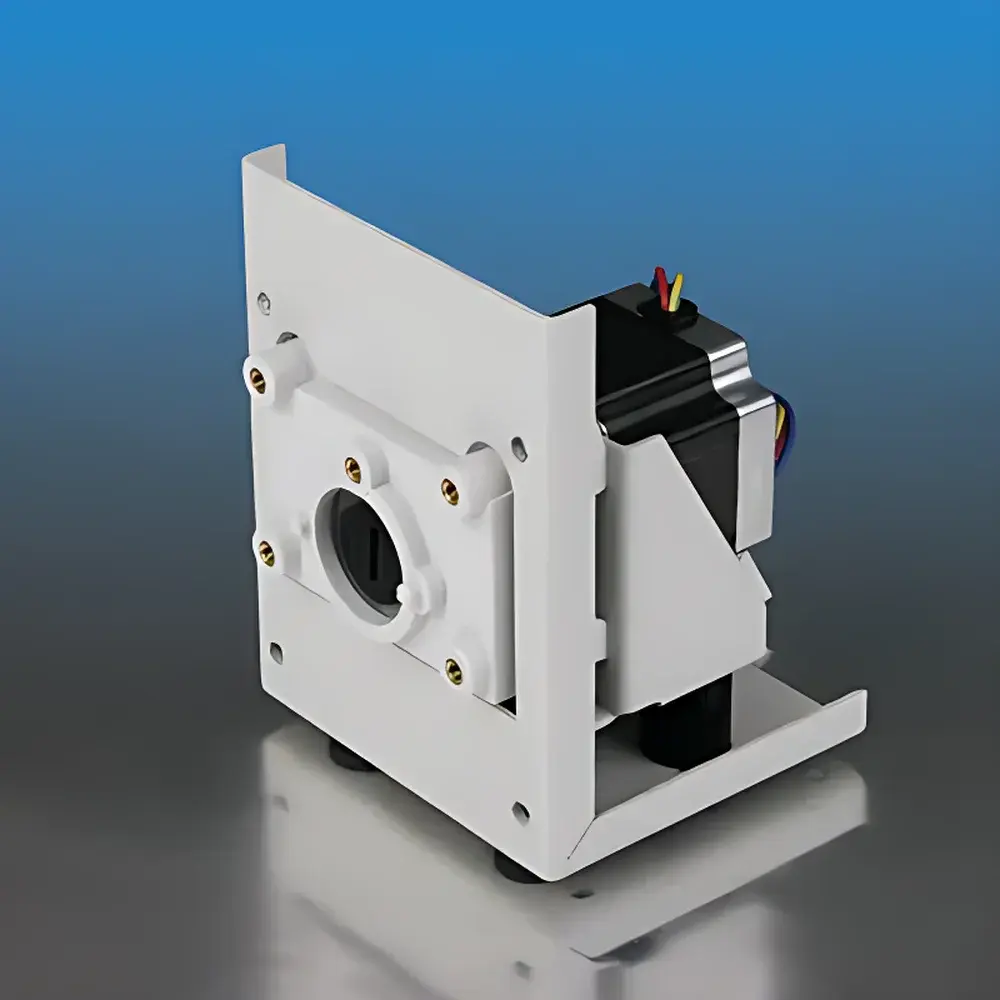
LongerPump T-S201 Compact Stepper-Driven Peristaltic Pump
| Brand | LongerPump |
|---|---|
| Origin | Hebei, China |
| Manufacturer Type | OEM/ODM Producer |
| Model | T-S201 |
| Motor | 57-step bipolar stepper motor (1.8° step angle, 2-phase, 1.5A/phase) |
| Max Flow Rate | ≤1140 mL/min (with BZ15-13-D pump head & 17# tubing) |
| Dimensions (L×W×H) | 103 × 102 × 130 mm |
| Operating Temperature | 0–40 °C |
| Relative Humidity | <80% RH |
| Compatible Pump Heads | YZ1515X, YZ2515X, DG-1(6)/DG-2(6), DG-1(10)/DG-2(10), BZ15-13 series, FG15-13, FG25-13, DMD15-13-B |
| Tubing Compatibility | ID ≤3.17 mm, wall thickness 0.8–1.0 mm |
| Electrical Interface | 4-wire unipolar/bipolar connector (Red=A+, Green=Common/A−, Yellow=B+, Blue=B−) |
| Insulation Class | B |
| Insulation Resistance | ≥100 MΩ |
| Phase Voltage | 2.1 V |
| Phase Resistance | 1.4 Ω ±10% |
| Inductance | 4.3 mH ±20% |
Overview
The LongerPump T-S201 is a compact, OEM-optimized stepper-driven peristaltic pump designed for integration into analytical instruments, medical devices, laboratory automation platforms, and industrial fluid-handling systems. Based on the principle of positive displacement via roller compression of elastomeric tubing, the T-S201 delivers precise, pulse-free, and contamination-free fluid transfer without internal valves or seals—ensuring inherent chemical compatibility and eliminating cross-sample carryover. Its core architecture centers on a high-torque 57-series bipolar stepper motor (1.8° step angle, 2-phase, rated at 1.5 A/phase), directly coupled to a modular drive shaft. This direct-drive configuration eliminates gearboxes or timing belts, minimizing mechanical backlash and enabling microstepping-capable open-loop control with high positional repeatability. The unit operates within a standard ambient range (0–40 °C, <80% RH) and conforms to IEC 61000-6-2 (immunity) and IEC 61000-6-4 (emission) for industrial environments. As a Class B electrical device, it meets CE marking requirements for electromagnetic compatibility in non-residential settings.
Key Features
- Ultra-compact footprint: 103 × 102 × 130 mm chassis enables seamless integration into space-constrained enclosures, including portable analyzers and benchtop diagnostic platforms.
- OEM-ready mechanical interface: Dual-mount design supports both bottom-panel screw fixation (M3 threaded inserts) and front-panel flange mounting, accommodating diverse chassis geometries and thermal management strategies.
- Modular pump head compatibility: Supports 14+ industry-standard pump heads—including YZ, DG, BZ, FG, and DMD series—allowing flow rate tuning from 32 mL/min (DG-1(10), single channel) to 1140 mL/min (BZ15-13-D, 17# tubing) without hardware redesign.
- Open-control stepper interface: 4-wire bipolar connection (Red/A+, Green/A−, Yellow/B+, Blue/B−) enables direct integration with PLCs, microcontrollers (e.g., Arduino, Raspberry Pi Pico), or motion controllers using standard STEP/DIR signaling—no proprietary controller required.
- Robust motor specification: IP20-rated motor with Class B insulation, 100 MΩ minimum insulation resistance, and thermally stable 4.3 mH inductance ensures long-term reliability under continuous duty cycles typical in QC/QA instrumentation.
Sample Compatibility & Compliance
The T-S201 does not contact fluid directly; all wetted parts are defined solely by the selected tubing and pump head housing material (typically acetal, stainless steel, or PPS). Users select tubing based on chemical resistance (e.g., Norprene® LFT for organics, PharMed® BPT for biopharma, Viton® for aggressive solvents) and dimensional tolerance (ID ≤3.17 mm, wall thickness 0.8–1.0 mm). No regulatory certifications (e.g., FDA 510(k), ISO 13485) are claimed for the pump itself; however, its design supports system-level compliance with ISO 15197 (in vitro diagnostics), USP (analytical instrument qualification), and GMP Annex 11 (computerized system validation) when integrated with audit-trail-capable host controllers. It is not intended for implantable or life-support applications.
Software & Data Management
The T-S201 operates as a hardware-level actuator with no embedded firmware or onboard intelligence. Flow rate is controlled externally via pulse train frequency (RPM ∝ STEP pulse frequency) and direction signal polarity. For traceable operation in regulated environments, users implement control logic on validated host platforms—for example, LabVIEW Real-Time with NI Motion Controllers (supporting IEC 62304-compliant software lifecycle), or Beckhoff TwinCAT 3 with integrated motion libraries compliant with FDA 21 CFR Part 11 electronic signature and audit trail requirements. Integration with SCADA systems (e.g., Ignition, Siemens WinCC) enables centralized monitoring of run time, direction status, and fault flags (via optional external current-sense feedback).
Applications
- Reagent delivery in clinical chemistry analyzers and immunoassay platforms
- Mobile phase metering in compact HPLC and IC systems
- Cell culture media perfusion in bioreactor control modules
- Calibration standard dosing in environmental water quality sensors
- Dispensing in automated sample preparation workstations (e.g., SPE, liquid handling)
- Low-pressure fluid circulation in HVAC commissioning test rigs and heat exchanger validation benches
FAQ
Does the T-S201 include a built-in speed controller or display?
No. It is a driver-only module requiring external step/direction signals. Control electronics must be supplied separately.
Can the T-S201 operate with microstepping drivers?
Yes—its 1.8° two-phase stepper motor is fully compatible with standard microstepping drivers (1/2, 1/4, 1/8, 1/16 step resolution), enabling smoother operation and reduced low-speed vibration.
What is the maximum allowable tubing wall thickness for DG-series pump heads?
DG-1(6) and DG-2(6) heads require tubing with wall thickness between 0.8 mm and 1.0 mm for optimal occlusion and service life.
Is electrical isolation provided between motor windings and chassis ground?
Yes—the motor meets IEC 60034-1 insulation resistance requirements (≥100 MΩ at 500 VDC), and the chassis is electrically isolated per IEC 61800-5-1 functional safety guidelines.
How is flow accuracy verified during system qualification?
Per USP , flow accuracy is confirmed using gravimetric or volumetric measurement (e.g., certified balance + timed collection) across the full operational RPM range, with documented uncertainty budgets traceable to NIST standards.





