
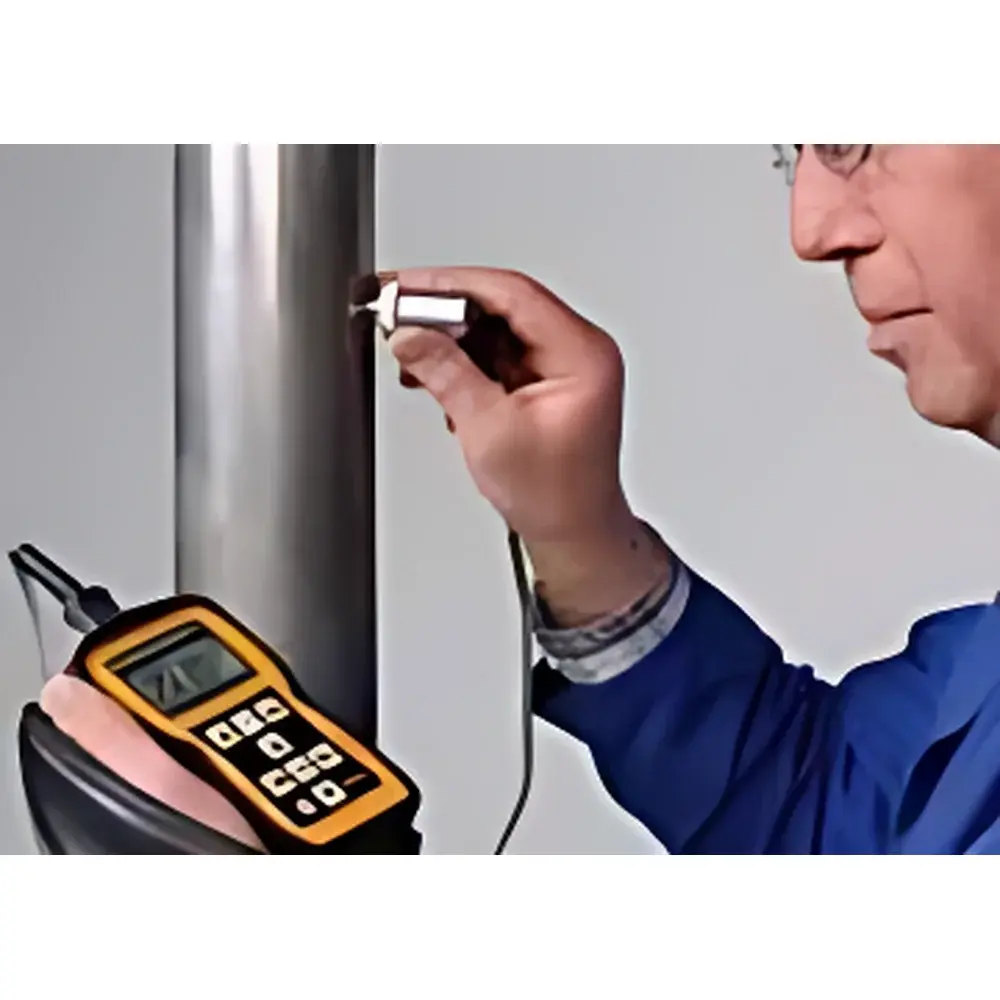
GE DM5E Basic / DM5E / DM5EDL Portable Ultrasonic Thickness Gauge
| Origin | USA |
|---|---|
| Manufacturer Type | Authorized Distributor |
| Origin Category | Imported |
| Model | DM5E Basic / DM5E / DM5EDL |
| Price | Upon Request |
| Measurement Range | 0.6–508 mm (steel), 2.00–127.00 mm in Dual-Multi mode (coating thickness 0.3–2.5 mm) |
| Resolution | 0.01 mm or 0.1 mm selectable |
| Sound Velocity Range | 508–18,699 m/s |
| Update Rate | 4 Hz / 8 Hz |
| Display | 64×128-pixel high-resolution backlit LCD, adjustable contrast |
| Thickness Readout | 5-digit, 10.6 mm height (Normal View) |
| Alarm | Min/Max threshold (0.25–508 mm), visual solid/hollow digit indication |
| Data Storage | 50,000 readings (DM5EDL only) |
| Interface | Mini-USB (DM5EDL only) |
| Power | Two AA batteries, up to 60 hours (no backlight) |
| Operating Temperature | –10°C to +50°C |
| Storage Temperature | –20°C to +60°C |
| Dimensions | 138 × 75 × 32 mm |
| Weight | 223 g |
| Compatible Probes | DA501, DA503, DA512, DA590, DA301, DA303, DA312, FH2E, DM401 |
Overview
The GE DM5E Basic / DM5E / DM5EDL series represents a generation of portable ultrasonic thickness gauges engineered for precision corrosion monitoring in demanding industrial environments. Based on pulse-echo and echo-to-echo ultrasonic measurement principles, these instruments determine material thickness by measuring the time-of-flight of high-frequency sound waves transmitted through a test specimen and reflected from its back wall. The DM5E platform is optimized for applications requiring high repeatability across variable surface conditions—including painted, corroded, or thermally elevated surfaces—common in oil & gas pipelines, petrochemical pressure vessels, power generation boiler tubes, and storage tank integrity assessments. Its robust transducer interface architecture supports multiple measurement modes, including standard single-echo, dual-echo (for coating-compensated thickness), and real-time B-scan visualization—enabling both spot verification and systematic wall-thinning profiling.
Key Features
- Three-tiered model architecture: DM5E Basic (core functionality), DM5E (adds Dual-Multi coating-penetration mode), and DM5EDL (adds integrated data logging with 50,000-point capacity and Mini-USB export)
- Ergonomic, lightweight design (223 g) with IP67-rated sealed membrane keypad—dustproof, water-resistant, and operable with one hand
- Extended battery life: up to 60 hours on two AA cells under typical usage without backlight activation
- Configurable display update rates (4 Hz / 8 Hz / 24 Hz scan mode) and user-selectable resolution (0.01 mm or 0.1 mm)
- Dual-Multi mode enables accurate base-metal thickness measurement through coatings up to 2.5 mm thick—eliminating need for paint removal and reducing inspection downtime
- B-scan imaging capability provides spatial context for localized corrosion, pitting, or laminar anomalies
- Programmable min/max alarms with visual feedback (solid/hollow digit rendering) for rapid pass/fail assessment in field QA/QC workflows
Sample Compatibility & Compliance
The DM5E series is compatible with a broad range of GE-certified contact transducers—including DA501 (standard 5 MHz), DA503 (low-frequency 2 MHz for thick-section steel), DA512 (high-frequency 7.5 MHz for thin-walled tubing), and DA590 (high-temperature probe rated to 204°C continuous, 590°C momentary contact). Probe interchangeability extends compatibility to select legacy DM4-series transducers (e.g., DA301, FH2E), supporting fleet-standardization across maintenance programs. All models comply with IEC 60601-1 (safety) and IEC 61000-6-3 (EMC) standards. While not intrinsically rated for hazardous areas, the instrument’s low-power electronics and non-sparking design support use in Zone 2/Class I Div 2 environments when operated per site-specific safety protocols. Data integrity features—including timestamped readings and configurable auto-shutdown—align with GLP/GMP documentation expectations for asset integrity records.
Software & Data Management
The DM5EDL variant integrates an embedded data logger supporting grid-based file structures—ideal for systematic inspection routes across large assets such as pipe racks or tank shells. Each stored record includes thickness value, date/time stamp, probe ID, sound velocity setting, and user-defined alphanumeric notes entered directly via the onboard keypad. Files export via Mini-USB to Windows-based PCs and can be converted natively into Microsoft Excel (.xlsx) format using preconfigured macro scripts included with the instrument software suite. No proprietary database is required; exported CSV or Excel files are fully interoperable with CMMS platforms (e.g., SAP PM, IBM Maximo) and statistical process control tools. Audit trails are maintained through sequential file naming and internal firmware logging—supporting traceability requirements under ISO 55001 and API RP 570.
Applications
- In-service wall thickness verification of carbon steel and stainless-steel piping in upstream, midstream, and downstream hydrocarbon facilities
- Corrosion under insulation (CUI) screening using high-temperature probes and specialized couplants
- Boiler tube and heat exchanger tube sheet inspections in thermal power plants
- Marine hull and ballast tank structural integrity surveys per ABS, DNV, or LR classification society guidelines
- Manufacturing QA for castings, forgings, and welded assemblies where dimensional compliance to ASTM E797 or ISO 16809 must be verified
- Regulatory compliance audits requiring documented thickness baselines and trend analysis per API 510, API 570, or NBIC Part 3
FAQ
What is the difference between pulse-echo and echo-to-echo measurement modes?
Pulse-echo measures from front surface to back wall; echo-to-echo (Dual-Multi) excludes the coating layer by calculating time between first back-wall echo and second back-wall echo, enabling net-metal thickness determination without coating removal.
Can the DM5E measure through rubber linings or plastic coatings?
Yes—within specified thickness limits (0.3–2.5 mm) and acoustic impedance constraints. Performance depends on coupling quality and coating homogeneity; validation against calibration standards is recommended for critical applications.
Is firmware upgrade supported in the field?
Yes—firmware updates are distributed via GE Sensing’s official support portal and applied using the Mini-USB interface and included PC utility software.
Does the instrument meet FDA 21 CFR Part 11 requirements for electronic records?
While the DM5EDL provides audit-ready data export and timestamping, full Part 11 compliance requires supplementary procedural controls (e.g., user access management, electronic signatures), implemented at the enterprise level rather than within the device firmware.
What calibration standards are recommended for daily verification?
NIST-traceable step wedges (e.g., ASTM E797 reference blocks) or certified thickness standards matching the sound velocity of the test material should be used prior to each inspection shift or after probe change.



