
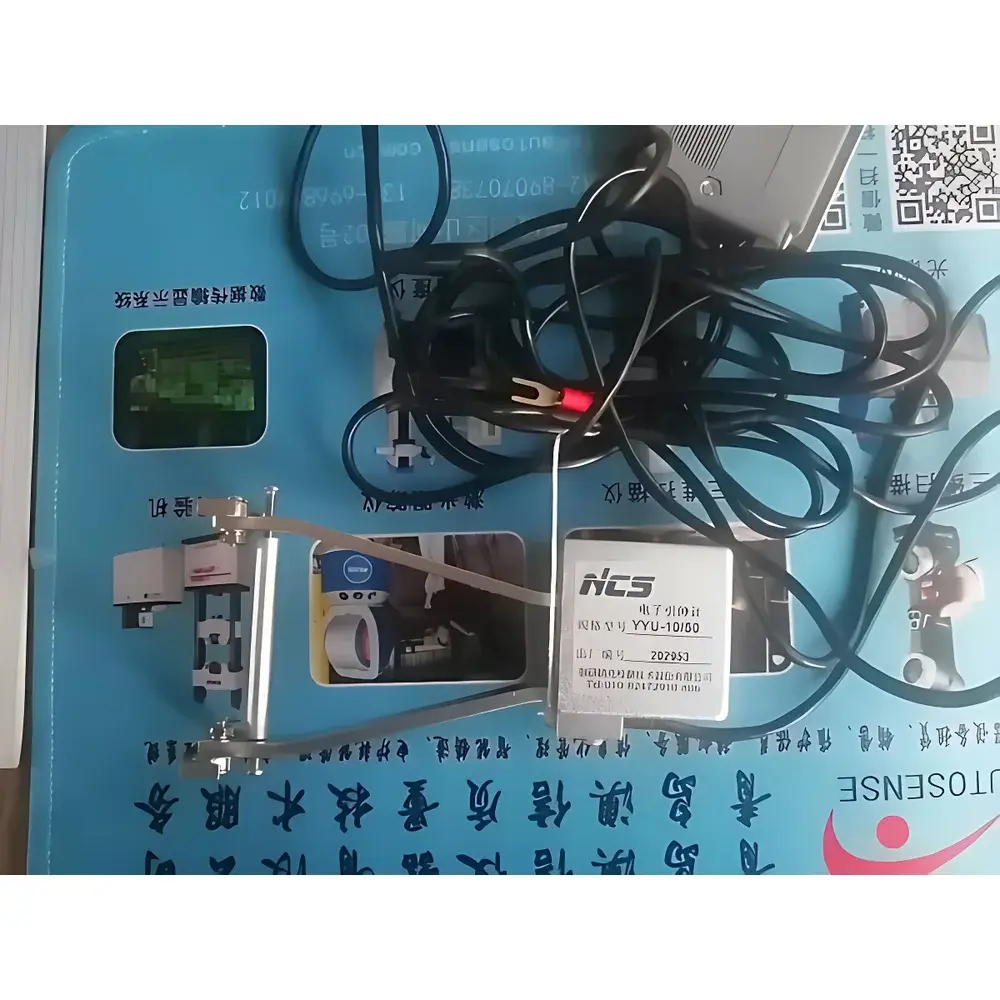
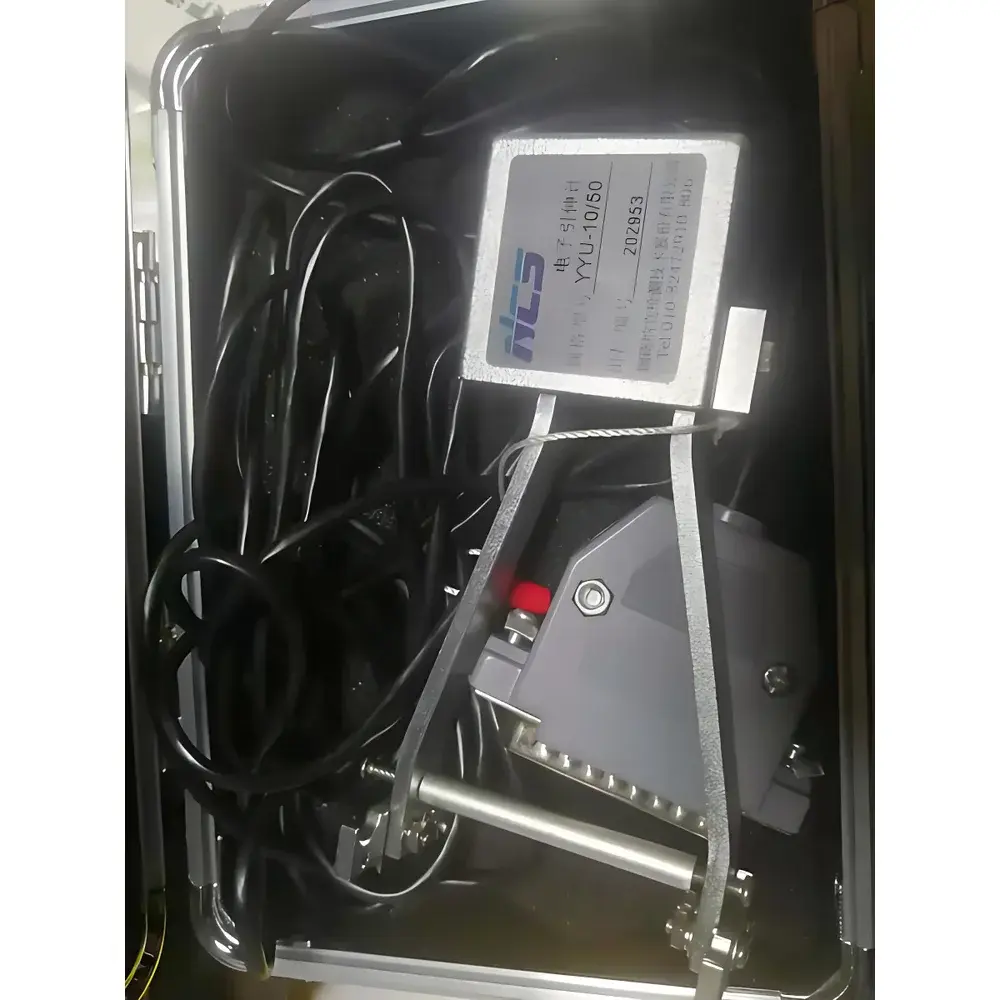
YYU-10/50 Electronic Extensometer
| Origin | Beijing, China |
|---|---|
| Manufacturer Type | Authorized Distributor |
| Model | YYU-10/50 |
| Price Range | USD 1,400 – 2,800 (FOB China) |
| Gauge Length Range | 10 mm nominal (adjustable via mechanical clamping) |
| Deformation Measurement Range | ±5.0 mm full scale |
| Indication Error | ±0.5% of reading (typical, per ISO 9513 Class 1) |
| Linearity | ≤0.2% of full scale |
Overview
The YYU-10/50 Electronic Extensometer is a precision contact-type strain measurement device engineered for integration with universal testing machines (UTMs) in materials science laboratories and industrial quality control environments. It operates on the principle of high-resolution linear variable differential transformer (LVDT) or strain-gauge-based displacement transduction, converting mechanical elongation or contraction of a test specimen into calibrated analog or digital output signals. Designed specifically for tensile, compression, and cyclic loading tests per ASTM E8/E8M, ISO 6892-1, and GB/T 228.1 standards, this extensometer delivers traceable, repeatable strain data essential for determining Young’s modulus, yield strength, uniform elongation (Ag), and total elongation at break (At). Its compact, low-mass design minimizes inertial interference during dynamic testing, while the rigid aluminum alloy frame ensures long-term dimensional stability under repeated thermal and mechanical stress.
Key Features
- Adjustable gauge length: Nominal 10 mm setting, mechanically configurable across 5–15 mm range via precision micrometer-driven blade positioning—enabling compliance with diverse standard specimen geometries (e.g., ISO 6892-1 Type 2, ASTM E8 sub-size coupons).
- Full-scale deformation range of ±5.0 mm supports both low-strain elastic characterization and moderate plastic deformation analysis without sensor saturation or repositioning.
- Class 1 performance per ISO 9513: Indication error ≤±0.5% of reading and linearity deviation ≤0.2% FS, verified through accredited calibration protocols using NIST-traceable laser interferometry.
- Low-profile, symmetrical dual-blade clamping mechanism with tungsten-carbide tips ensures uniform gripping pressure and eliminates slippage—even on polished or coated metal surfaces (e.g., Al 6061-T6, Ti-6Al-4V, cold-rolled steel).
- Integrated 0–10 V analog output (±5 V differential option available) and RS-485 digital interface support seamless synchronization with major UTM controllers (Instron, MTS, Shimadzu, Sunstest) and third-party DAQ systems.
- Robust architecture: IP54-rated enclosure, operating temperature range −10 °C to +50 °C, and shock resistance up to 50 g (IEC 60068-2-27) ensure reliability in factory-floor and multi-shift laboratory deployments.
Sample Compatibility & Compliance
The YYU-10/50 is validated for use with metallic specimens (sheet, rod, wire), polymer bars, and composite laminates meeting minimum thickness requirements ≥0.5 mm and surface roughness Ra ≤3.2 µm. It complies with metrological requirements outlined in ISO 9513 (Metallic materials — Calibration of extensometers used in uniaxial testing) and supports audit-ready documentation per GLP and GMP frameworks. When paired with compliant UTM software, it enables full traceability—including operator ID, calibration certificate number, environmental conditions (temperature/humidity logs), and real-time uncertainty budgeting per GUM (JCGM 100:2008). Data integrity meets FDA 21 CFR Part 11 expectations when deployed with electronic signature-enabled acquisition platforms.
Software & Data Management
Raw displacement signals are processed in real time via embedded firmware with 16-bit ADC resolution and 1 kHz sampling rate (configurable up to 5 kHz). The extensometer interfaces natively with Bluehill 3/4 (Instron), TestXpert II (Zwick), and MTest (MTS) software suites, enabling automatic calculation of engineering strain (ε = ΔL/L₀), true strain, and strain rate derivatives. All raw channel data—including timestamped analog voltage, temperature-compensated offset drift correction, and status flags (e.g., “blades engaged”, “overrange warning”)—are exported in CSV or HDF5 format. Audit trails record every calibration event, firmware update, and user-initiated zero-balance action, supporting ISO/IEC 17025 accreditation workflows.
Applications
- Tensile property mapping of aerospace-grade alloys during qualification per AMS 2300 and EN 4500-1.
- Quality assurance of medical device components (e.g., nitinol stents, orthopedic implant rods) per ISO 14801 and ASTM F2516.
- Constitutive modeling of thermoplastic polymers (PP, PC, PEEK) under quasi-static and ramp-hold loading.
- Educational mechanics labs requiring ISO 9513-compliant instrumentation for undergraduate materials testing curricula.
- Failure analysis investigations where localized necking behavior and post-yield strain localization must be resolved independently of machine crosshead displacement.
FAQ
What gauge lengths can the YYU-10/50 accommodate?
It is optimized for a nominal 10 mm gauge length but supports mechanical adjustment between 5 mm and 15 mm using the integrated micrometer scale—sufficient for ISO and ASTM standard specimen types.
Does it require external power or signal conditioning?
No. It operates from a standard ±15 V DC supply provided by the host UTM controller or optional external power module; built-in signal conditioning eliminates need for external amplifiers.
Is calibration certification included with purchase?
Yes—a factory calibration report traceable to CNAS-accredited metrology labs (certificate number and uncertainty values provided) is shipped with each unit.
Can it be used on non-metallic specimens such as rubber or foam?
With appropriate blade inserts (optional soft-tip kits), it is suitable for low-modulus elastomers and cellular foams—though strain rates should remain below 0.01 s⁻¹ to avoid viscoelastic relaxation artifacts.
How is blade alignment verified prior to testing?
An optical alignment jig (included) allows visual verification of parallelism within ±0.02° using integrated vernier scales and reference targets etched onto the base plate.
Related Products



