
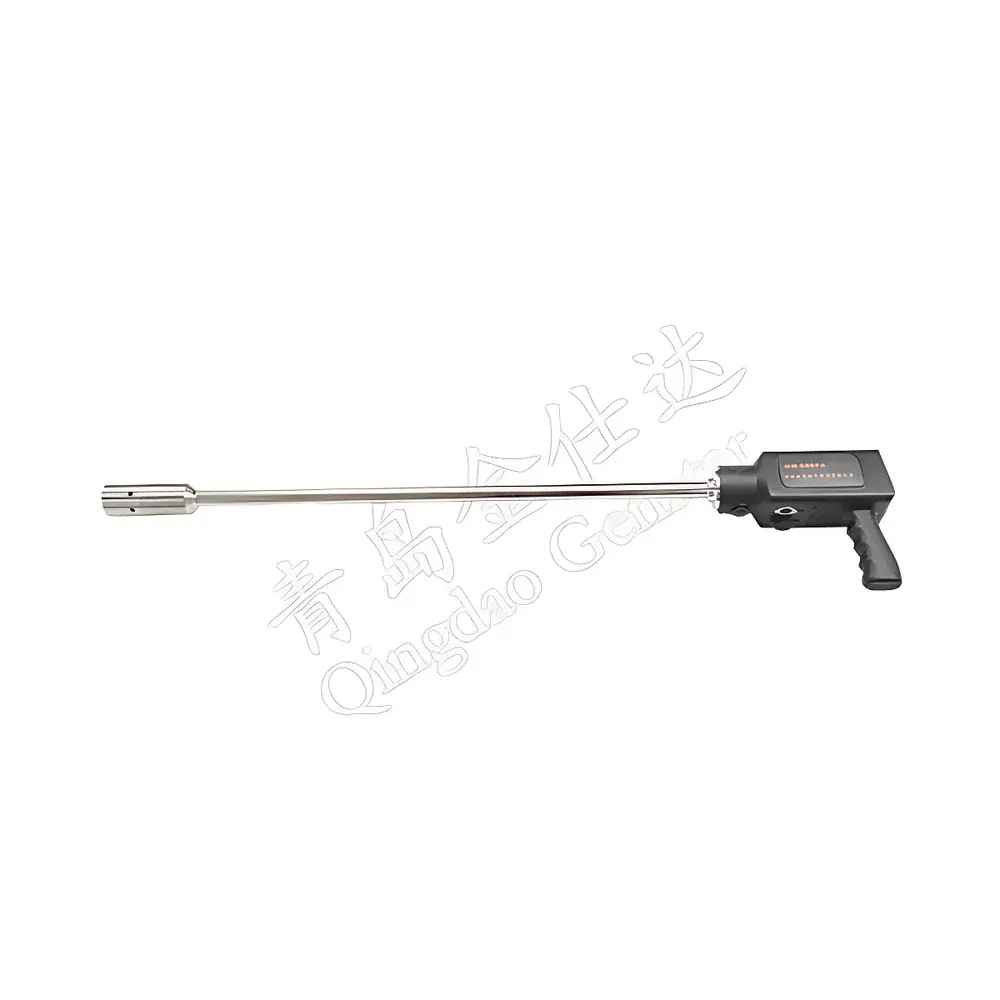
Genetec GH-6062A Capacitive Moisture-in-Flue-Gas Analyzer
| Brand | Genetec |
|---|---|
| Model | GH-6062A |
| Measurement Principle | Resistive-Capacitive (RC) Hygrometry |
| Application | In-situ moisture measurement in fixed-source flue gas ducts |
| Response Time | <30 s |
| Compliance | GB/T 11605-2005, GB/T 16157-1996, HJ 836-2017 |
| Temperature & Pressure Compensation | Integrated |
| Display | OLED LCD |
| Data Storage | 1000 measurement records |
| Filtration | Dual-layer particulate filter |
| Sensor Protection | Integrated anti-condensation heating element |
| Design | Portable, integrated probe-and-electronics architecture |
| Origin | Shandong, China |
| Manufacturer Type | OEM/ODM manufacturer |
Overview
The Genetec GH-6062A Capacitive Moisture-in-Flue-Gas Analyzer is an industrial-grade in-situ instrument engineered for direct, real-time measurement of moisture content (water vapor concentration) in flue gas streams from stationary emission sources. It operates on the resistive-capacitive (RC) hygrometry principle: a high-stability polymer-based capacitive sensor undergoes dielectric constant changes proportional to ambient water vapor partial pressure. Unlike optical or chilled-mirror methods, RC sensing provides robust performance under high-dust, variable-temperature, and mildly corrosive conditions typical of boiler stacks, kiln exhausts, and industrial process ducts. The analyzer incorporates embedded temperature and static pressure transducers to apply dynamic compensation per thermodynamic vapor pressure models—ensuring traceable accuracy across operating ranges without manual recalibration. Its design conforms to Chinese national standards for emissions monitoring infrastructure, including GB/T 11605-2005 (humidity metrology), GB/T 16157-1996 (stack sampling methodology), and HJ 836-2017 (low-concentration particulate mass determination), supporting regulatory compliance in environmental monitoring programs.
Key Features
- Industrial-grade imported capacitive humidity sensor with corrosion-resistant electrode coating and long-term baseline stability under continuous exposure to flue gas condensates and acidic vapors
- Real-time dual-parameter compensation: simultaneous on-board temperature and static pressure measurement enables dynamic dew point and relative humidity correction using the Magnus–Tetens equation framework
- Dual-stage particulate filtration system: sintered stainless-steel pre-filter + hydrophobic membrane layer minimizes sensor fouling while maintaining gas permeability
- Integrated anti-condensation heating circuit: maintains sensor surface temperature 5–10 °C above local dew point to prevent liquid water deposition during low-temperature operation
- Compact monolithic construction: probe, signal conditioning electronics, and user interface are co-housed—eliminating external cabling, signal degradation, and installation complexity
- OLED graphical display with intuitive menu navigation: boot-to-measurement workflow requires zero configuration; units selectable between %RH, g/m³, and mg/m³ (dry basis)
Sample Compatibility & Compliance
The GH-6062A is validated for use in non-explosive, non-radioactive flue gas environments with temperatures up to 180 °C and particulate loadings ≤10 g/m³ (standard configuration). It is not rated for chlorine-rich or HF-containing streams without optional ceramic-coated sensor variants. As a Class II environmental monitoring device per China’s Ministry of Ecology and Environment (MEE) technical guidelines, it satisfies data integrity requirements for CEMS (Continuous Emission Monitoring Systems) auxiliary parameter modules. While not intrinsically safe, its low-power design (≤24 V DC) permits deployment in Zone 2 classified areas when installed with appropriate conduit sealing. Documentation includes full traceability to national metrological verification procedures per JJG 885-2018 (hygrometer calibration).
Software & Data Management
Data acquisition occurs autonomously at user-defined intervals (1–600 s); each record stores timestamp, temperature, pressure, raw capacitance value, compensated moisture reading, and status flags (e.g., heater active, filter saturation warning). Internal flash memory retains up to 1000 entries with cyclic overwrite protection. USB-C interface supports firmware updates and bulk export in CSV format compatible with LIMS platforms. Optional Bluetooth 5.0 module enables wireless telemetry to field tablets running Genetec’s certified FlueData Logger v3.x—supporting audit trails, electronic signatures, and 21 CFR Part 11–compliant metadata logging (user ID, GPS coordinates, calibration history). All stored data include ISO/IEC 17025–aligned uncertainty estimates derived from sensor drift characterization over 12-month validation cycles.
Applications
- Regulatory stack testing for thermal power plants, cement clinker kilns, and municipal waste incinerators per HJ/T 397 and EU BREF reference documents
- Process optimization of desulfurization (FGD) and selective catalytic reduction (SCR) systems where moisture affects reagent stoichiometry and catalyst lifetime
- Validation of dilution-type CEMS by cross-checking with gravimetric moisture references during QA/QC audits
- Field verification of dry-basis pollutant concentration conversions required by GB 13223 and EPA Method 4
- Commissioning support for new combustion equipment, ensuring flue gas dew point remains below duct material tolerance limits
FAQ
Does the GH-6062A require periodic calibration with NIST-traceable standards?
Yes—annual field calibration using saturated salt solutions (LiCl, MgCl₂, NaCl) or certified humidity generators is recommended per GB/T 11605-2005 Annex B. Factory calibration certificate includes as-found/as-left data.
Can the instrument operate continuously inside a hot flue duct?
It is rated for continuous in-stack operation up to 180 °C with optional high-temp probe housing; standard version requires external cooling sleeve above 120 °C.
Is raw sensor output accessible for custom algorithm integration?
Yes—Modbus RTU protocol over RS-485 exposes uncorrected capacitance (pF), temperature (°C), and pressure (kPa) values for third-party SCADA integration.
What maintenance intervals are specified for the dual-layer filter?
Filter replacement is advised every 3 months in high-dust applications (≥2 g/m³); visual inspection port allows in-situ assessment without disassembly.
Does the device meet GLP or GMP documentation requirements for pharmaceutical manufacturing exhaust monitoring?
While not certified for Grade A cleanroom use, its audit trail functionality, electronic signature support, and calibration traceability align with Annex 11 and WHO TRS 937 data integrity expectations for non-sterile process exhaust verification.







