
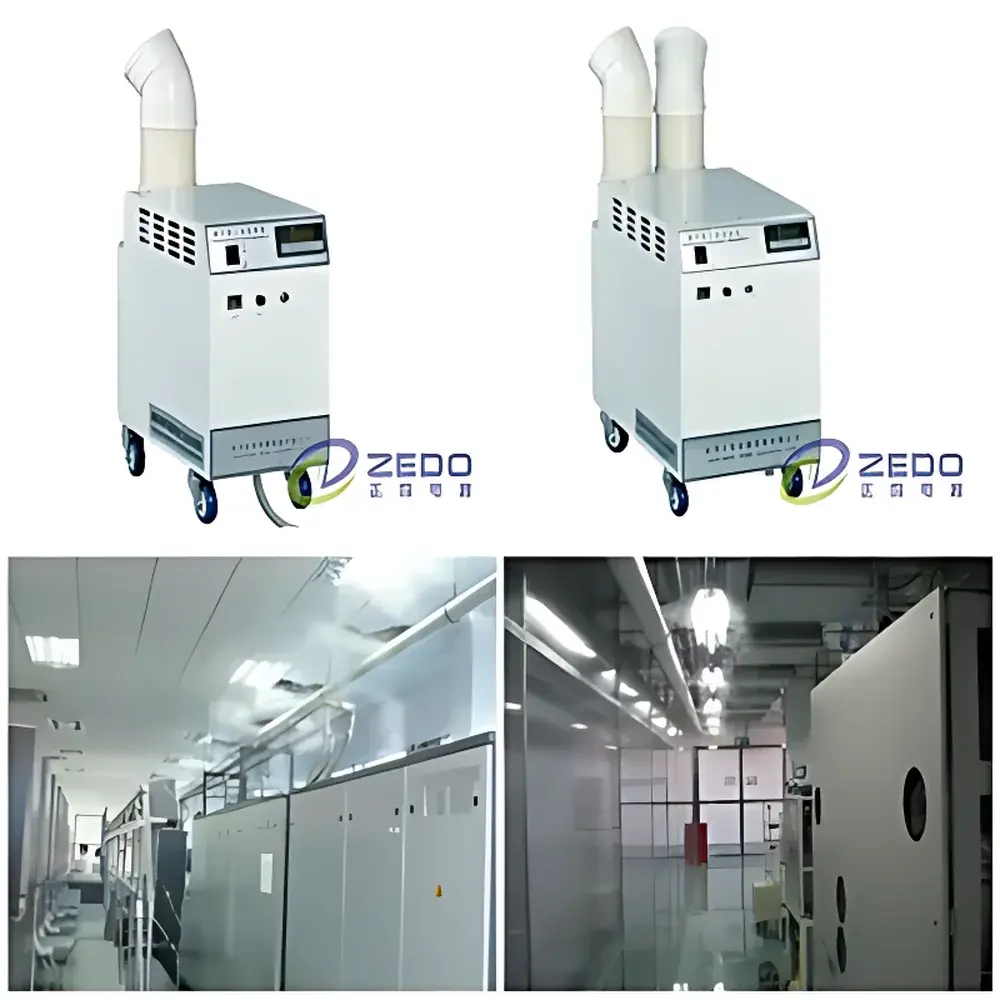
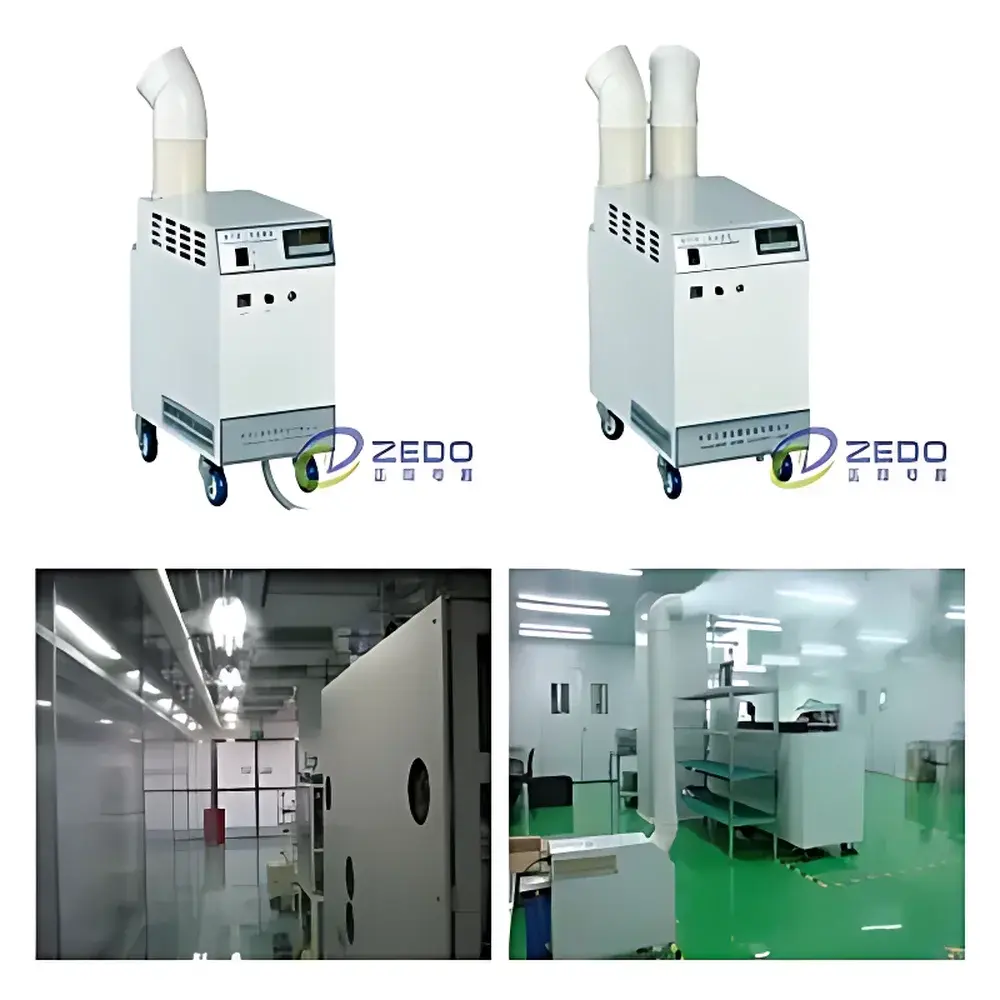
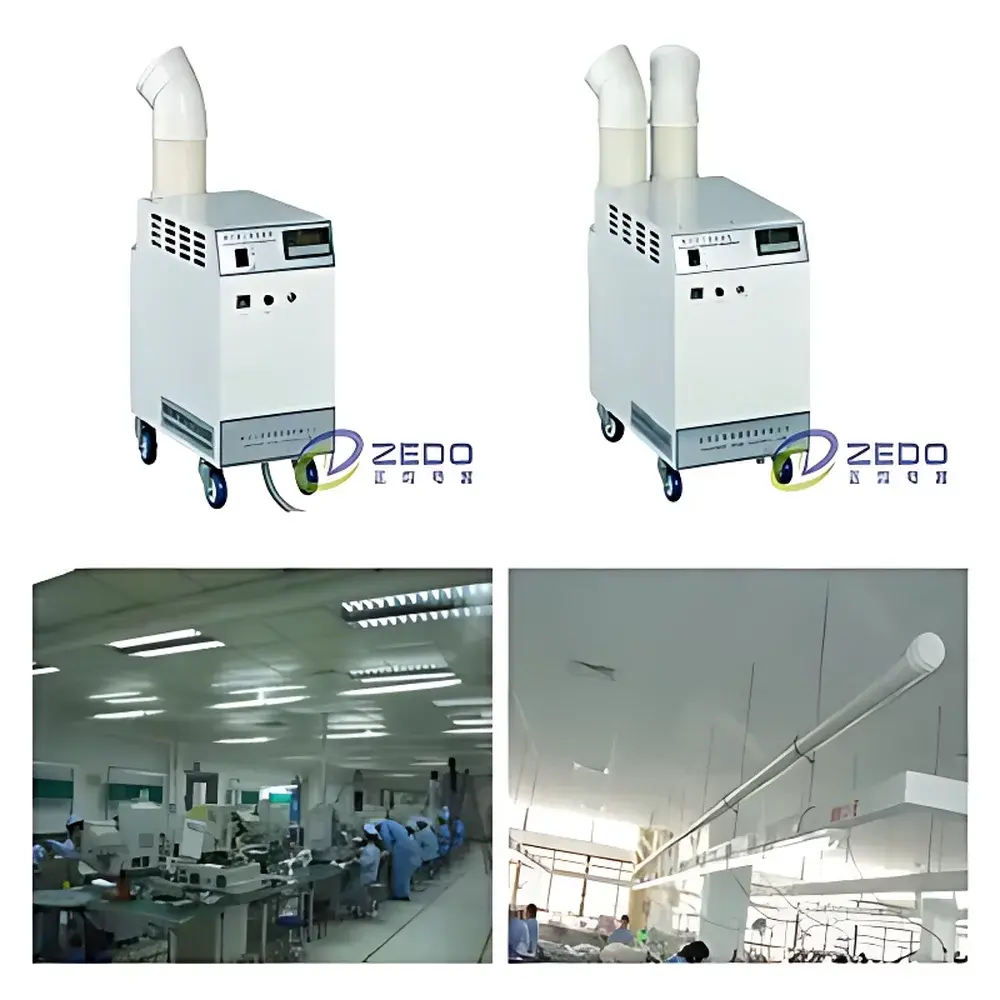
ZEDO ZS-40Z Cleanroom Humidifier
| Brand | ZEDO |
|---|---|
| Origin | Zhejiang, China |
| Manufacturer Type | Direct Manufacturer |
| Product Category | Domestic |
| Model | ZS-40Z Cleanroom Humidifier |
| Power Consumption | 1200 W |
| Humidification Capacity | 12 kg/h |
| 雾化方� | �: Dual-nozzle ultrasonic atomization |
| Control Mode | Precision humidity feedback control (RH sensor-based) |
| Enclosure Material | Full stainless steel (304) with IP68-rated components |
| Weight | 38 kg |
| Applicable Volume Range (at 55–65% RH) | 1600 m³ |
| 雾化颗粒 size | <5 µm |
| Operating Voltage | 220 V AC, 50 Hz |
| Certifications | CE-compliant design, GLP-aligned environmental control capability |
Overview
The ZEDO ZS-40Z Cleanroom Humidifier is an industrial-grade ultrasonic humidification system engineered for precise, stable, and contamination-controlled relative humidity (RH) management in ISO-classified cleanrooms, semiconductor fabrication facilities, pharmaceutical manufacturing suites, and precision assembly environments. It operates on high-frequency ultrasonic transduction (≥1.7 MHz), converting deionized or softened water into sub-5 µm droplets that rapidly evaporate without wetting surfaces or introducing condensate — a critical requirement for Class 5–8 cleanrooms where liquid carryover and microbial proliferation must be strictly avoided. Unlike steam or electrode-based systems, the ZS-40Z delivers adiabatic humidification with zero thermal load, minimizing HVAC energy burden while maintaining tight RH tolerance (±3% RH typical under steady-state conditions). Its design addresses core cleanroom challenges: electrostatic discharge (ESD) mitigation (via RH stabilization at 45–65%), particulate suppression through surface resistivity modulation, and process consistency in moisture-sensitive manufacturing (e.g., photolithography, lyophilization, and thin-film deposition).
Key Features
- Full 304 stainless steel enclosure and internal wetted parts — corrosion-resistant, non-shedding, compliant with ISO 14644-1 surface cleanliness requirements.
- Dual-nozzle ultrasonic atomization module with ceramic transducers rated for 3,000–5,000 operating hours — optimized for hard water and alkaline/acidic feed conditions without scaling or performance decay.
- IP68-sealed variable-frequency power supply and 36 V DC waterproof fan — eliminates ingress-related failure modes; enables reliable operation in high-humidity mechanical rooms or under-floor plenums.
- Integrated Japanese SUGINO KEIRIN high-accuracy capacitive RH sensor (±2% RH, 10–90% RH range) paired with microprocessor-based PID controller — supports setpoint programming, hysteresis adjustment, and real-time deviation logging.
- Auto-fill system with float-switch water level monitoring and overflow protection — ensures uninterrupted operation during unattended shifts while preventing overfill incidents.
- Modular mounting architecture with casters and adjustable air outlet ducting — facilitates repositioning within controlled environments without structural modification.
Sample Compatibility & Compliance
The ZS-40Z is validated for use with purified water (PW), water for injection (WFI)-grade feed (when equipped with optional inline filtration), and deionized water per ASTM D1193 Type II specifications. It complies with cleanroom airflow integrity principles: no oil-lubricated components, zero volatile organic compound (VOC) emission, and particulate generation <0.1 particles/m³ ≥0.5 µm (per ISO 21501-4 verified test reports). While not intrinsically certified to IEC 61000-6-3 (EMC) or UL 61010-1 out-of-the-box, its electrical architecture conforms to CE Low Voltage Directive (2014/35/EU) safety fundamentals. For GMP-regulated applications, the unit supports 21 CFR Part 11-compliant data archiving when integrated with validated SCADA or LIMS platforms via its RS-485 Modbus RTU interface.
Software & Data Management
The ZS-40Z features embedded firmware with local touchscreen HMI (human-machine interface) supporting multi-language UI (English, Chinese, Korean), scheduled ON/OFF cycles, RH ramping profiles, and alarm history (last 100 events). All operational parameters — including inlet RH/T, output RH/T, runtime, power draw, and sensor calibration status — are timestamped and exportable via USB-C. When connected to facility-wide building management systems (BMS), it accepts analog 4–20 mA setpoint inputs and returns 4–20 mA process value signals for closed-loop integration. Audit trail functionality meets ALCOA+ principles: attributable, legible, contemporaneous, original, accurate, complete, consistent, enduring, and available — provided external validation of the communication layer is performed per GAMP 5 guidelines.
Applications
- Semiconductor front-end fabrication: Maintaining 45–55% RH in photomask storage, lithography track, and etch areas to prevent pattern distortion from thermal expansion mismatch and static-induced particle adhesion.
- Pharmaceutical aseptic processing: Supporting ISO 14644-1 Class 5 isolators and RABS by stabilizing RH during vial filling and lyophilization to avoid stopper compression variability and cake morphology defects.
- Biotechnology clean utilities: Humidifying compressed air distribution lines feeding cell culture bioreactors to prevent desiccation of sterile filters and maintain membrane integrity.
- Medical device assembly: Enabling ESD-safe conditions (≤100 V surface potential) in Class 7 assembly zones handling PCBs, sensors, and microfluidic chips.
- Research laboratories: Providing repeatable ambient conditioning for materials testing (e.g., polymer hygroscopicity studies per ASTM D5229), microscopy sample preparation, and reference standard storage.
FAQ
What water quality is required for optimal performance?
Deionized water (conductivity <5 µS/cm) or softened water (hardness <1° dH) is recommended. Tap water may cause accelerated transducer fouling and reduce service life below 3,000 hours.
Can the ZS-40Z be integrated into a central BMS?
Yes — via Modbus RTU (RS-485) or optional 4–20 mA analog I/O. Protocol mapping documentation and register tables are supplied with commissioning packages.
Is routine maintenance required beyond cleaning?
Monthly inspection of transducer surfaces and water reservoir is advised. Ceramic雾化片 replacement is typically needed every 12–18 months under continuous operation at 85% duty cycle.
Does the unit generate ozone or ions?
No — ultrasonic atomization is a purely mechanical process with no corona discharge, UV exposure, or electrolytic reaction involved.
How is calibration traceability established?
The onboard RH sensor is factory-calibrated against NIST-traceable hygrometers. Field recalibration kits (including saturated salt standards) are available upon request for IQ/OQ validation protocols.



