
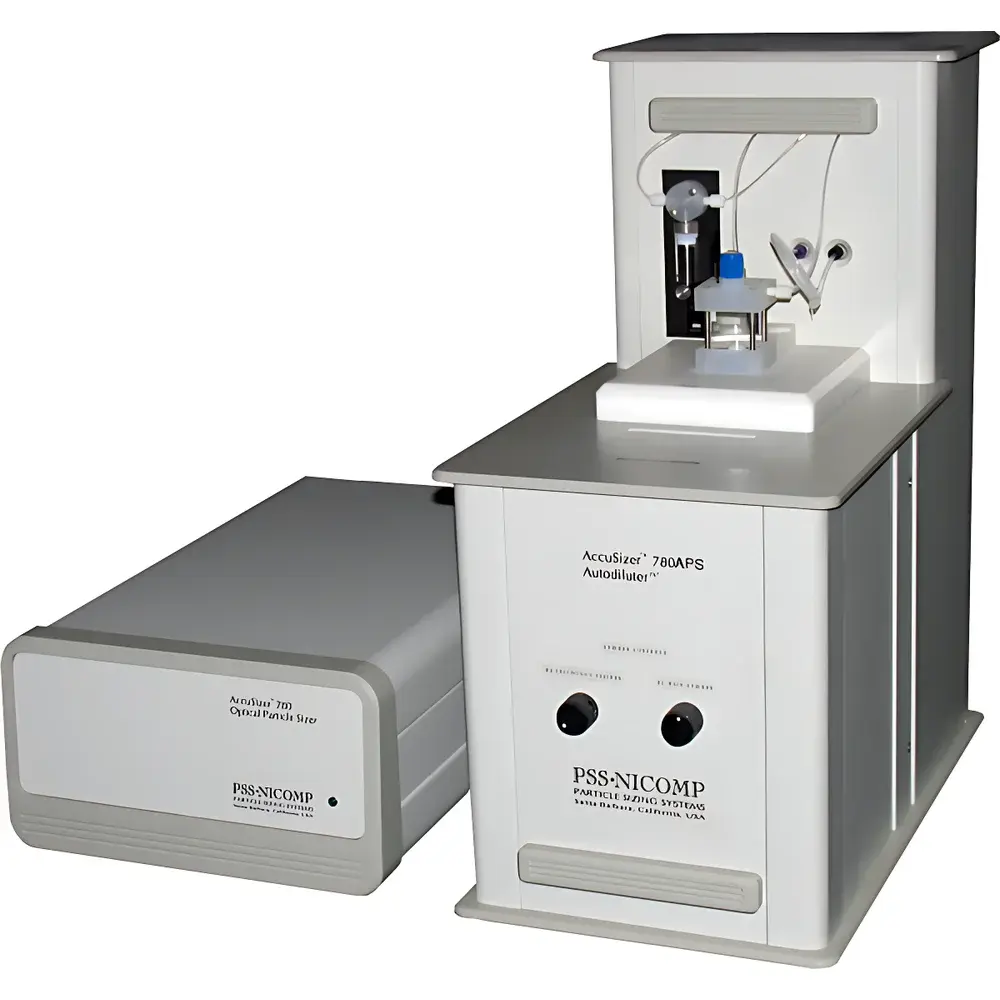
Particle Sizing Systems AccuSizer 780 APS Automated Single Particle Optical Sizing (SPOS) Analyzer
| Brand | Particle Sizing Systems |
|---|---|
| Origin | USA |
| Model | AccuSizer 780 APS |
| Instrument Type | Optical Particle Counter (SPOS-based) |
| Detection Principle | Single Particle Optical Sensing (Light Extinction) |
| Particle Size Range | 0.5–400 µm (with optional modules down to 0.15 µm and up to 1,000 µm) |
| Sensitivity | ≥10 particles/mL (for ≥2 µm particles) |
| Counting Accuracy | ±10% |
| Sizing Accuracy | ±2% (NIST-traceable standards) |
| Sample Throughput | Fully automated — auto-sampling, auto-dilution, auto-flushing, auto-calibration |
Overview
The Particle Sizing Systems AccuSizer 780 APS is a fully automated, high-resolution optical particle counter engineered for quantitative single-particle analysis in liquid suspensions. Unlike ensemble-averaging techniques such as laser diffraction or dynamic light scattering (DLS), the AccuSizer 780 APS employs Single Particle Optical Sizing (SPOS) — a direct-counting methodology based on light extinction — to detect, size, and enumerate individual particles across a broad dynamic range (0.5–400 µm, extendable via modular configurations). This principle enables statistically robust population statistics, precise tail-end distribution characterization, and unambiguous detection of low-abundance outliers — critical parameters in pharmaceutical injectables, biologics formulation, semiconductor slurries, and advanced battery electrolytes. The system’s architecture integrates precision fluidics, calibrated optical detection, and closed-loop feedback control to ensure repeatability under GLP/GMP-compliant workflows.
Key Features
- Fully automated operation: integrated autosampler, programmable dilution module, self-cleaning flow path, and real-time calibration verification
- SPOS detection with NIST-traceable sizing accuracy (±2%) and counting precision (±10%) at concentrations as low as 10 particles/mL for ≥2 µm events
- High-resolution particle distribution profiling — resolves multimodal populations and quantifies sub-1% outlier fractions invisible to ensemble methods
- Modular sensor options: standard 0.5–400 µm aperture; optional 0.15–10 µm (high-sensitivity microchannel) and 10–1000 µm (macro-particle) configurations
- Robust hardware design compliant with ISO 21501-4 for light extinction particle counters and aligned with ASTM F2149 and USP requirements for particulate matter testing
- Embedded diagnostics and audit trail logging supporting FDA 21 CFR Part 11 compliance when deployed with validated software packages
Sample Compatibility & Compliance
The AccuSizer 780 APS accommodates aqueous and organic dispersions, including protein therapeutics, liposomal formulations, polymer emulsions, ceramic slurries, and nanoparticle drug carriers. Its non-destructive, low-shear sampling pathway preserves fragile aggregates and avoids sonication-induced artifacts common in DLS or centrifugal sedimentation. The instrument meets key regulatory benchmarks: it satisfies USP and for visible and subvisible particle enumeration in parenterals; supports ISO 13322-2 validation protocols for image-based and direct-counting particle analyzers; and provides documented traceability for IQ/OQ/PQ qualification in regulated manufacturing environments. Optional accessories include sterile-filtered sample loops, low-volume cuvettes (250 µL), and temperature-controlled flow cells (4–40 °C).
Software & Data Management
AccuSizer Software v8.x delivers intuitive method development, real-time histogram visualization, and customizable reporting templates aligned with internal SOPs and external submission standards (e.g., CMC sections of IND/BLA filings). Raw event data (time-stamped particle diameter, pulse height, transit time) is stored in open-format .csv and proprietary .aps binary files, enabling third-party statistical analysis (e.g., Weibull fitting, kernel density estimation). Audit trails record all user actions, parameter changes, and calibration events with electronic signatures. When configured with networked deployment and role-based access control, the software satisfies 21 CFR Part 11 requirements for electronic records and signatures in FDA-regulated laboratories.
Applications
- Pharmaceutical quality control: subvisible particle quantification per USP , aggregation kinetics monitoring in mAb formulations, and stability-indicating assay development
- Biotechnology R&D: exosome sizing and concentration profiling, viral vector titer validation, and PEGylated nanoparticle batch consistency assessment
- Materials science: catalyst dispersion uniformity, CMP slurry particle integrity, and lithium-ion cathode precursor slurry contamination screening
- Consumer products: sunscreen nanoparticle release profiling, inkjet pigment stability, and cosmetic emulsion phase separation detection
- Academic research: fundamental colloid stability studies, nucleation/growth modeling, and interfacial adsorption kinetics validation
FAQ
How does SPOS differ from laser diffraction or DLS in particle sizing?
SPOS counts and sizes each particle individually via light extinction, delivering absolute number-based distributions and detecting rare outliers. Laser diffraction yields volume-weighted averages insensitive to tails; DLS reports intensity-weighted hydrodynamic diameters with poor resolution for polydisperse systems.
Can the AccuSizer 780 APS analyze undiluted samples?
No — it requires dilution to maintain coincidence error below 5%. The integrated auto-dilutor ensures reproducible, operator-independent preparation per ISO 21501-4 guidelines.
Is the system suitable for GMP manufacturing environments?
Yes — with validated software, calibrated sensors, full audit trail, and IQ/OQ documentation packages, it supports routine use in QC release testing and process monitoring.
What sample volume is required per analysis?
Standard analysis uses 1–5 mL total volume; low-volume kits support analysis from 250 µL with minimal carryover.
Does the AccuSizer 780 APS support regulatory submissions?
Yes — raw data export, metadata-rich reports, and full electronic record integrity enable direct inclusion in regulatory dossiers under ICH M4 and FDA eCTD frameworks.
Related Products



