
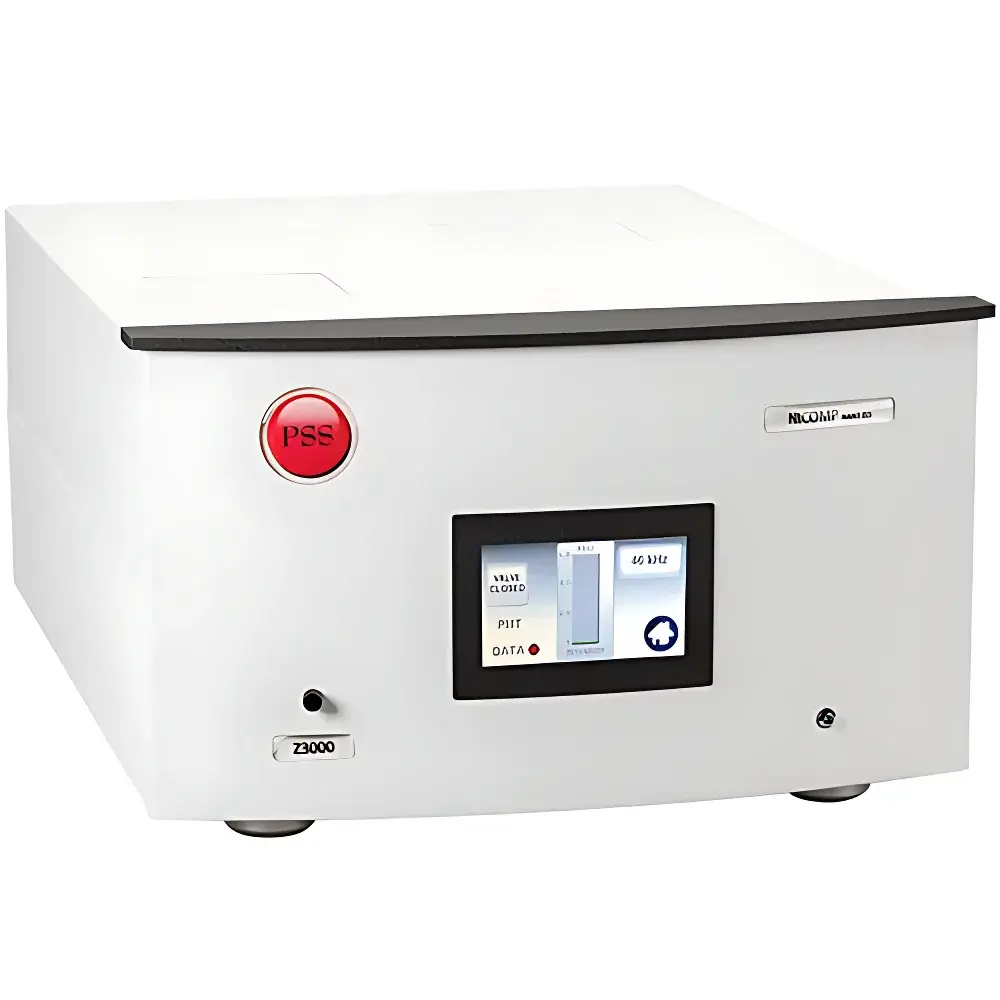
PSS Nicomp Z3000 Standard Zeta Potential Analyzer with Integrated DLS Capability
| Brand | Particle Sizing Systems (PSS), USA |
|---|---|
| Origin | USA |
| Model | Nicomp Z3000 Standard |
| Zeta Potential Range | ±500 mV |
| pH Range | 1–14 |
| Temperature Range | 0–90 °C |
| pH Resolution | 0.1 |
| Temperature Resolution | 0.1 °C |
| Accuracy | ≥99% |
| Repeatability | ≥99% |
Overview
The PSS Nicomp Z3000 Standard Zeta Potential Analyzer is a dual-mode, laboratory-grade electrophoretic light scattering (ELS) instrument engineered for high-fidelity surface charge characterization of colloidal and nanoscale dispersions. Unlike conventional single-technique analyzers, the Z3000 Standard integrates electrophoretic mobility measurement—based on laser Doppler velocimetry (LDV)—with dynamic light scattering (DLS) in a shared optical platform. This co-located architecture enables simultaneous or sequential acquisition of zeta potential and hydrodynamic size distribution from the same sample aliquot under identical thermal and electrochemical conditions. The system operates on the principle that charged particles undergo electrophoretic motion under an applied electric field; their velocity is measured via frequency shift of scattered laser light (Doppler effect), then converted to zeta potential using the Henry equation and Smoluchowski approximation (valid for aqueous systems with κa ≫ 1). Its design targets rigorous QC/QA workflows in pharmaceutical development, nanomaterial synthesis, and formulation science where surface charge stability directly correlates with colloidal integrity, shelf life, and biological interaction profiles.
Key Features
- Electrophoretic Light Scattering (ELS) core with precision AC field modulation to suppress electrode polarization and minimize Joule heating—critical for sensitive biological samples and low-conductivity organic media.
- Dual-mode operation: seamless switching between zeta potential mode and DLS mode without hardware reconfiguration; both share the same APD-LDC detector and temperature-controlled cuvette holder.
- High-sensitivity avalanche photodiode detector (APD-LDC) delivering 7–10× signal gain over standard PMTs—enabling reliable measurements down to 0.1 mg/mL protein concentrations and sub-10 nm particles in low-scattering matrices.
- Programmable temperature control (0–90 °C, ±0.1 °C stability) with condensation-free chamber design—ensuring reproducible electrokinetic data across wide pH and ionic strength gradients.
- Multi-angle DLS capability (10°–175°, 0.7° step resolution) optional via add-on module—enhancing sizing accuracy for polydisperse systems >100 nm and mitigating angular bias in high-refractive-index dispersions.
- Modular architecture supporting future integration of auto-dilution, auto-titration (with Metrohm-compatible pH titrators), and robotic autosamplers—facilitating GLP-compliant unattended batch analysis.
Sample Compatibility & Compliance
The Nicomp Z3000 Standard accommodates aqueous and non-aqueous dispersions—including proteins, liposomes, polymeric nanoparticles, surfactant micelles, metal oxides, and ceramic colloids—within pH 1–14 and conductivity up to 200 mS/cm. Sample volume requirements are flexible: 4 mL standard quartz cells (1 × 4 cm path) for routine analysis, or 1 mL micro-cells with 10 µL minimum injection volume for precious or highly concentrated formulations. All fluidic pathways are chemically inert (PEEK, fused silica, borosilicate glass), minimizing adsorption artifacts. The system complies with ISO 13099 (colloidal characterization), ASTM D7853 (zeta potential of nanomaterials), and USP (light scattering particle size). Software validation packages support 21 CFR Part 11 compliance, including electronic signatures, audit trails, role-based access control, and data integrity safeguards required for FDA-submitted analytical methods.
Software & Data Management
Nicomp Analysis Software v4.x provides a unified interface for ELS and DLS data acquisition, processing, and reporting. It implements real-time electrophoretic mobility histogramming with automatic baseline correction and field-strength optimization algorithms. For zeta potential, users may select Smoluchowski, Hückel, or Henry models based on medium viscosity and particle size; DLS analysis supports both Gaussian (single-peak) and proprietary Nicomp multimodal deconvolution—capable of resolving components differing in diameter by as little as 1.5× (e.g., 93 nm/150 nm mixtures). Raw correlation functions, mobility distributions, and size histograms are exportable in CSV, TXT, and PDF formats. Batch report generation includes statistical summaries (mean, PDI, %RSD), trend charts across pH or temperature gradients, and comparative overlays—fully traceable to original instrument metadata. Audit logs record all parameter changes, user actions, and calibration events per ALCOA+ principles.
Applications
This instrument serves critical roles across regulated and research-intensive domains: In biopharmaceutical development, it quantifies zeta potential shifts during buffer screening, excipient selection, and stability stress testing—directly informing aggregation propensity and colloidal robustness of monoclonal antibodies, mRNA-LNPs, and viral vectors. In nanomaterial manufacturing, it validates surface charge reversal during functionalization (e.g., PEGylation, carboxylation), monitors coating uniformity, and detects early-stage agglomeration in CMP slurries or catalyst dispersions. Academic labs apply it to study polyelectrolyte complexation, stimuli-responsive hydrogel swelling, and environmental nanoparticle fate—especially where pH-dependent charge reversal governs transport or toxicity. Formulation scientists use automated pH titration modules to construct zeta-pH master curves for emulsions, suspensions, and topical gels—linking surface charge to rheological behavior and sensory performance.
FAQ
Does the Nicomp Z3000 Standard require calibration standards for zeta potential measurement?
No. Zeta potential is calculated from first-principles electrophoretic mobility, temperature, and medium viscosity—no empirical calibration is needed. However, mobility verification using NIST-traceable latex standards is recommended for system performance qualification.
Can it measure zeta potential in organic solvents such as ethanol or chloroform?
Yes—provided the solvent’s dielectric constant and viscosity are entered into the software. Optional high-voltage electrodes and low-conductivity cell configurations extend compatibility to low-polarity media.
How does the system handle highly polydisperse or aggregated samples?
The integrated Nicomp multimodal algorithm resolves overlapping populations in both mobility and size space. For severely aggregated samples, optional centrifugal or filtration pre-treatment is advised prior to analysis.
Is temperature control active during electrophoretic measurement?
Yes—precise Peltier-based thermal regulation remains fully operational during voltage application, eliminating thermal drift artifacts common in non-temperature-stabilized ELS systems.
What sample preparation steps are necessary before analysis?
Samples should be filtered (0.2 µm syringe filter) to remove dust and large debris. Dilution to optimal conductivity (typically 1–10 mS/cm) is required; the optional auto-dilution module automates this per ISO 13099-2 guidelines.



