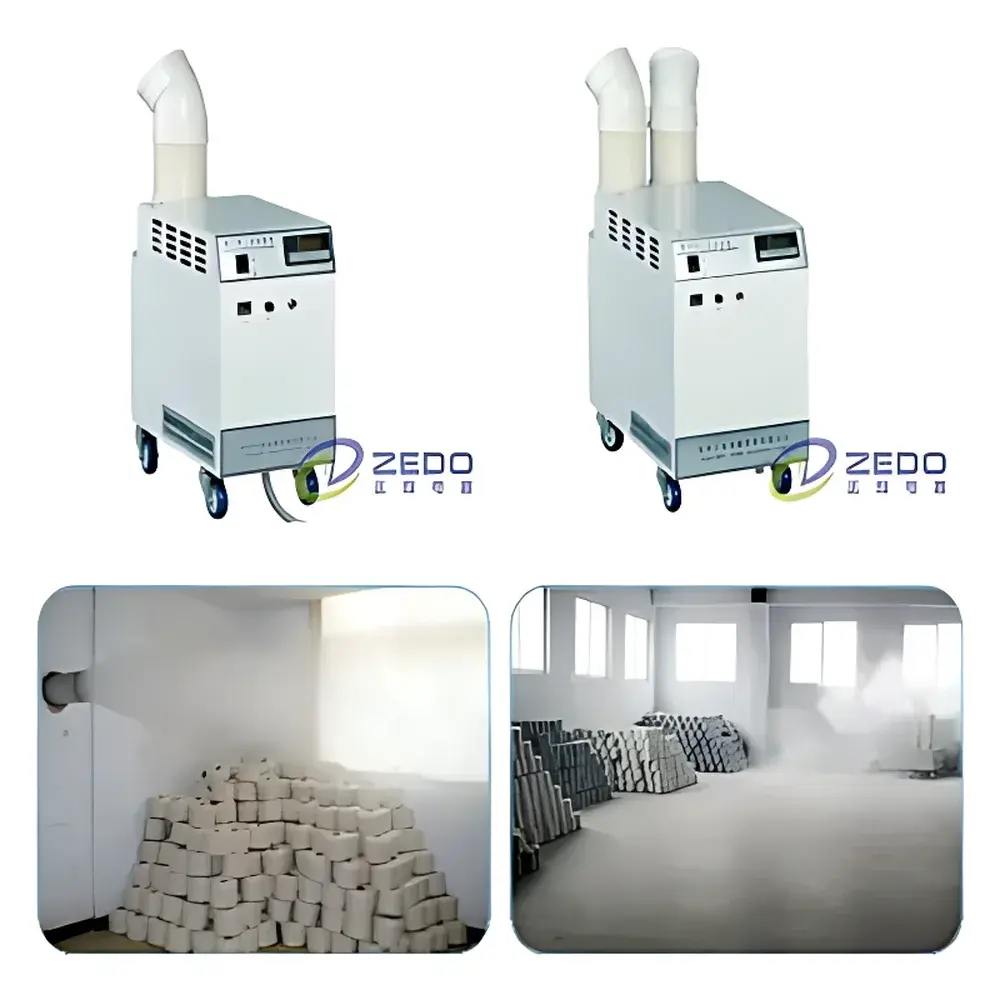
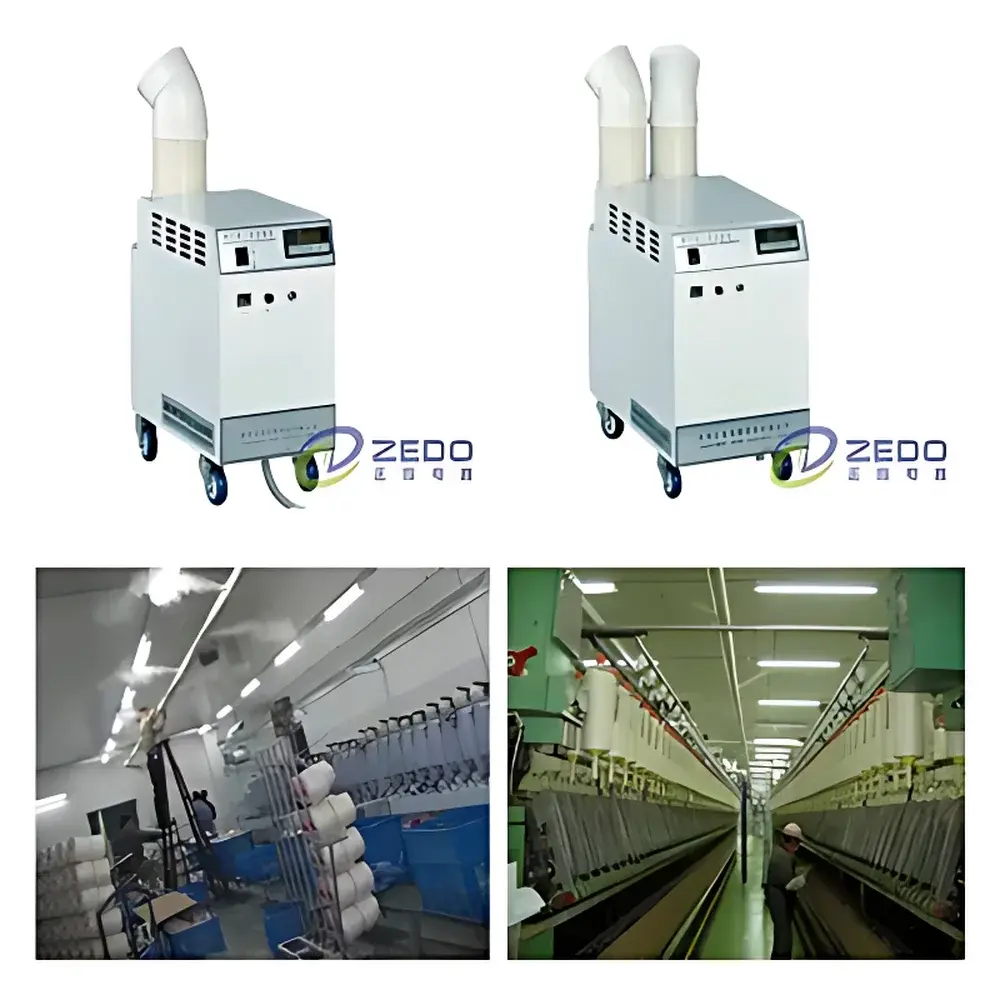
ZEDO ZS-40Z Cotton Yarn Moisture Restoration Humidifier
| Brand | ZEDO |
|---|---|
| Origin | Zhejiang, China |
| Manufacturer Type | Direct Manufacturer |
| Country of Origin | China |
| Model | ZS-40Z |
| Humidification Capacity | 12 kg/h |
| Power Consumption | 1200 W |
| Control Mode | Humidity-Sensing Automatic Control (with Japanese SHINYEI high-precision hygrometer) |
| 雾化方� | �: Ultrasonic Atomization (Ceramic Transducer) |
| Enclosure Material | Full Stainless Steel (304) with Powder-Coated Finish |
| IP Rating | IP68 Waterproof Power Supply & Fan |
| Atomizer Lifespan | 3,000–5,000 hours |
| Mobility | Equipped with Locking Casters |
| Safety Features | Auto Water-Level Detection, Overflow Protection, Dry-Run Prevention |
Overview
The ZEDO ZS-40Z Cotton Yarn Moisture Restoration Humidifier is an industrial-grade ultrasonic humidification system engineered specifically for textile manufacturing environments where precise relative humidity (RH) control is critical to fiber integrity and process stability. Unlike general-purpose humidifiers, the ZS-40Z operates on high-frequency ultrasonic oscillation (≥1.7 MHz) to generate sub-10 µm water droplets—enabling rapid, uniform dispersion into ambient air without wetting surfaces or compromising electrical safety. Its primary functional objective is moisture restoration: counteracting hygric loss during spinning, winding, weaving, knitting, and storage by maintaining RH between 60–70%—a range empirically validated to increase cotton yarn tensile strength by ~50%, reduce breakage rates, suppress static charge accumulation, and stabilize twist retention across processing stages. The unit is not a standalone climate controller but a targeted humidity compensation device integrated into existing HVAC infrastructure or deployed as a localized saturation source in high-velocity airflow zones (e.g., near draw frames, auto-coners, or warping beams).
Key Features
- Full 304 Stainless Steel Construction: Seamless welded tank and enclosure resist corrosion from alkaline or chlorinated municipal water; powder-coated exterior ensures long-term aesthetic and structural integrity in high-humidity industrial settings.
- IP68-Rated Submersible Electronics: Proprietary sealed variable-frequency power supply and control circuitry meet IEC 60529 IP68 requirements—certified for continuous operation submerged at 1 m depth—eliminating failure modes associated with condensation ingress or splash exposure.
- Ceramic Ultrasonic Transducers: Acid- and scale-resistant piezoelectric elements rated for 3,000–5,000 operational hours; compatible with total dissolved solids (TDS) up to 300 ppm without performance degradation or clogging.
- 36V IP68 Brushless DC Fan: Ball-bearing-driven axial fan delivers consistent airflow (>120 m³/h) with low vibration amplitude (<0.5 mm/s RMS), enabling stable mist column formation even under turbulent duct conditions.
- Intelligent Humidity Regulation: Microprocessor-based controller integrates real-time feedback from a calibrated SHINYEI HS-1000 capacitive hygrometer (±2% RH accuracy, 0–100% RH range), supporting setpoint-driven ON/OFF, timed cycling, or closed-loop proportional control.
- Modular Mobility & Safety Architecture: Four locking casters allow repositioning without tools; automatic water-level sensing, overflow cutoff, and dry-run lockout comply with EN 60335-1 safety standards for industrial appliances.
Sample Compatibility & Compliance
The ZS-40Z is validated for use with natural fibers (cotton, wool, linen, silk), regenerated cellulose (viscose, lyocell), and synthetic filament yarns (polyester, nylon, acrylic). It supports moisture regain restoration protocols aligned with ASTM D2495 (Standard Test Method for Moisture Content of Cotton by Oven-Drying), ISO 6741-1 (Textiles — Determination of Moisture Regain), and GB/T 9994–2018 (Chinese national standard for textile moisture content testing). The humidifier’s output stability and repeatability are traceable to NIST-traceable hygrometers during factory calibration. All electrical components conform to CE marking directives (2014/30/EU EMC, 2014/35/EU LVD), and the stainless steel wetted parts satisfy FDA 21 CFR 178.3710 (indirect food contact compliance for water systems).
Software & Data Management
While the ZS-40Z operates via embedded firmware without cloud connectivity, its controller logs operational history—including runtime hours, activation cycles, and humidity deviation events—for GLP-compliant recordkeeping. Optional RS-485 Modbus RTU interface enables integration into SCADA or MES platforms (e.g., Siemens Desigo, Rockwell FactoryTalk) for centralized monitoring of RH setpoints, fault alerts, and preventive maintenance scheduling. Audit trails support 21 CFR Part 11–compliant electronic signatures when paired with validated HMI terminals.
Applications
- Cotton spinning mills: Mitigating moisture loss during roving, ring spinning, and rotor spinning; reducing end breaks by ≥15% per shift.
- Weaving preparation: Stabilizing warp tension and minimizing sizing defects during beam warping and slashing.
- Knotting and splicing stations: Enhancing yarn cohesion during auto-splicing to lower knot rejection rates.
- Storage conditioning rooms: Maintaining 65 ± 3% RH for bale or cone storage to prevent desiccation-induced embrittlement.
- Dyeing pre-treatment: Saturating yarn packages prior to jigger or jet dyeing to ensure uniform dye uptake and color consistency.
- Nonwovens production: Controlling static in carding and cross-lapping operations for improved web uniformity.
FAQ
What is the recommended RH setpoint for cotton yarn processing?
60–70% RH is optimal for most cotton spinning and weaving operations; deviations beyond ±5% require recalibration of tension controls and twist multipliers.
Can the ZS-40Z operate with hard water?
Yes—the ceramic transducers tolerate TDS ≤300 ppm; for higher hardness, inline reverse osmosis or softening is advised to extend service intervals.
Is remote monitoring supported out of the box?
No native Ethernet/Wi-Fi; however, the RS-485 port allows third-party protocol gateways for BMS integration.
How often does the transducer require replacement?
Under typical 8-hr/day operation, replacement is required every 12–18 months based on cumulative runtime (3,000–5,000 hours).
Does the unit comply with cleanroom ISO Class 8 requirements?
It meets particle generation thresholds for ISO 14644-1 Class 8 when installed with HEPA-filtered feed air and maintained per ZEDO’s quarterly service checklist.