
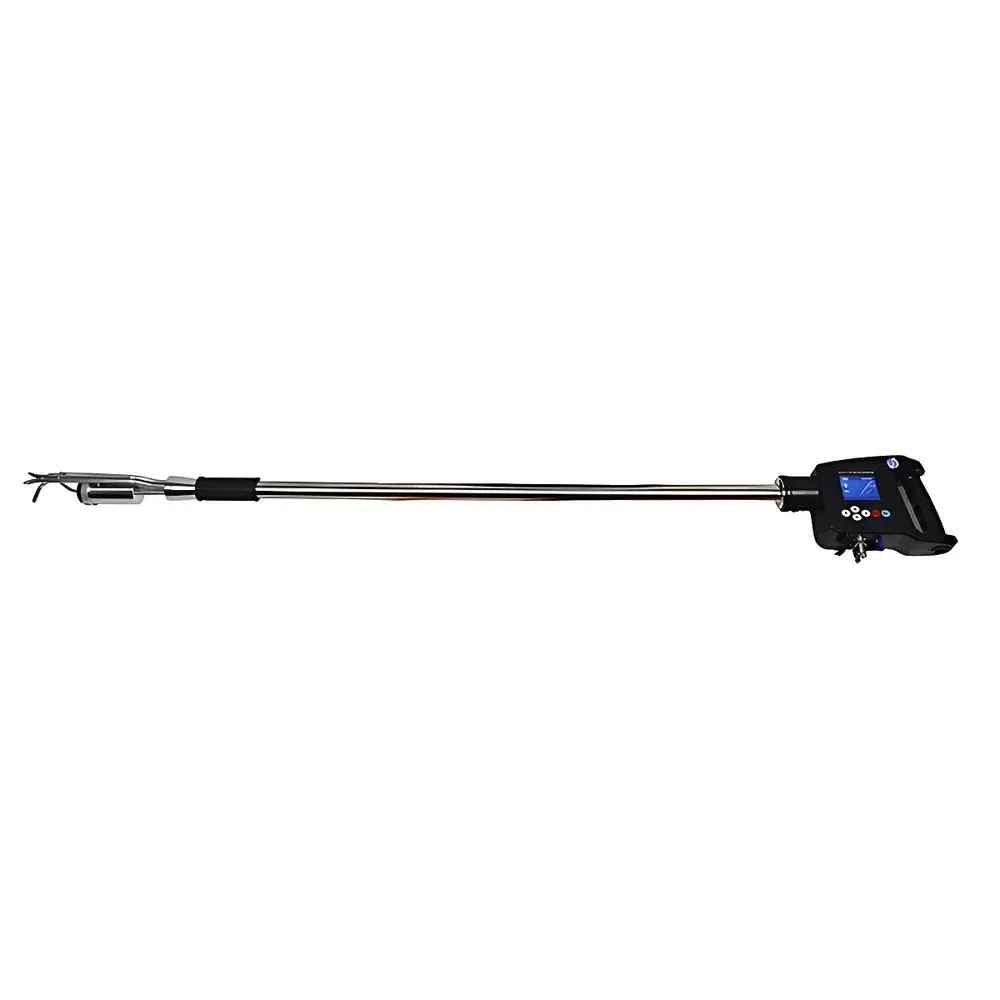
Genetec GH-6061D Multi-Function Stack Sampling Probe
| Brand | Genetec |
|---|---|
| Model | GH-6061D |
| Origin | Shandong, China |
| Manufacturer Type | OEM Producer |
| Instrument Type | Portable |
| Application Scope | Particulate Matter (PM), Cooking Oil Fume & Oil Mist Sampling from Fixed Pollution Sources |
| Compliance Standards | HJ 836–2017, HJ/T 48–1999, HJ 1077–2019 |
| Heating Capability | Front-End Heated Probe (Temperature-Controlled) |
| Display | High-Brightness Color LCD |
| Data Output | Real-Time Flue Gas Temperature, Probe Tip Temperature, Isokinetic Flow Velocity, Dynamic Pressure, Static Pressure |
| Calibration | Auto Zero Correction & Software-Based Field Calibration |
| Sample Interface | Compatible with Standard Glass Fiber Filter Tubes (HJ/T 48), Low-Concentration PTFE Membrane Filters (HJ 836), and Infrared-Compliant Oil Fume Collection Cartridges (HJ 1077) |
Overview
The Genetec GH-6061D Multi-Function Stack Sampling Probe is an engineered field instrument designed for regulatory-compliant particulate and aerosol sampling from industrial exhaust stacks and ducts. It operates on the principle of isokinetic sampling—maintaining proportional velocity between the flue gas stream and the probe’s inlet to ensure representative collection of suspended particulates across varying flow regimes. Unlike generic gas samplers, the GH-6061D integrates thermal management, real-time parameter telemetry, and modular media compatibility to meet the stringent physical and metrological requirements of Chinese environmental monitoring standards—including HJ 836–2017 (low-concentration PM determination by gravimetric method), HJ/T 48–1999 (technical specifications for particulate samplers), and HJ 1077–2019 (infrared spectrophotometric determination of cooking oil fume and oil mist). Its portable architecture enables deployment in both mobile monitoring campaigns and fixed-site QA/QC verification, supporting either standalone operation or synchronized integration with host particulate analyzers.
Key Features
- Front-end heated sampling section with closed-loop temperature control—prevents condensation and particle loss in high-humidity or low-temperature flue gas environments (typical operating range: 100–180 °C, adjustable in 1 °C increments)
- High-brightness color LCD display showing real-time flue gas temperature, probe tip temperature, isokinetic flow velocity, dynamic pressure, static pressure, and differential pressure
- Modular sampling interface accommodating three standardized collection formats: conventional glass-fiber filter tubes (per HJ/T 48), low-concentration PTFE membrane filters (per HJ 836), and infrared-compatible oil fume sorbent cartridges (per HJ 1077)
- Onboard microprocessor with auto-zero correction algorithm and software-accessible calibration routines—enables field validation without disassembly or external hardware
- Integrated pitot-static tube assembly with NIST-traceable pressure transducers for direct calculation of volumetric flow rate, stack cross-sectional velocity profile, and isokinetic sampling ratio
- Ruggedized aluminum alloy housing rated IP54 for dust and splash resistance; optimized weight distribution (≤2.8 kg) for extended handheld use during stack access operations
Sample Compatibility & Compliance
The GH-6061D is validated for use with certified consumables referenced in national emission monitoring protocols. For low-concentration particulate measurement (HJ 836–2017), it supports 47-mm PTFE membrane filters mounted on stainless-steel support rings, ensuring minimal blank mass and high collection efficiency (>99.95% for PM10). For oil fume and oil mist analysis (HJ 1077–2019), the probe interfaces with quartz fiber filters pre-coated with CCl4-soluble sorbents compatible with Fourier-transform infrared (FTIR) quantification. All pressure and temperature measurements conform to the uncertainty budget defined in JJG 518–2021 (verification regulation for flue gas analyzers). The device meets electromagnetic compatibility (EMC) requirements per GB/T 18268.1–2010 and is suitable for GLP-aligned field laboratories conducting stack testing under CNAS-accredited quality systems.
Software & Data Management
Data acquisition is handled via embedded firmware compliant with Modbus RTU protocol, enabling seamless integration into centralized emission monitoring systems (CEMS). Raw sensor outputs—including thermocouple voltage, pressure differentials, and heater current—are logged at 1 Hz resolution with time-stamped metadata (UTC sync via optional GPS module). Exported CSV files include calibrated engineering units and traceable calibration coefficients. Firmware supports audit-trail logging per ISO/IEC 17025:2017 clause 7.7—recording all user-initiated calibration events, zero adjustments, and configuration changes with operator ID and timestamp. No proprietary cloud platform is required; local storage uses industrial-grade microSD card (up to 32 GB) with write-protection switch.
Applications
- Regulatory stack testing for thermal power plants, cement kilns, and waste incinerators under China’s “Blue Sky Defense Campaign” enforcement framework
- Source apportionment studies involving cooking oil fume emissions from commercial kitchen exhaust systems
- QA/QC verification of continuous particulate monitors (CPMs) installed in industrial ductwork
- Field validation of low-concentration PM measurement systems prior to HJ 836–2017 compliance reporting
- Research-grade aerosol characterization in pilot-scale combustion facilities where humidity-induced artifact mitigation is critical
FAQ
Is the GH-6061D certified for use in official environmental inspections in China?
Yes—it is designed and verified to meet the metrological and functional requirements of HJ 836–2017, HJ/T 48–1999, and HJ 1077–2019, and is routinely deployed by provincial EPBs and third-party testing institutions accredited under CNAS.
Can the probe operate independently without connection to a main analyzer?
Yes—the built-in sensors and display allow full characterization of flue gas conditions (temperature, pressure, velocity) and real-time heater status, making it suitable for preliminary site surveys and probe performance verification.
Does it support data export in formats compatible with LIMS or EPA-approved reporting templates?
Yes—CSV output includes column headers aligned with China’s national emission reporting schema (e.g., “FlueGasTemp_C”, “IsokineticRatio”, “FilterID”), and timestamps are formatted to ISO 8601:2004 for automated ingestion into laboratory information management systems.







