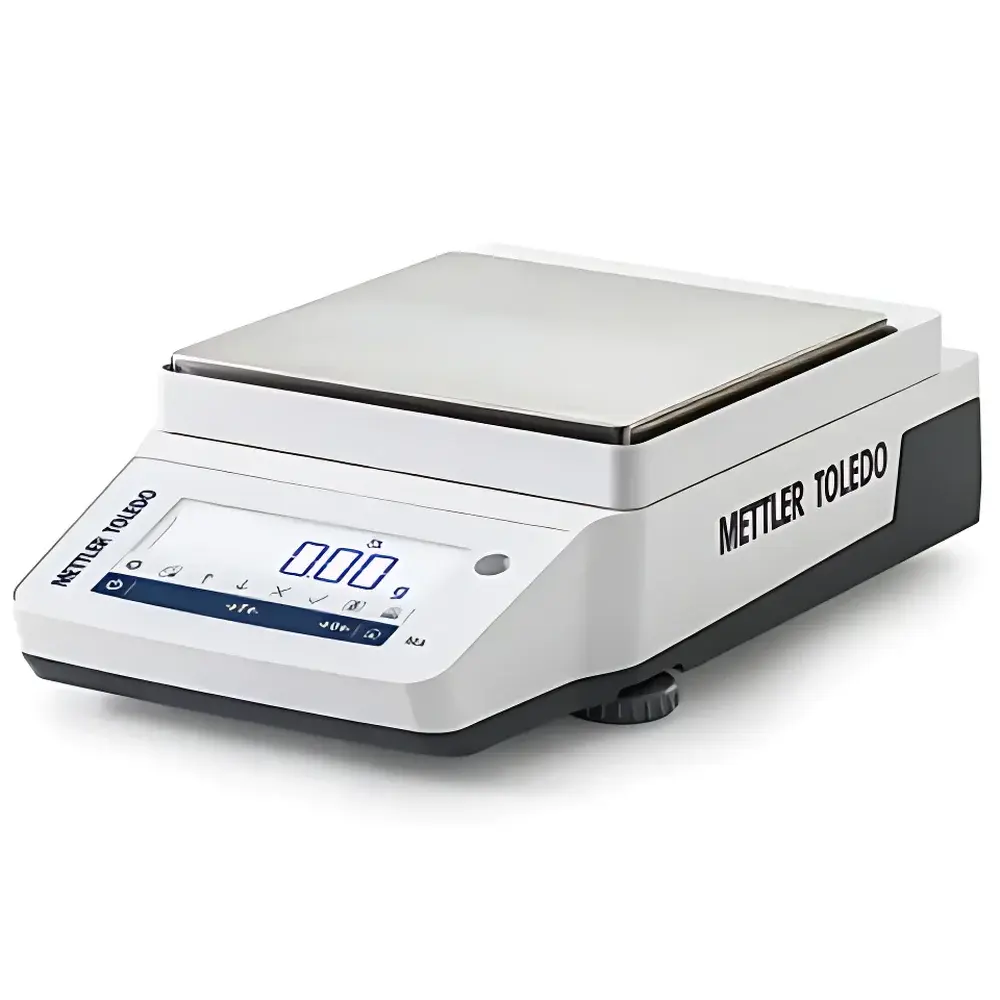
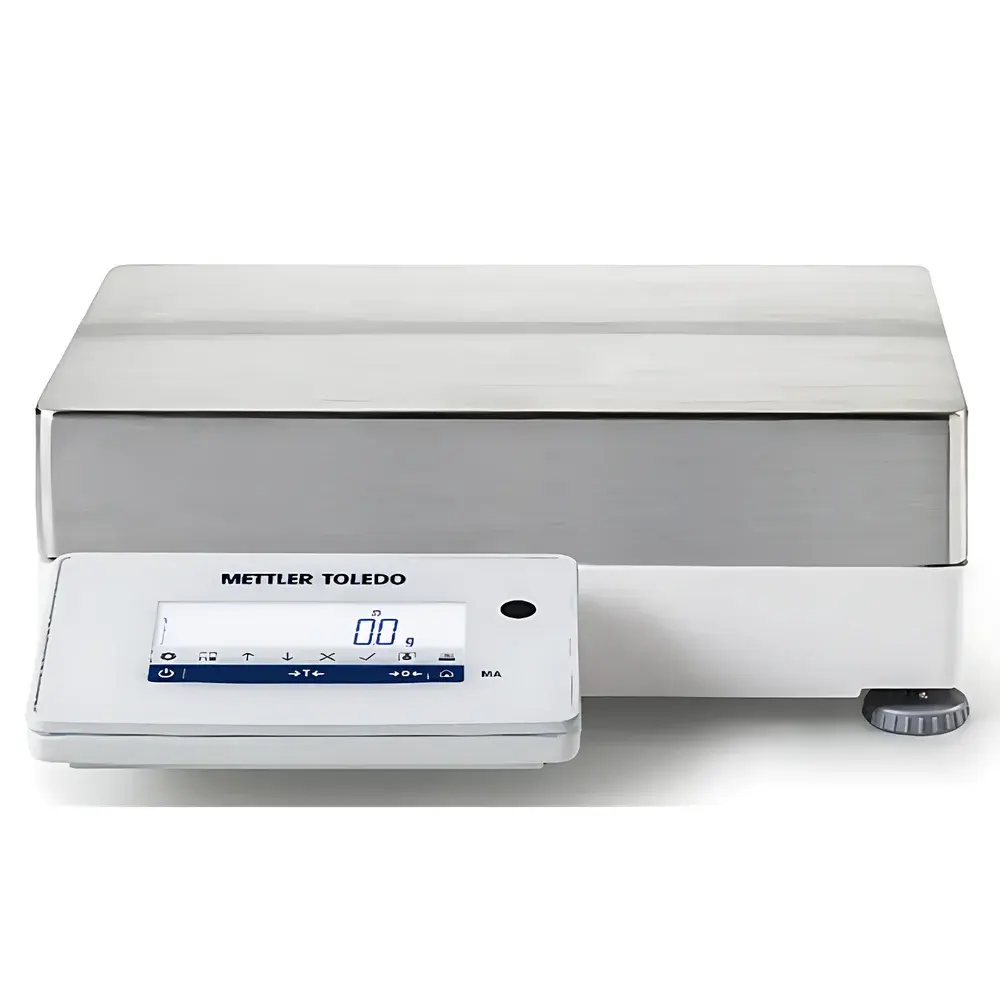
METTLER TOLEDO MA12001L Precision Balance
| Brand | METTLER TOLEDO |
|---|---|
| Origin | Shanghai, China |
| Model | MA12001L Precision Balance |
| Display | High-brightness LCD with on-screen guidance |
| Interface | USB-A, RS232 |
| Calibration | Internal motorized calibration with built-in test weights |
| Construction | Robust housing with scratch-resistant glass draft shield and stainless-steel pan |
| Compliance | Designed to support GLP/GMP documentation workflows |
| Data Management | Supports direct printout, PC transfer, and USB storage export |
Overview
The METTLER TOLEDO MA12001L Precision Balance is an entry-level analytical-grade weighing instrument engineered for routine laboratory and quality control environments where reproducibility, ergonomic operation, and regulatory traceability are essential. Utilizing electromagnetic force compensation (EMFC) technology, the MA12001L delivers stable, drift-compensated measurements under standard ambient conditions (20 ± 5 °C, <70 % RH). Its design prioritizes operational robustness and user-guided workflow integrity—particularly in environments requiring consistent daily use across multiple operators without dedicated metrology training. Unlike high-end analytical balances with microgram resolution, the MA12001L targets applications demanding 1 mg readability and ±0.002 g repeatability (at full capacity), making it suitable for formulation checks, sample preparation, inventory reconciliation, and intermediate QC testing in pharmaceutical, chemical, food, and academic laboratories.
Key Features
- High-contrast, backlit LCD display with intuitive on-screen prompts guiding users step-by-step through tare, weighing, and result confirmation—reducing operator-dependent errors.
- Touch-sensitive front-panel keys with tactile feedback, enabling glove-compatible operation and minimizing mechanical wear compared to traditional membrane switches.
- Integrated internal calibration system with motor-driven test weight deployment; automatic recalibration triggered by time intervals, temperature shifts (>1.5 °C), or user command—ensuring continuous metrological validity.
- Draft shield assembly constructed from chemically resistant, abrasion-proof tempered glass; removable and autoclavable components facilitate rapid cleaning and contamination control per ISO 17025 and FDA 21 CFR Part 11 hygiene expectations.
- Stainless-steel weighing pan (120 mm diameter) mounted on a rigid, vibration-damped base—optimized for stability on standard lab benches without external anti-vibration tables.
- Real-time environmental monitoring (temperature and drift detection) embedded in firmware to flag non-compliant measurement conditions before data capture.
Sample Compatibility & Compliance
The MA12001L accommodates solid samples up to its maximum capacity (12,000 g), powders, granules, and small packaged units—provided they fit within the draft shield’s internal dimensions (200 × 200 × 240 mm W×D×H). It is not intended for volatile, corrosive, or static-prone materials without auxiliary containment. The balance complies with international metrological standards including OIML R76-1 (Class II), EN 45501, and ANSI/NCSL Z540-1. Its firmware architecture supports audit-trail-enabling configurations required for GLP and GMP environments—including timestamped event logs (calibration, tare, print, data export), user access levels, and password-protected configuration changes. While the device itself does not enforce 21 CFR Part 11 electronic signature requirements, its data export protocols (ASCII, CSV) and interface behavior are fully compatible with validated LIMS and ELN systems that implement such controls at the host level.
Software & Data Management
Data output is managed exclusively via hardware interfaces: RS232 (for legacy printers and serial-enabled PCs) and USB-A (supporting HID-class virtual COM port emulation and mass-storage mode for direct file dump to FAT32-formatted USB drives). No proprietary software installation is required for basic data capture. All exported records include mandatory metadata: date/time stamp, gross/net/tare values, unit of measure, operator ID (if entered), and calibration status flag. Optional integration with METTLER TOLEDO LabX Lite (freely downloadable) enables centralized instrument monitoring, customizable report templates, and automated PDF generation compliant with internal SOPs. Raw data files retain unaltered timestamps and cannot be edited post-export—preserving data integrity throughout the chain of custody.
Applications
- Raw material receipt inspection and batch release verification in contract manufacturing organizations (CMOs).
- Weighing of excipients and active pharmaceutical ingredients (APIs) during pre-formulation studies.
- Calibration mass verification against certified reference standards in metrology labs.
- Teaching laboratories requiring durable, low-maintenance instruments for undergraduate chemistry and biology courses.
- Food safety labs performing moisture content pre-weighing and net-weight labeling compliance checks.
- Environmental testing facilities weighing soil, sediment, or filter media prior to gravimetric analysis (e.g., TSS, PM10).
FAQ
What is the readability and maximum capacity of the MA12001L?
The MA12001L offers 1 mg readability with a maximum capacity of 12,000 g.
Does the balance support external calibration with user-provided weights?
Yes—external calibration is supported via the front-panel menu using Class M2 or better certified weights, though internal motorized calibration is recommended for routine use.
Can the MA12001L be connected to a networked LIMS system?
Direct Ethernet or Wi-Fi connectivity is not available; however, seamless integration is achieved via RS232-to-TCP/IP converters or USB-connected host PCs running middleware such as LabX Lite or custom Python/Node.js daemons.
Is the balance suitable for use in regulated pharmaceutical manufacturing?
It meets foundational metrological and documentation requirements for non-critical weighing steps; final release testing must follow site-specific validation protocols aligned with Annex 15 and USP .
How often does the internal calibration execute automatically?
By default, the system triggers auto-calibration every 4 hours, or immediately following a detected ambient temperature change exceeding ±1.5 °C—configurable via service mode.