
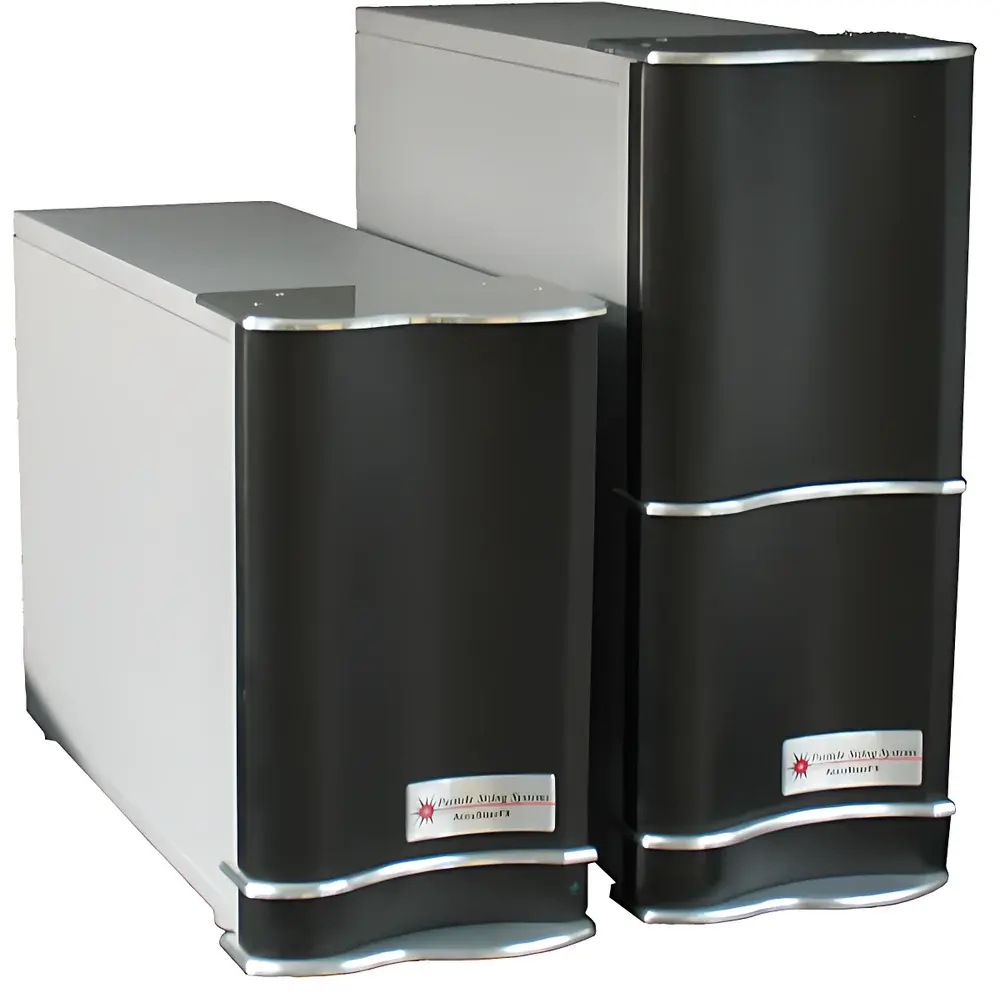
Particle Sizing Systems PSS FX-Nano High-Concentration Single Particle Optical Sizer (SPOS)
| Brand | Particle Sizing Systems (PSS) |
|---|---|
| Origin | USA |
| Model | FX-Nano |
| Instrument Type | Optical Particle Counter |
| Detection Principle | Single Particle Optical Sensing (SPOS) with Focused Beam Technology |
| Minimum Detectable Size | 150 nm |
| Maximum Sample Concentration | 10⁷ particles/mL |
| Compliance | Designed for ASTM F2884-19, ISO 21501-4, USP <788> & <789>, FDA 21 CFR Part 11–ready software architecture |
| Software Platform | AccuSizer v8.0 with Audit Trail, Electronic Signatures, and GLP/GMP-compliant data management |
Overview
The Particle Sizing Systems PSS FX-Nano is a high-concentration single particle optical sizer (SPOS) engineered for precise, quantitative particle counting and sizing in undiluted or minimally processed samples. Unlike ensemble-based techniques such as dynamic light scattering (DLS) or laser diffraction, the FX-Nano employs a patented focused-beam optical detection system that interrogates individual particles flowing through a microfluidic channel. Each particle passing through the laser interrogation zone generates a discrete pulse proportional to its cross-sectional area—enabling direct enumeration and size classification with high resolution across the 150 nm to 100 µm range. This principle ensures statistical fidelity in distribution shape, particularly critical for detecting low-abundance subvisible particles in biopharmaceutical formulations, catalyst slurries, and advanced nanomaterial dispersions. The instrument is purpose-built to bridge analytical continuity from early-stage R&D to final-fill QC and process monitoring environments without requiring hardware reconfiguration.
Key Features
- Focused beam optical sensing technology enabling true single-particle resolution at concentrations up to 10⁷ particles/mL—orders of magnitude higher than conventional SPOS systems.
- Auto-dilution module integrated into the fluidics path for seamless handling of viscous or ultra-concentrated suspensions without manual intervention.
- Real-time, raw pulse-by-pulse data acquisition with no binning artifacts—preserving intrinsic distribution skewness and multimodality.
- Patented electro-optical configuration maintaining sub-micron resolution and sizing accuracy even under high-background conditions.
- Modular sensor design supporting interchangeable flow cells optimized for low-volume (100 µL), high-throughput (1 mL/min), or narrow-distribution validation applications.
- Compliance-ready firmware architecture supporting 21 CFR Part 11 requirements including electronic signatures, audit trails, and user-access controls.
Sample Compatibility & Compliance
The FX-Nano accommodates aqueous and organic dispersions—including protein aggregates, liposomes, polymer nanoparticles, ceramic slurries, and metal colloids—without mandatory pre-filtration or dilution. Its robust optical path tolerates turbidity levels exceeding 200 NTU, eliminating false negatives from scattering saturation. Method validation aligns with ICH Q5A(R2), USP and for subvisible particle testing in injectables, ASTM F2884-19 for medical device particulate characterization, and ISO 21501-4 for calibration traceability using NIST-traceable latex standards. All measurement protocols support full documentation per GLP and GMP frameworks, with raw data files stored in vendor-neutral HDF5 format for third-party reanalysis.
Software & Data Management
AccuSizer v8.0 provides a validated, scalable software environment supporting both standalone operation and integration into LIMS or MES platforms via OPC UA and RESTful API interfaces. Key capabilities include automated SOP-driven workflows, real-time statistical process control (SPC) charting, batch comparison with Kolmogorov–Smirnov significance testing, and customizable reporting templates compliant with regulatory submission standards (e.g., eCTD Module 3). All user actions—including parameter changes, sample annotations, and report exports—are logged with timestamped, immutable audit trails. Role-based permissions enforce separation of duties between operators, reviewers, and administrators—ensuring full adherence to ALCOA+ data integrity principles.
Applications
- Biopharmaceutical development: Quantitative tracking of submicron protein aggregates during formulation screening, stability studies, and filtration validation.
- Advanced materials manufacturing: In-line monitoring of nanoparticle synthesis batches, catalyst slurry homogeneity, and battery electrode dispersion quality.
- Medical device testing: Extraction particle profiling per ISO 10993-12 and USP for leachables and wear debris analysis.
- Quality control laboratories: Release testing of parenteral products, ophthalmic suspensions, and inhalable dry powders where count-based specifications govern lot disposition.
- Academic and government research: Fundamental studies on nucleation kinetics, aggregation mechanisms, and interfacial stabilization dynamics in complex colloidal systems.
FAQ
What is the lower detection limit for the FX-Nano, and how is it achieved without excessive background noise?
The FX-Nano achieves reliable detection down to 150 nm through a combination of focused-beam optics and signal-to-noise optimization—leveraging high particle concentration itself to suppress relative background contribution, rather than relying solely on ultra-clean diluents.
Can the FX-Nano replace DLS for protein aggregation analysis?
Yes—for quantifying absolute particle counts and resolving heterogeneous populations; however, DLS remains complementary for rapid hydrodynamic radius estimation in dilute, monodisperse systems.
Does the system support automated calibration verification?
Yes—integrated reference standard injection routines validate sizing accuracy and counting efficiency before each analytical run per ASTM E2412-22 guidelines.
Is method transfer possible between FX-Nano and legacy AccuSizer models?
Fully supported via standardized SOP export/import and identical pulse-processing algorithms—ensuring consistent pass/fail outcomes across instrument generations.
How does the FX-Nano handle highly viscous or non-Newtonian samples?
The optional high-pressure syringe pump module maintains laminar flow profiles up to 50 cP viscosity, while adaptive flow-rate compensation preserves sizing linearity across shear-sensitive matrices.



