
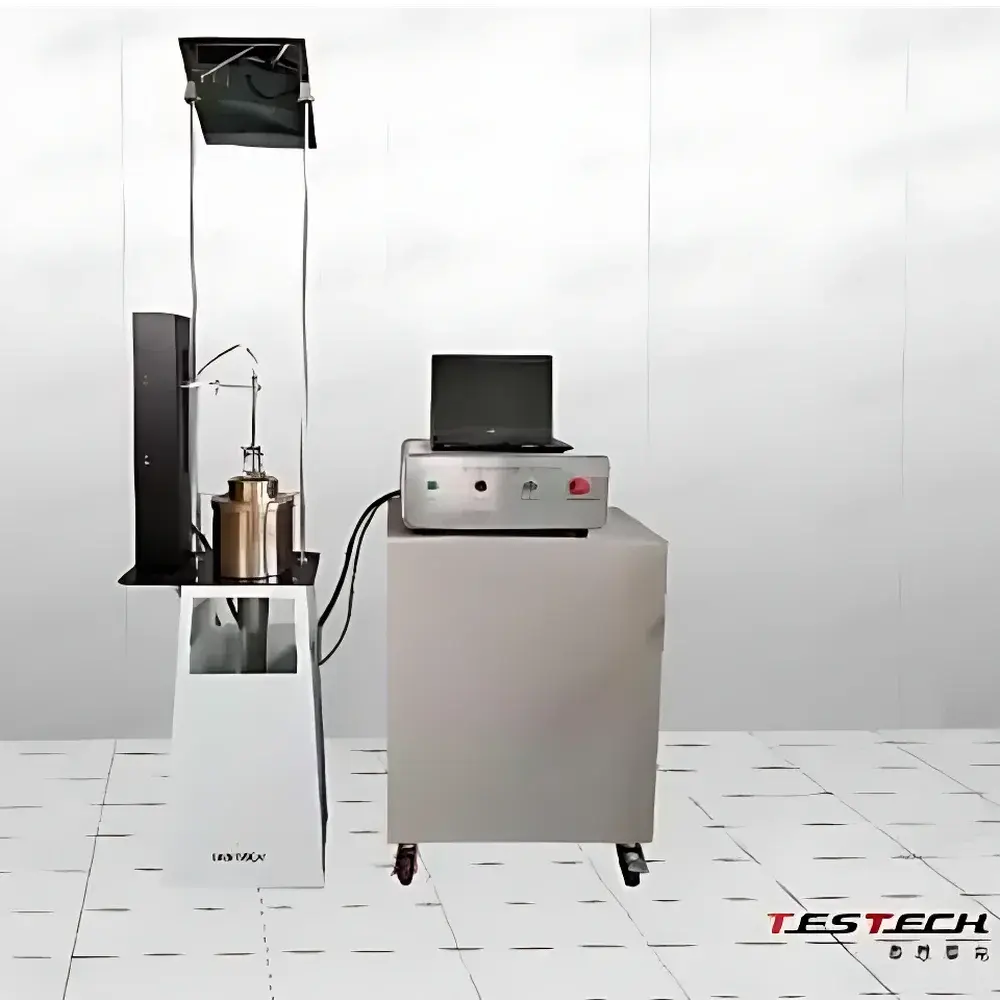
TESTech TTech-ISO1182 Non-Combustibility Tester for Battery Enclosures
| Brand | TESTech |
|---|---|
| Origin | Jiangsu, China |
| Manufacturer Type | Direct Manufacturer |
| Country of Origin | China |
| Model | TTech-ISO1182 |
| Price Range | USD 150–300 (FOB) |
| Compliance Standards | ISO 1182, GB/T 5464, ASTM E136, BS 476-4 & BS 476-11 |
| Furnace Dimensions | Φ95 mm × Φ75 mm × 150 mm |
| Heating Capacity | Up to 900 °C |
| Test Temperature | 750 ±1 °C |
| Temperature Uniformity | ±1 °C (at 750 °C, steady-state) |
| Thermal Equilibration Time | ≤35 min from cold start |
| Temperature Sensor | Insulated K-type armored thermocouple (Φ3 mm sheath, 0.3 mm junction) |
| Temp. Measurement Range | 0–1000 °C |
| Accuracy | ±0.5% of reading |
| Control System | PLC with solid-state relay and PID algorithm |
| Heating Element | High-stability bar heater |
| Data Output | Real-time temperature curve exportable to CSV/PDF |
Overview
The TESTech TTech-ISO1182 Non-Combustibility Tester is a precision-engineered thermal assessment instrument designed specifically for evaluating the non-combustibility performance of battery enclosure materials under standardized fire exposure conditions. It operates on the principle of vertical furnace heating in accordance with the gravimetric and thermal response methodology defined in ISO 1182:2010, “Reaction to fire tests — Non-combustibility test”. In this test, a cylindrical specimen is suspended centrally within a preheated muffle furnace maintained at 750 ±1 °C for 20 minutes. The instrument continuously monitors furnace temperature, specimen surface temperature (via embedded thermocouple), mass loss, and flame occurrence. A material passes the non-combustibility classification if it exhibits no sustained flaming, mass loss ≤50%, and temperature rise in the furnace ≤50 K above ambient—criteria aligned with ISO 1182, ASTM E136, and GB/T 5464. This tester is integral to lithium-ion battery safety validation workflows, supporting UN 38.3 Section 38.3.1 (cell and battery enclosure qualification), IEC 62619, and UL 1642/UL 2580 compliance pathways.
Key Features
- Patented intelligent control architecture integrating PLC-based PID regulation with solid-state relay switching for stable thermal ramping and precise 750 ±1 °C hold accuracy
- Stainless-steel muffle furnace chamber (Φ95 mm × Φ75 mm × 150 mm internal dimensions) engineered for uniform heat distribution and long-term corrosion resistance
- High-reliability bar-type heating elements capable of reaching up to 900 °C, enabling extended calibration verification and thermal margin testing
- Insulated K-type armored thermocouple (Φ3 mm outer sheath, 0.3 mm hot junction) mounted per ISO 1182 requirements for direct furnace wall and specimen proximity monitoring
- Automated thermal equilibration sequence: achieves stable 750 °C furnace temperature in ≤35 minutes from ambient start, verified via dual-point thermocouple logging
- Real-time temperature profiling with timestamped data capture; curves exportable as CSV or printable PDF reports compliant with GLP documentation requirements
- Integrated safety interlocks including overtemperature cutoff (950 °C hard limit), door-open shutdown, and emergency power-off circuitry
Sample Compatibility & Compliance
The TTech-ISO1182 accommodates standard cylindrical specimens measuring 45 mm in height and 25 mm in diameter, prepared per ISO 1182 Annex A and ASTM E136 Section 6. Specimen preparation includes conditioning at 23 ±2 °C and 50 ±5% RH for ≥48 hours prior to testing. Compatible materials include polymer composites (e.g., PC/ABS, PPS, LCP), metal housings (aluminum alloys, stainless steel), ceramic coatings, and flame-retardant elastomeric gaskets used in prismatic, pouch, and cylindrical cell enclosures. The system fully satisfies regulatory audit requirements for ISO/IEC 17025-accredited laboratories, with traceable calibration certificates available for furnace thermocouples (NIST-traceable) and digital temperature indicators. All firmware and operational logs support 21 CFR Part 11-compliant electronic record retention when paired with TESTech’s optional AuditTrail™ software module.
Software & Data Management
Control and data acquisition are managed through a dedicated HMI interface running embedded real-time OS firmware. Temperature profiles, time-stamped event markers (e.g., furnace ignition, specimen insertion, flame detection), and final pass/fail determinations are stored locally on industrial-grade SD card with write-protection. Export options include CSV (for Excel or MATLAB analysis), PDF (with embedded digital signature and lab header), and XML (for LIMS integration). Optional TESTech DataLink™ software enables remote monitoring, multi-instrument synchronization, and automated report generation aligned with ISO 17025 Clause 7.8.2 (reporting of results). Audit trails record user login, parameter changes, calibration events, and test execution history with immutable timestamps—fully supporting FDA and EU MDR traceability mandates.
Applications
- Qualification of battery enclosure materials against UN 38.3, IEC 62619, and GB 38031 safety standards
- Comparative evaluation of halogen-free flame-retardant additives in thermoplastic battery housings
- Validation of thermal barrier coatings applied to aluminum battery trays
- Supplier qualification testing for OEMs requiring documented non-combustibility evidence per automotive ASAM standards
- Research into novel ceramic-polymer hybrid encapsulation systems for high-energy-density cells
- Internal R&D screening of recycled polymer blends intended for EV battery module housings
FAQ
What standards does the TTech-ISO1182 explicitly support?
It is validated for ISO 1182:2010, GB/T 5464–2014, ASTM E136–22, BS 476-4:1970, and BS 476-11:1982. Full test method alignment documentation is provided with each unit.
Is furnace temperature uniformity verified during calibration?
Yes—uniformity mapping is performed at three axial positions (top/mid/bottom) and two radial points per level using NIST-traceable reference thermocouples. A uniformity deviation of ≤±1 °C at 750 °C is certified.
Can the system be integrated into an existing LIMS environment?
Via optional RS-485 Modbus RTU or Ethernet TCP/IP interface, with configurable XML schema output for seamless ingestion into laboratory information management systems.
What maintenance intervals are recommended for long-term accuracy?
Thermocouple verification every 6 months; full furnace calibration (including uniformity check) annually; visual inspection of heating elements and insulation integrity before each test series.





