
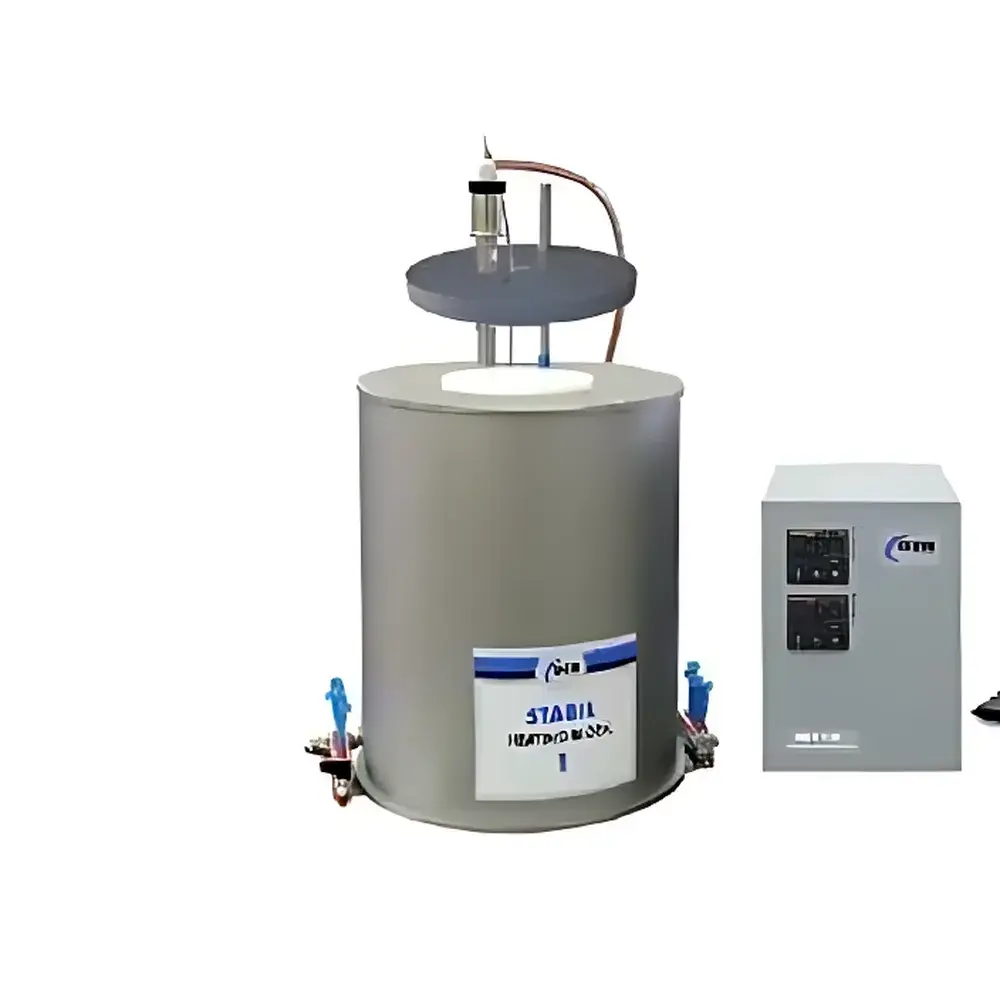
TESTech TTech-GBT16429 Godbert-Greenwald Dust Cloud Minimum Ignition Temperature (MIT) Tester
| Brand | TESTech |
|---|---|
| Model | TTech-GBT16429 |
| Standard Compliance | GB/T 16429, IEC 61241-2-1:1994, EN 50281-2-1:1999 |
| Furnace Temp Range | RT–800 °C (temporarily up to 1000 °C for cleaning) |
| Temp Control Accuracy | ±1% above 500 °C, ±3% below 300 °C |
| Air Pressure Reservoir | 0–1 bar |
| Pressure Accuracy | ±5% |
| Dimensions (W×D×H, incl. stand) | 500×300×450 mm |
| Power Supply | 230 V/50 Hz or 110 V/60 Hz |
Overview
The TESTech TTech-GBT16429 Godbert-Greenwald Dust Cloud Minimum Ignition Temperature (MIT) Tester is a precision-engineered laboratory instrument designed to determine the lowest temperature at which a suspended cloud of combustible dust will spontaneously ignite when exposed to a heated environment. This test method is grounded in the fundamental principles of thermal ignition kinetics and heterogeneous combustion physics—specifically, the balance between heat generation from exothermic oxidation reactions and convective/radiative heat loss within a turbulent dust-air mixture. The apparatus implements the standardized Godbert-Greenwald furnace configuration, wherein a vertically oriented transparent quartz tube serves as both the heating chamber and optical observation path, enabling real-time visual detection of incandescence or flame propagation. As defined in GB/T 16429 and harmonized with IEC 61241-2-1 and EN 50281-2-1, the MIT value is a critical parameter for classifying hazardous areas in process industries, informing surface temperature limits for electrical equipment (e.g., ATEX/IECEx temperature classes), and supporting hazard and operability (HAZOP) studies.
Key Features
- Godbert-Greenwald-type vertical quartz furnace with bottom-open configuration for controlled dust dispersion and unobstructed bottom-view ignition observation
- High-purity fused quartz tube (≥99.95% SiO₂) ensuring thermal stability up to 1000 °C and optical clarity across UV–visible spectrum
- Precise programmable temperature control system with dual-range accuracy: ±1% deviation above 500 °C; ±3% below 300 °C—validated per IEC 60584 thermocouple calibration protocols
- Integrated compressed air reservoir (0–1 bar) with calibrated pressure transducer (±5% full-scale accuracy) for reproducible dust dispersion velocity and cloud density
- Dual-voltage power input (110 V/60 Hz or 230 V/50 Hz) with internal isolation transformer and overtemperature cut-off circuitry for operational safety
- Compact benchtop footprint (500 × 300 × 450 mm) including rigid aluminum alloy support frame with adjustable leveling feet
Sample Compatibility & Compliance
The TTech-GBT16429 is validated for testing dry, non-agglomerating particulate materials with particle size distributions typically ranging from 10 µm to 150 µm (D₅₀), including metal powders (Al, Mg, Ti), organic dusts (wood, sugar, flour), polymer granules, and pharmaceutical excipients. Sample mass loading is optimized per standard procedure—typically 0.5–2.0 g dispersed into ≥1 L of preheated air—to ensure representative cloud homogeneity without wall deposition artifacts. All operational procedures and reporting formats comply with the mandatory requirements of GB/T 16429, including stepwise temperature decrement protocol (20 °C steps above 300 °C; 10 °C steps at or below 300 °C), minimum observation duration (≥5 s per temperature step), and pass/fail criteria based on sustained luminosity or flame front propagation. The system supports audit-ready documentation aligned with GLP and ISO/IEC 17025 quality management frameworks.
Software & Data Management
While the base TTech-GBT16429 operates via analog temperature controller and manual pressure regulation, optional digital upgrade kits include an embedded microprocessor-based controller with RS-485 Modbus RTU interface. This enables integration into centralized lab data acquisition systems (e.g., LabVIEW, DeltaV, or custom SCADA platforms). Temperature setpoints, actual furnace readings, pressure reservoir status, and operator timestamps are logged at 1 Hz resolution and exportable as CSV or PDF reports compliant with FDA 21 CFR Part 11 requirements—including electronic signatures, audit trails, and user-access level controls. Raw video capture (via optional USB microscope camera mounted coaxially with furnace axis) may be synchronized with thermal data for forensic root-cause analysis of borderline ignition events.
Applications
- Hazard classification of industrial zones under IEC 60079-10-2 and NFPA 499 for dust explosion risk zoning
- Selection and certification of temperature-classified equipment (T-class ratings) for use in Zone 20, 21, and 22 hazardous locations
- Formulation screening of flame-retardant additives by comparative MIT shift analysis
- Validation of inerting strategies (e.g., N₂ or CO₂ blanketing) through MIT elevation quantification
- Supporting Process Safety Information (PSI) deliverables required under OSHA 1910.119 and CCPS guidelines
- Academic research in dust combustion kinetics, including Arrhenius parameter derivation and activation energy estimation
FAQ
What standards does the TTech-GBT16429 fully satisfy?
It is engineered and verified to meet all technical and procedural requirements of GB/T 16429, IEC 61241-2-1:1994, and EN 50281-2-1:1999—including furnace geometry tolerances, temperature uniformity profiles, and observation methodology.
Can this instrument test nanoparticle suspensions?
No. Per standard scope limitations, it is intended for respirable- and inhalable-range dusts (typically >10 µm). Nanoparticles require specialized electrostatic dispersion and containment systems not integrated in this design.
Is calibration traceable to national metrology institutes?
Yes. Furnace temperature calibration uses PtRh10-Pt thermocouples certified to NIST-traceable standards (certificates provided with each unit); pressure sensors are calibrated against Fluke 700G series reference gauges.
How is repeatability ensured across multiple operators?
Standardized SOPs—including fixed dispersion timing (0.5 s pulse), consistent sample sieving (ISO 3310-1, 90 µm mesh), and defined ambient humidity limits (<40% RH)—are documented in the included GLP-compliant operation manual.
Does the system support automated temperature ramping?
The base model uses manual setpoint adjustment. Optional firmware-enabled controllers provide programmable ramp/soak sequences with user-defined step durations and dwell times, fully compliant with ASTM E2058 Annex A3 recommendations.



