
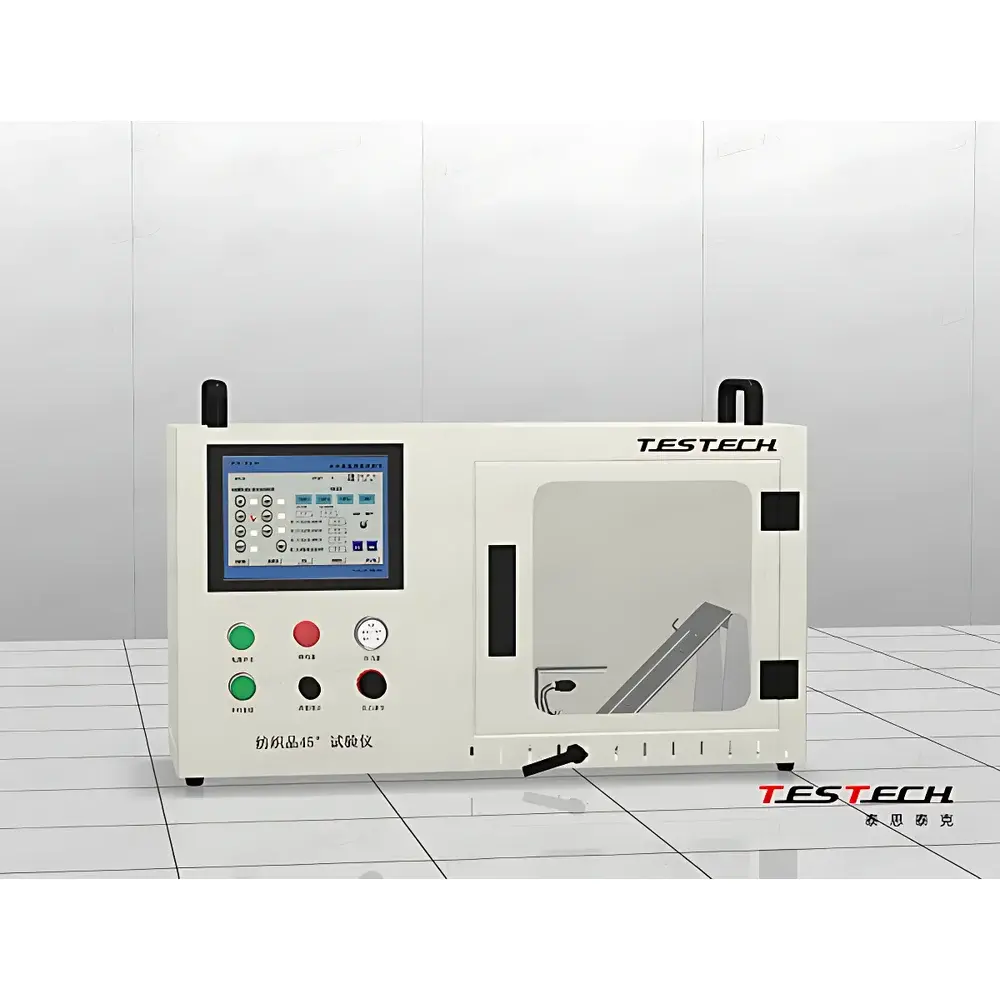
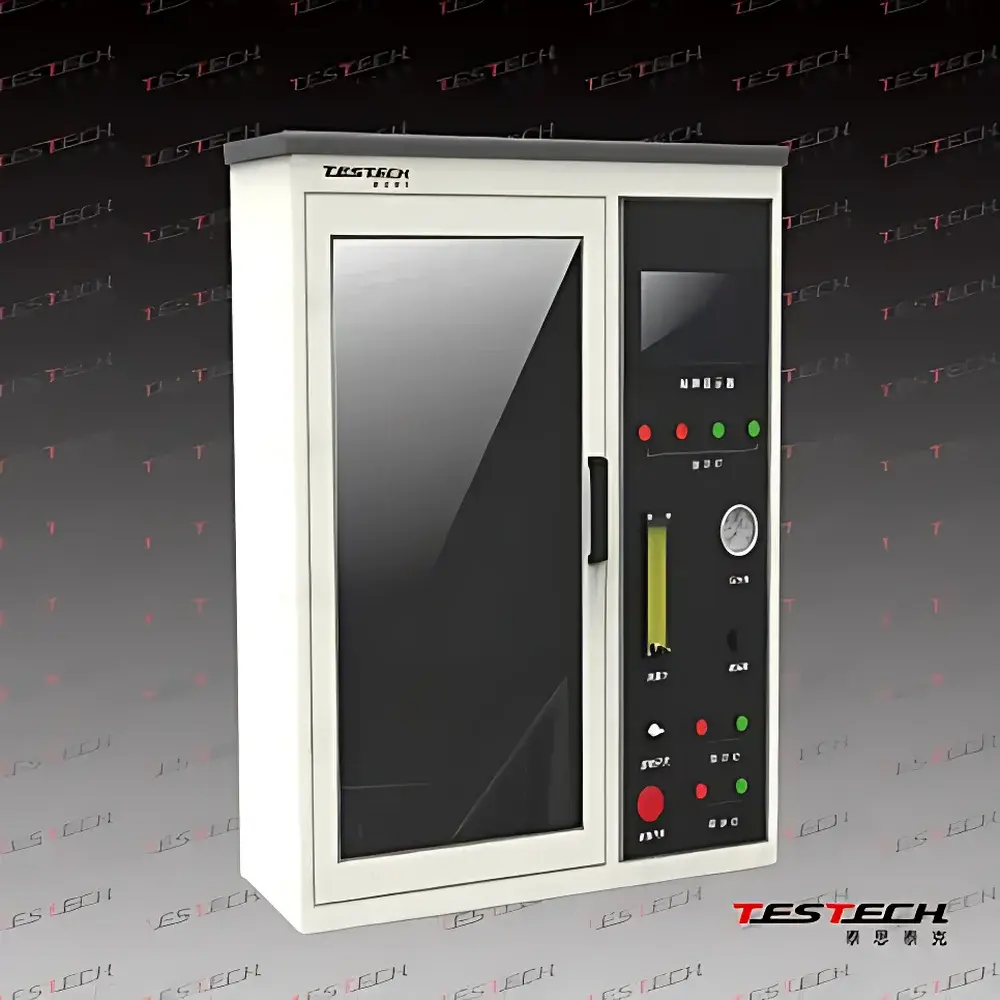
TESTech TTech-GBT14644 45-Degree Textile Flammability Tester
| Brand | TESTech |
|---|---|
| Model | TTech-GBT14644 |
| Standard Compliance | GB/T 14644, ASTM D1230, NFPA 702, CA TB 117 (2000) Section C |
| Flame Height | 16 mm |
| Timer Resolution | 0.1 s |
| Dimensions (W×D×H) | 750 × 300 × 900 mm |
| Power Supply | AC 220 V, 50/60 Hz, 5 A |
| Weight | 30 kg |
| Control System | PLC + Touchscreen HMI |
| Ignition Duration | 1 s |
| Sample Orientation | 45° incline |
| Flame Source | Butane gas (user-supplied) |
Overview
The TESTech TTech-GBT14644 45-Degree Textile Flammability Tester is an engineered laboratory instrument designed to quantify the surface flame spread behavior of textile fabrics under standardized inclined orientation conditions. It operates in strict accordance with the principle defined in GB/T 14644–1993 (“Textiles – Determination of Burning Behaviour – 45° Directional Flame Spread Rate”), which specifies a controlled ignition protocol: a calibrated butane flame (16 mm height) is applied for exactly 1 second to the lower edge of a fabric specimen mounted at a precise 45° angle; the time required for the flame front to propagate a defined vertical distance (typically 127 mm or 5 inches) along the specimen surface is measured and reported as the flame spread rate. This test method evaluates the propensity of textile materials to sustain and propagate surface combustion — a critical parameter for assessing fire hazard in apparel, upholstery, curtains, and healthcare textiles. The apparatus implements a deterministic physical measurement rather than qualitative pass/fail classification, delivering repeatable, traceable data suitable for regulatory submission and material development workflows.
Key Features
- Precision-engineered 45° sample holder with mechanical locking and alignment verification to ensure consistent specimen inclination across all tests.
- Imported needle valve and pressure-regulated butane gas delivery system, integrated with high-stability pressure gauge for real-time monitoring and reproducible flame geometry.
- Calibrated 16 mm flame height reference scale and standardized burner assembly compliant with ASTM D1230 and GB/T 14644 dimensional requirements.
- High-temperature resistant borosilicate glass observation door with anti-fog coating, enabling unobstructed visual monitoring of flame propagation dynamics without compromising thermal integrity.
- PLC-based control architecture with industrial-grade touchscreen HMI interface for intuitive operation, parameter configuration, and real-time status feedback.
- Automated timing sequence: start trigger initiates both ignition and timer simultaneously; micro-switch detection at the designated flame travel endpoint terminates timing with ±0.1 s resolution.
- Built-in calculation engine that automatically computes flame spread rate (mm/s), stores raw timestamps and derived results in non-volatile memory, and supports export via USB interface.
- Integrated safety features including main power disconnect switch, flame-out detection logic, and fail-safe gas cutoff upon abnormal operational conditions.
Sample Compatibility & Compliance
The TTech-GBT14644 accommodates standard textile specimens measuring 150 mm × 50 mm (length × width), cut parallel to warp and weft directions per GB/T 14644 and ASTM D1230 protocols. Specimens are clamped in a rigid aluminum frame ensuring uniform tension and minimal edge curling during exposure. The instrument meets mechanical and procedural requirements for multiple international standards, including but not limited to: GB/T 14644–1993 (China), ASTM D1230–22 (Standard Test Method for Flammability of Apparel Textiles), NFPA 702–2022 (Standard for Fire Testing of Textiles and Films Used in Healthcare Facilities), and California Technical Bulletin 117–2000, Section C (for synthetic filling materials). While the device itself does not carry third-party certification, its design enables laboratories to maintain ISO/IEC 17025-compliant testing processes when operated within validated SOPs and routine calibration schedules.
Software & Data Management
The embedded PLC controller logs each test session with timestamp, operator ID (optional input), specimen ID, flame duration, measured propagation time, calculated burn rate, and system diagnostic flags. Data are stored in CSV-compatible format on internal flash memory and can be retrieved via USB mass storage mode. No proprietary software installation is required for basic data retrieval; however, optional Windows-based reporting utility (available upon request) supports automated report generation aligned with GLP documentation templates, including audit trail metadata and electronic signature fields compliant with FDA 21 CFR Part 11 requirements when deployed with appropriate IT infrastructure controls. All firmware updates are delivered via signed binary packages with version-controlled release notes.
Applications
This tester serves quality assurance laboratories in textile manufacturing, contract testing facilities, academic research groups studying flame-retardant chemistry, and regulatory compliance departments evaluating PPE and hospital linens. Typical use cases include comparative screening of halogen-free vs. phosphorus-based flame retardants, validation of back-coating efficacy on polyester blends, pre-certification testing for OEKO-TEX® Standard 100 Class II products, and root-cause analysis of batch-to-batch flammability variability. Its deterministic output supports statistical process control (SPC) charting and correlation studies with LOI (Limiting Oxygen Index) or cone calorimetry data.
FAQ
What type of fuel gas is required?
Butane gas (minimum 95% purity) is specified. Propane or mixed LPG is not permitted due to inconsistent flame temperature and velocity profiles.
Is calibration service available from TESTech?
Yes — annual calibration kits (including certified flame height gauge, stopwatch traceability certificate, and alignment jig) are offered. On-site calibration by accredited engineers can be scheduled separately.
Does the instrument comply with ISO/IEC 17025 requirements?
The hardware provides the metrological foundation for ISO/IEC 17025 implementation; full accreditation depends on the end-user’s documented procedures, environmental controls, staff competency records, and uncertainty budgeting — all outside the scope of the instrument itself.
Can test data be integrated into LIMS systems?
Raw CSV exports are LIMS-compatible. Custom API integration (e.g., RESTful endpoints) is available under enterprise support agreements.
What maintenance intervals are recommended?
Visual inspection before each use; pressure regulator and needle valve cleaning every 50 tests; full functional verification and flame geometry check every 200 tests or quarterly — whichever occurs first.



