
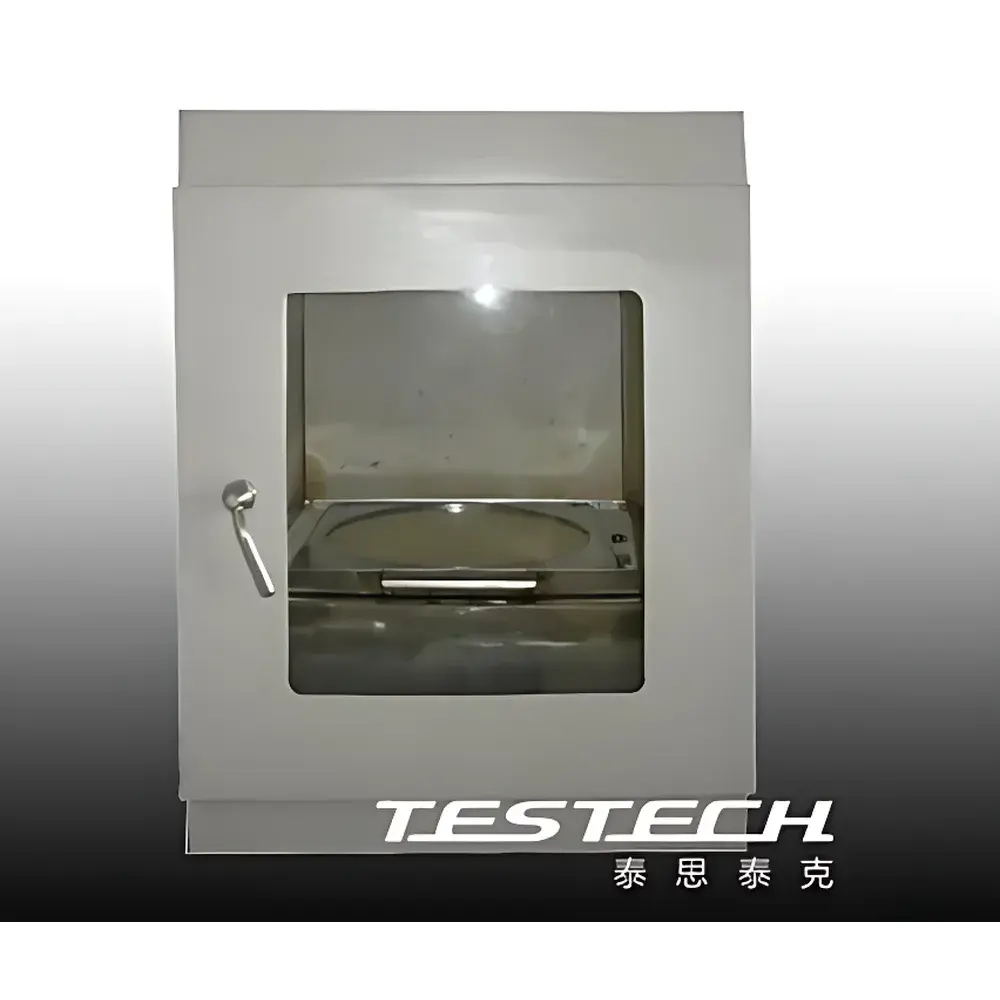
TESTech TTech-GB11049 Floor Covering Textile Horizontal Flame Spread Test Chamber
| Brand | TESTech |
|---|---|
| Origin | Jiangsu, China |
| Manufacturer Type | Direct Manufacturer |
| Origin Category | Domestic (China) |
| Model | TTech-GB11049 |
| Quotation | Upon Request |
| Chamber Interior Finish | Black Baked Enamel (Compliant with GB11049–2008) |
| Structural Materials | Stainless Steel Fixtures & Hardware |
| Operating Ambient | 10–30 °C, 20–65% RH |
| Fuel Supply | Butane Gas (Commercial Grade, ≥95% purity) |
| External Dimensions (L×W×H) | 0.30 × 0.30 × 0.58 m |
| Net Weight | 25 kg |
Overview
The TESTech TTech-GB11049 Floor Covering Textile Horizontal Flame Spread Test Chamber is a precision-engineered combustion test system designed explicitly to evaluate the horizontal flame propagation behavior of floor covering textiles under controlled laboratory conditions. It implements the standardized small-flame ignition methodology defined in GB 11049–2008, the Chinese national standard equivalent to ISO 6925 and technically aligned with ASTM E648 (Critical Radiant Flux) and EN 13501–1 (Fire Classification of Construction Products) for comparative flame spread assessment. The apparatus operates on the principle of exposing a horizontally oriented, conditioned textile specimen to a calibrated butane gas flame (20 mm height, 15 mm diameter tip) for a fixed duration (30 s), followed by measurement of the resulting char length — a quantitative indicator of flame resistance and self-extinguishing capability. This test method is widely adopted by quality control laboratories, fire safety certification bodies, and R&D departments in carpet, rug, vinyl, and modular flooring manufacturing.
Key Features
- Compliance-optimized chamber geometry: Internal volume and airflow dynamics engineered to meet GB 11049–2008’s strict requirements for thermal stability and flame uniformity during exposure.
- Black baked enamel interior finish: Achieves ≥95% light absorption to minimize radiant interference and ensure consistent thermal boundary conditions — as mandated by Clause 5.2 of GB 11049–2008.
- Full stainless steel internal fixtures: Sample holder, flame nozzle mount, and calibration gauge are fabricated from AISI 304 stainless steel to resist oxidation, thermal warping, and butane combustion byproduct corrosion over repeated test cycles.
- Integrated butane pressure regulation: Equipped with a precision needle valve and upstream pressure gauge (0–0.4 MPa range) to maintain stable fuel flow rate (±2% repeatability), critical for flame height reproducibility.
- Modular sample positioning system: Allows rapid, repeatable placement of 100 mm × 300 mm specimens at defined distances from the flame impingement point (20 mm offset), per Section 7.3 of the standard.
- Compact footprint and benchtop deployment: Designed for integration into accredited testing labs with limited floor space; no external ventilation hood required when operated in accordance with GB/T 27025–2019 (General Requirements for Competence of Testing and Calibration Laboratories).
Sample Compatibility & Compliance
The TTech-GB11049 accommodates flat, flexible floor covering materials including woven and tufted carpets, rubber-backed vinyl tiles, needle-punched nonwovens, and composite laminate flooring substrates — provided specimens meet the dimensional tolerance (±0.5 mm) and conditioning requirements specified in GB 11049–2008 (23 °C ± 2 °C, 50% RH ± 5% for ≥48 h). Each test run requires three replicate specimens per material batch to establish statistical confidence in char length reporting. The system supports full traceability documentation per ISO/IEC 17025:2017 — including instrument calibration records (flame height verification with certified gauge), environmental monitoring logs (temperature/humidity), and operator identity tracking. It is routinely validated against reference materials such as certified flame-retardant polypropylene carpet backing (NIST SRM 2911a analogs).
Software & Data Management
While the TTech-GB11049 is a manually operated, analog-controlled test chamber (no embedded microprocessor or digital interface), it is fully compatible with external laboratory information management systems (LIMS) via structured data entry templates. TESTech provides a compliant test report generator (Excel-based, ISO 17025–ready) that auto-populates fields for specimen ID, ambient conditions, flame height verification, char length measurements (mean ± SD), pass/fail determination per GB 11049–2008 Table 1 thresholds, and technician signature with timestamp. All raw measurement records — including photographic evidence of char lines (with scale reference) — are retained for minimum 5 years to satisfy GLP audit requirements and CNAS accreditation criteria.
Applications
- Pre-market validation of flame retardancy for residential and commercial carpet manufacturers supplying into China’s building code-compliant supply chain.
- Root cause analysis of flame spread anomalies during production line troubleshooting (e.g., coating thickness variation, binder resin degradation).
- Comparative benchmarking against international standards: Results correlate empirically with ASTM E648 Critical Radiant Flux (CRF) values for classification under NFPA 253 and EN 13501–1 Bfl-s1/Cfl-s1 ratings.
- Supporting third-party certification submissions to CCC (China Compulsory Certification) and CPSC-related import compliance dossiers.
- Academic research on polymer pyrolysis kinetics and intumescent additive efficacy in thermoplastic floor coverings.
FAQ
Does the TTech-GB11049 comply with ISO/IEC 17025 calibration requirements?
Yes — all critical mechanical dimensions (flame nozzle orifice, specimen support spacing, chamber internal reflectivity) are verified annually using NIST-traceable gauges and spectrophotometric black standard references.
Can the chamber be used with propane instead of butane?
No — GB 11049–2008 explicitly specifies commercial butane (C₄H₁₀) with defined calorific value and laminar flame characteristics; propane alters flame temperature profile and invalidates conformance.
Is exhaust ducting mandatory?
Not for single-test operation; however, continuous use (>5 tests/day) requires connection to a fume extraction system meeting GB 50019–2015 ventilation design guidelines to maintain indoor CO and NOₓ below OSHA PEL limits.
What maintenance intervals are recommended?
Stainless steel components require quarterly visual inspection for carbon buildup; flame nozzle must be ultrasonically cleaned every 20 test cycles using analytical-grade acetone to prevent orifice clogging.
How is operator training delivered?
TESTech provides on-site, hands-on competency assessment per GB/T 27025–2019 Annex A, including specimen conditioning protocols, flame height calibration procedure, and char length measurement technique using ISO 5725–2 repeatability criteria.



