
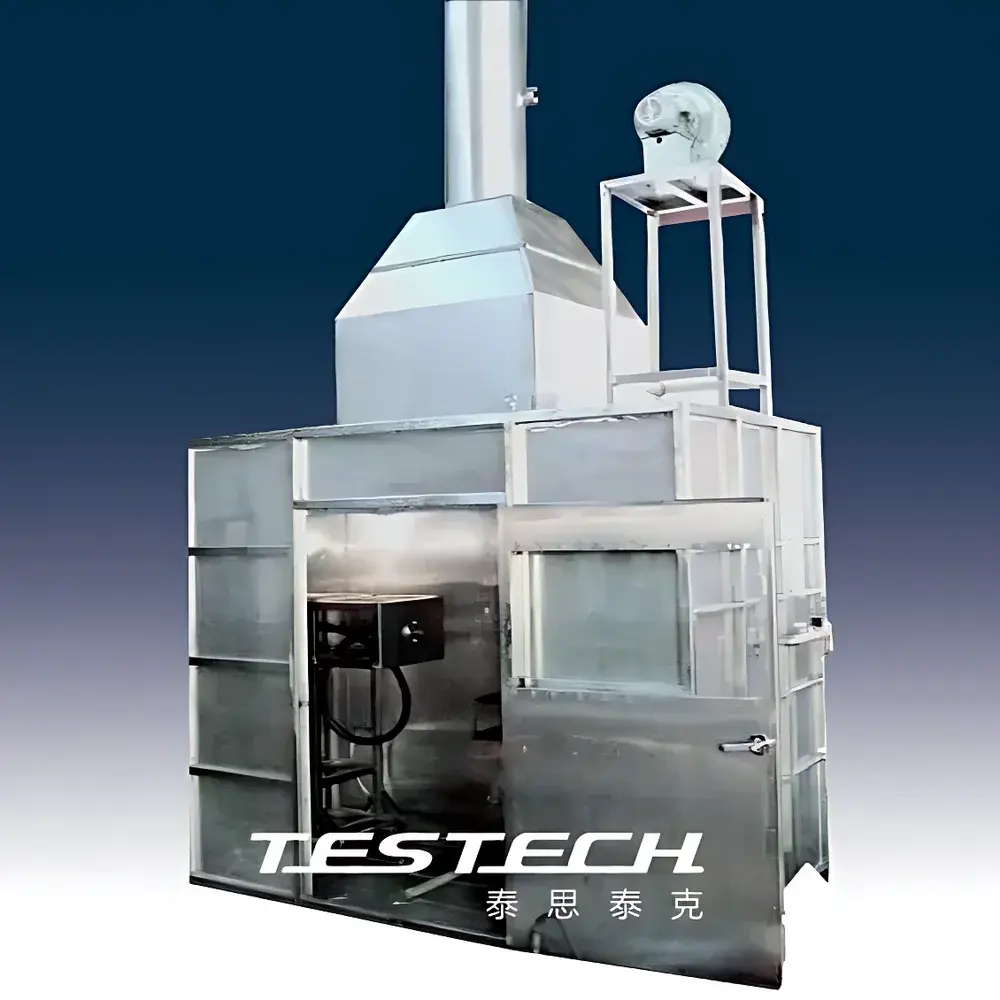
TESTech TTech-ISO19922 Fire Resistance Test System for Valves, Hose Assemblies and Plastic Piping per ISO 10497, ISO 19921, ISO 19922 & IMO FTP Code Part II (Res. A.753)
| Brand | TESTech |
|---|---|
| Origin | Jiangsu, China |
| Manufacturer Type | Direct Manufacturer |
| Product Origin | Domestic (China) |
| Model | TTech-ISO19922 |
| Price | Upon Request |
| Combustion Chamber Dimensions | 2500(W) × 1500(D) × 3000(H) mm |
| Burner Area per Unit | ≥80 × 350 mm (6 modular units) |
| Exhaust Duct | Ø400 × 1000 mm |
| Water Temperature Range | 0–120°C ±2°C |
| Test Pressure Range | 0.01–1.0 MPa (max) |
| Pressure Measurement Accuracy | ±0.01 MPa |
| Timing Resolution | 0–9999 s ±0.1 s |
| Pump Power | 1.5 kW (max. 10 kgf/cm² water pressure) |
| Heating Power | 15 kW |
| Flame Temperature | 800°C ±50°C |
| Gas/Air Flow Control | Mass Flow Controllers (0–100 L/min) |
| Data Acquisition | Automated GUI-based system with audit-trail-capable logging |
| Compliance Standards | ISO 10497, ISO 19921, ISO 19922, IMO FTP Code Part II (Res. A.753), JB/T 6899-1993 |
Overview
The TESTech TTech-ISO19922 Fire Resistance Test System is an engineered solution for evaluating the structural integrity and functional performance of valves, metallic hose assemblies with elastomeric seals, and plastic piping systems under simulated fire exposure conditions. Designed in strict accordance with internationally recognized fire safety standards—including ISO 10497 (fire testing of industrial valves), ISO 19921 and ISO 19922 (fire resistance of flexible hose assemblies), and IMO FTP Code Part II (Resolution A.753 for plastic piping on ships)—this system replicates real-world thermal and mechanical stress scenarios encountered during onboard or industrial fire events. The test principle involves simultaneous application of controlled flame impingement (800°C ±50°C) and internal hydraulic pressure loading while monitoring leakage, deformation, and functional operability over defined exposure durations. Its robust architecture supports full-scale, load-bearing tests under pressurized service conditions—critical for marine classification societies, fire certification bodies, and OEM component validation laboratories.
Key Features
- Modular six-unit burner array (each ≥80 × 350 mm), enabling scalable flame coverage for specimens of varying nominal diameters (DN15 to DN300)
- Motorized, adjustable burner positioning system to accommodate diverse valve geometries and hose coupling configurations
- Stainless-steel internal tooling and chamber lining, combined with rockwool-insulated彩 steel (color-coated steel) outer enclosure for thermal stability and corrosion resistance
- Integrated mass flow controllers (MFCs) for precise, real-time regulation of propane/air mixture (0–100 L/min), ensuring repeatable flame profile and temperature uniformity
- High-accuracy digital pressure transducers (DPT) with ±0.01 MPa resolution for continuous monitoring of internal test pressure during fire exposure
- Automated data acquisition via a laboratory-grade GUI interface, supporting time-synchronized logging of pressure, temperature, flow, and timing parameters
- Dual-purpose exhaust duct (Ø400 × 1000 mm) coupled with minimum 15 m³/min extraction capacity to maintain safe combustion byproduct removal and chamber ventilation
- Comprehensive test sequencing logic compliant with pass/fail criteria defined in ISO 10497 Annex B and IMO FTP Code Clause 7.2
Sample Compatibility & Compliance
The TTech-ISO19922 accommodates a wide range of fire-critical components: gate/check/ball valves (flanged or threaded), corrugated metal hoses with EPDM/NBR seals, and rigid thermoplastic piping (PVC, PP, PE) per IMO FTP Code Part II Res. A.753 classification levels 1–3. All test fixtures are CNC-machined from 316 stainless steel to prevent thermal distortion and ensure dimensional repeatability across multiple test cycles. The system is validated for compliance with ISO/IEC 17025 requirements for test method validation and supports traceable calibration of all critical sensors (pressure, temperature, flow). Documentation includes full traceability to NIST-traceable reference standards and alignment with GLP principles for regulatory submissions to classification societies such as DNV, LR, ABS, and BV.
Software & Data Management
The embedded control software provides ISO 17025-aligned data integrity features: role-based user access, electronic signatures, automated audit trails, and immutable test record archiving. All raw sensor data—including time-stamped pressure decay curves, temperature gradients across specimen surfaces, and volumetric leakage rates—are exported in CSV and PDF report formats compatible with FDA 21 CFR Part 11–compliant environments. Report templates include mandatory fields per ISO 10497 Clause 8 (post-test valve operability verification), ISO 19922 Clause 6.4 (seal integrity assessment), and IMO FTP Code Table 2 (flame spread index calculation). Optional integration with LIMS platforms is supported via OPC UA protocol.
Applications
This system serves as a primary qualification platform for manufacturers supplying fire-rated components to maritime, offshore oil & gas, and process industries. Typical use cases include: type approval testing of Class-approved marine valves; validation of hose assembly fire endurance for FPSO and LNG carrier applications; comparative evaluation of polymer pipe formulations under hydrothermal stress; and root-cause analysis of seal failure mechanisms during fire exposure. It is also deployed by notified bodies for witnessed conformity assessments and by R&D labs conducting accelerated aging studies correlated with fire performance degradation.
FAQ
Does the system support both cold and hot pressure hold testing per ISO 10497 Annex C?
Yes—the integrated hydraulic circuit maintains stable test pressure before, during, and after flame exposure, with automatic pressure replenishment logic to compensate for thermal expansion effects.
Can the system be configured for non-marine applications, such as petrochemical plant piping?
Yes—custom test protocols can be programmed to align with API RP 2510, NFPA 59A, or EN 13501-2 requirements upon request.
Is third-party calibration documentation included with delivery?
Yes—factory calibration certificates for all transducers, thermocouples, and flow meters are provided, each referencing national metrology institute (NIM) traceability.
What maintenance intervals are recommended for the burner modules and MFCs?
Burner nozzles require inspection every 50 test cycles; MFC recalibration is advised annually or after 200 operational hours, whichever occurs first.
Does the system meet electromagnetic compatibility (EMC) requirements for shipboard installation?
While designed for land-based lab use, EMC compliance per IEC 60533 (Class A2) can be achieved with optional shielding upgrades and filtered power conditioning units.



