
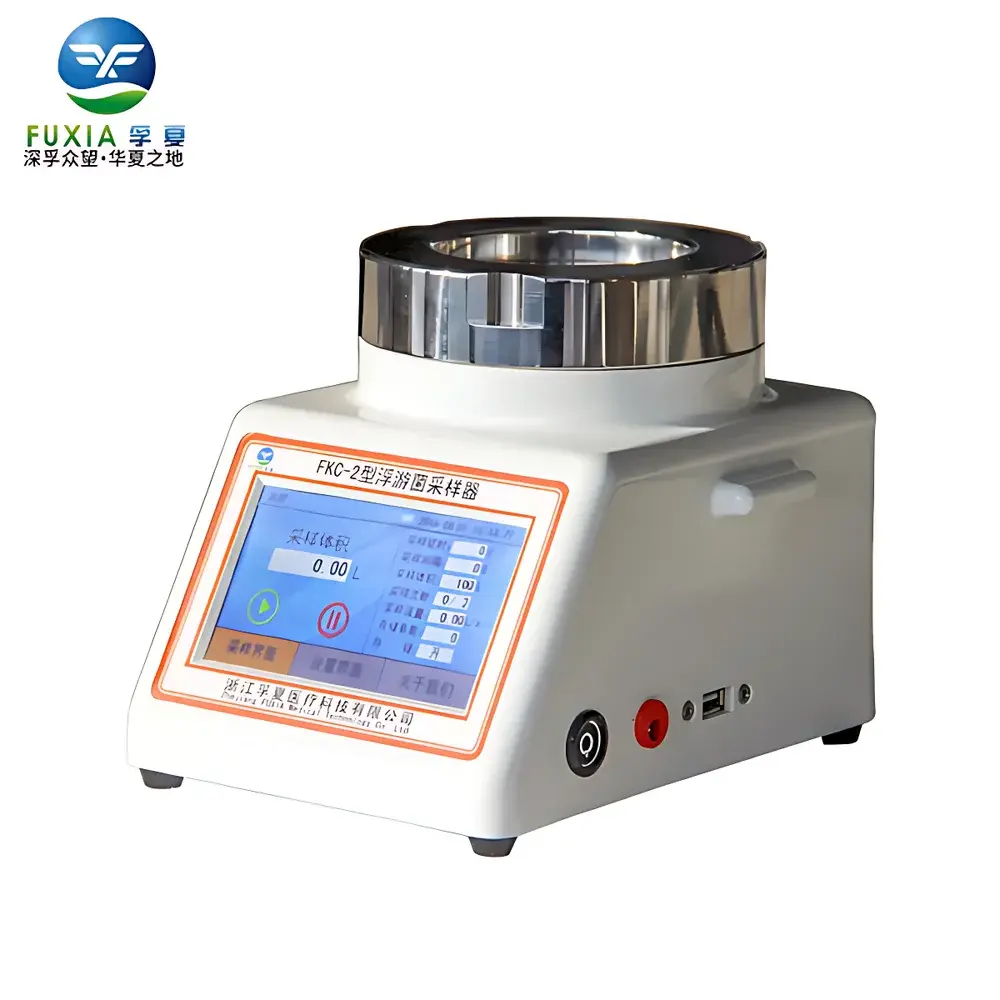
FUXIA FKC-2 Anderson-Type Airborne Microbial Sampler
| Brand | FUXIA |
|---|---|
| Origin | Zhejiang, China |
| Model | FKC-2 |
| Sampling Principle | Andersen Impaction |
| Flow Rate | 100 L/min ±5% |
| Flow Measurement Accuracy | ±5% |
| Operating Time | >4 hours (battery-powered) |
| Temperature Range | 10–60 °C |
| Relative Humidity Range | 10–75% RH |
| Dimensions | 155 × 190 × 155 mm (W×D×H) |
| Weight | 2.1 kg |
| Sampling Head Material | SUS316L stainless steel |
| Nozzle Count | 397 |
| Nozzle Diameter | 0.7 mm (straight bore, no chamfer) |
| Impact Velocity | 10.8 m/s (Andersen Stage 5 equivalent) |
| Data Storage Capacity | 5,000 sample records |
| Interface | USB port for data export |
| Compliance | ISO 14698-1/2, GB/T 16293–2010 |
Overview
The FUXIA FKC-2 Anderson-Type Airborne Microbial Sampler is a precision-engineered, touch-screen controlled active air sampler designed for quantitative assessment of viable airborne microorganisms in cleanroom environments, pharmaceutical manufacturing facilities, hospital isolation rooms, and microbiological laboratories. It operates on the well-established Andersen impactor principle—specifically calibrated to replicate the aerodynamic cut-off characteristics of Andersen Stage 5—enabling efficient inertial impaction of particles ≥0.6 µm onto standard 90 mm Petri dishes containing nutrient agar. The device delivers a consistent volumetric flow rate of 100 L/min with ±5% accuracy, ensuring reproducible colony-forming unit (CFU) recovery across repeated sampling events. Its compact, ABS polymer housing features seamless, non-porous construction to eliminate cleaning crevices and support rigorous decontamination protocols required under GMP and ISO 14698-1 hygiene management frameworks.
Key Features
- 397 precisely drilled, straight-bore stainless-steel (SUS316L) nozzles (0.7 mm diameter) minimize particle bounce and microbial overlap, enhancing counting fidelity and reducing false negatives.
- Full-color capacitive touchscreen interface enables intuitive programming of sampling volume (1–9999 L), delay time (0–255 s), and cycle duration (0–9999 s).
- Onboard memory stores up to 5,000 complete sampling records—including timestamp, set flow, actual flow, elapsed time, and total volume—with automatic parameter pagination.
- Dedicated ASIC-based flow control circuitry ensures long-term stability of 100 L/min airflow under variable battery load or ambient pressure conditions.
- Tool-free Petri dish exchange mechanism accommodates industry-standard 90 × 15 mm agar plates without disassembly or alignment tools.
- Battery operation supports ≥4 hours of continuous sampling (typical usage), with AC/DC adapter (220 V AC input → 16.8 V DC output) included for benchtop or mobile deployment.
Sample Compatibility & Compliance
The FKC-2 is validated for use with conventional tryptic soy agar (TSA), Sabouraud dextrose agar (SDA), and other microbiologically appropriate media. Its impactor geometry and velocity profile align with the particle size selectivity defined in ISO 14698-2 for viable particle monitoring and satisfy the method requirements of Chinese national standard GB/T 16293–2010 for pharmaceutical cleanroom environmental monitoring. The SUS316L sampling head withstands repeated exposure to ethanol, hydrogen peroxide vapor (HPV), and saturated chlorine dioxide—making it suitable for integration into controlled environment qualification and routine environmental monitoring (EM) programs compliant with EU Annex 1 and USP . Device firmware and data handling architecture support audit-ready traceability when used within GLP/GMP workflows requiring documented calibration, user access logs, and electronic record integrity.
Software & Data Management
Raw sampling metadata—including date/time stamps, programmed vs. measured flow, cumulative volume, and operational status flags—are stored internally in non-volatile memory. Export is performed via standard USB 2.0 interface using FAT32-formatted flash drives; exported files are plain-text CSV format with UTF-8 encoding, enabling direct import into LIMS, Excel, or statistical analysis platforms (e.g., JMP, Minitab). No proprietary software installation is required. All stored entries include unique session identifiers and checksum-verified timestamps to ensure data integrity. While the FKC-2 does not implement FDA 21 CFR Part 11-compliant electronic signatures or role-based access control, its deterministic data logging model facilitates retrospective validation and satisfies baseline ALCOA+ principles (Attributable, Legible, Contemporaneous, Original, Accurate) when paired with procedural controls.
Applications
- Routine environmental monitoring (EM) in Grade A/B/C/D cleanrooms per ISO 14644 and EU GMP Annex 1.
- Viable particulate mapping during facility commissioning, requalification, and contamination investigations.
- Validation of HVAC system performance, including filter integrity testing and air change rate verification.
- Microbiological risk assessment in aseptic processing suites, isolators, and RABS environments.
- Research applications involving aerosolized bacterial/fungal spore deposition kinetics and bioaerosol transport modeling.
- Quality control in medical device packaging areas and sterile compounding pharmacies (USP ).
FAQ
What regulatory standards does the FKC-2 comply with?
It conforms to ISO 14698-1/2 (biocontamination control) and GB/T 16293–2010 (airborne microbial testing in pharmaceutical settings). Its design basis aligns with Andersen impactor performance criteria referenced in ISO 14644-1 Annex B.
Can the FKC-2 be used with non-standard Petri dishes?
No—it is mechanically optimized for 90 mm diameter × 15 mm height Petri dishes. Deviations may compromise seal integrity and impaction efficiency.
Is flow calibration traceable to national standards?
The instrument includes a built-in thermal mass flow sensor calibrated against NIST-traceable reference devices during factory certification; users must perform periodic field verification using a primary standard flow calibrator (e.g., dry cal gas meter or bubble flowmeter).
Does the device support real-time flow adjustment during sampling?
No—flow is fixed at 100 L/min. Volume control is achieved by setting total sampling duration or target volume; the system maintains constant flow throughout the programmed cycle.
How is battery runtime affected by ambient temperature?
At temperatures above 45 °C or below 15 °C, battery discharge efficiency decreases; nominal 4-hour runtime assumes operation between 20–30 °C and 40–60% RH.
Related Products







