
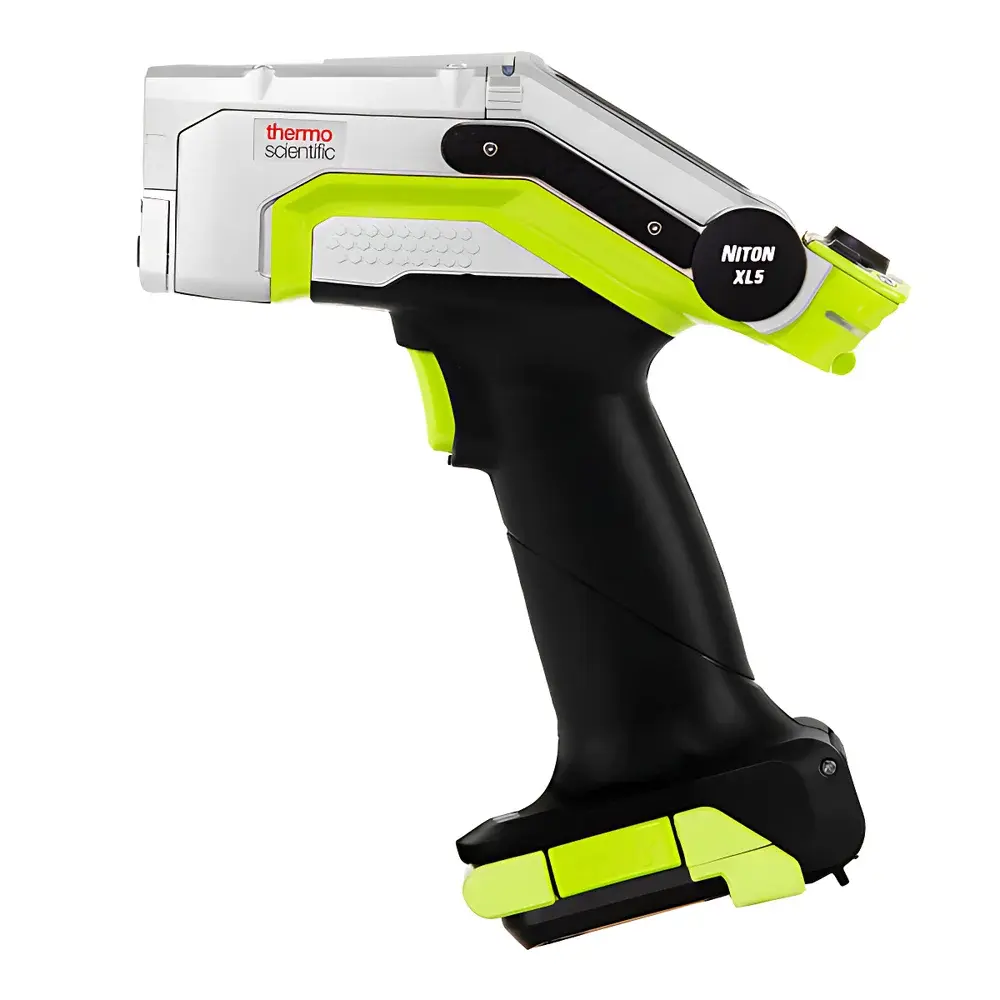
Niton XL5 Handheld Ore Analyzer
| Brand | Niton |
|---|---|
| Origin | USA |
| Manufacturer | Thermo Fisher Scientific |
| Model | XL5 |
| Application | Field-Portable |
| Industry-Specific Use | Geological & Mining Exploration |
| Elemental Range | Mg to U |
| Quantification Range | 1 ppm – 99.99% |
| Repeatability | ±0.1% RSD |
| Detector | Graphene-Enhanced Silicon Drift Detector (SDD) |
Overview
The Niton XL5 Handheld Ore Analyzer is a field-deployable Energy Dispersive X-Ray Fluorescence (EDXRF) spectrometer engineered for high-fidelity elemental quantification in geological exploration, mining operations, and resource evaluation. Leveraging fundamental EDXRF physics—where primary X-rays from a miniature high-efficiency X-ray tube excite characteristic secondary (fluorescent) X-rays from sample atoms—the XL5 delivers rapid, non-destructive, in-situ analysis of solid rock, drill core, soil, and ore fragments. Unlike laboratory-based techniques requiring sample dissolution or pelletization, the XL5 operates directly on heterogeneous, unprepared surfaces, enabling real-time geochemical mapping without transport delays or lab turnaround bottlenecks. Its design targets the critical decision window in mineral exploration: delivering statistically robust elemental concentrations within seconds to support boundary delineation, grade estimation, and three-dimensional deposit modeling under field conditions.
Key Features
- Graphene-Enhanced SDD Detector: Incorporates a next-generation silicon drift detector with graphene-based thermal management, delivering improved count-rate linearity and low-energy sensitivity—particularly critical for light elements (Mg–P) in silicate matrices.
- 5-W High-Efficiency Microfocus X-ray Tube: Engineered by Thermo Fisher Scientific, this tube provides 20% higher photon flux per watt compared to conventional micro-tubes, enhancing signal-to-noise ratio for trace-element detection down to 1 ppm.
- Dual-Camera Targeting System: Co-registered macro and micro cameras enable precise positioning over sub-millimeter features (0.5 mm analysis spot), while simultaneously capturing full-sample contextual imagery for audit-ready documentation.
- Hot-Swappable Battery Architecture: Supports uninterrupted operation during extended field campaigns; battery replacement requires no instrument shutdown, eliminating recalibration cycles and thermal stabilization delays.
- Ergonomic Industrial Design: Optimized center-of-gravity distribution and compact form factor allow stable one-handed operation in confined spaces—including borehole trays, trench walls, and underground drifts.
- Dynamic Beam Optimization: Real-time tube current and voltage adjustment based on sample composition ensures optimal excitation conditions across diverse matrices—from ultramafic rocks to oxidized laterites—without manual method selection.
Sample Compatibility & Compliance
The XL5 accommodates irregular, coarse, and weathered geological samples without grinding or pressing. It complies with IEC 61000-4 electromagnetic compatibility standards and meets FDA 21 CFR Part 1040.20 requirements for radiation safety in handheld XRF devices. While not certified for GLP/GMP environments per se, its built-in audit trail (user ID, timestamp, GPS coordinates, spectrum metadata) supports ISO/IEC 17025-compliant data integrity workflows when integrated into validated QA/QC protocols. All calibrations are traceable to NIST SRM reference materials, and factory-certified performance verification reports are supplied with each unit.
Software & Data Management
NitonConnect PC software serves as the central hub for instrument configuration, firmware updates, remote diagnostics, and spectral library management. It enables role-based user access control, customizable reporting templates (PDF/CSV), and certificate-of-analysis generation compliant with ASTM E1621 and ISO 18115-2 guidelines. Wireless connectivity via Wi-Fi and Bluetooth 5.0 allows secure synchronization with enterprise LIMS or GIS platforms. Raw spectra, processed results, geotagged images, and instrument health logs are stored in an encrypted SQLite database, supporting forensic reconstruction of analytical sequences during regulatory audits.
Applications
- Exploration & Prospecting: Rapid multi-element screening of outcrops, float, and stream sediments to identify geochemical anomalies and prioritize follow-up sampling—reducing lab submission volume by up to 70% in early-stage programs.
- Drill Core Logging: Continuous, meter-by-meter elemental profiling of core trays to define lithological contacts, alteration halos, and metal zonation—enabling real-time adjustments to drilling depth and orientation.
- Mine Face & Stockpile Analysis: On-belt or in-pit grade control for Cu, Fe, Ni, Zn, Pb, Au (via Au-Lα), and REEs, supporting dynamic blending decisions and mill feed optimization.
- Tailings & Waste Characterization: Quantification of residual metals and hazardous elements (e.g., As, Cd, Hg) for environmental compliance monitoring and reprocessing feasibility assessment.
- Geotechnical & Environmental Site Assessment: Screening for heavy metal contamination in soils and sediments per EPA Method 6200 and ASTM D7213.
FAQ
Does the XL5 require daily calibration checks?
No—factory-calibrated methods are stable for field use over 8–12 hours; however, a quick verification using a check standard (e.g., Ni-Cu alloy or basalt CRM) is recommended before critical assay batches.
Can the XL5 analyze light elements like Mg, Al, and Si in silicates?
Yes—its optimized vacuum path and graphene-SDD detector provide reliable quantification of Mg (12) through P (15) in geological matrices, subject to surface homogeneity and moisture content.
Is GPS data embedded in exported reports?
Yes—each measurement includes WGS84 latitude, longitude, elevation, and UTC timestamp, all exportable in CSV or GeoJSON formats.
What radiation safety certifications does the XL5 hold?
It is certified to IEC 62495 (handheld XRF) and complies with national regulations including US 21 CFR 1020.40 and EU Directive 2013/59/Euratom.
How is data integrity maintained during offline field operation?
All measurements are locally stored with cryptographic hashing; sync conflicts are resolved via timestamp-weighted versioning upon reconnection to NitonConnect.





