
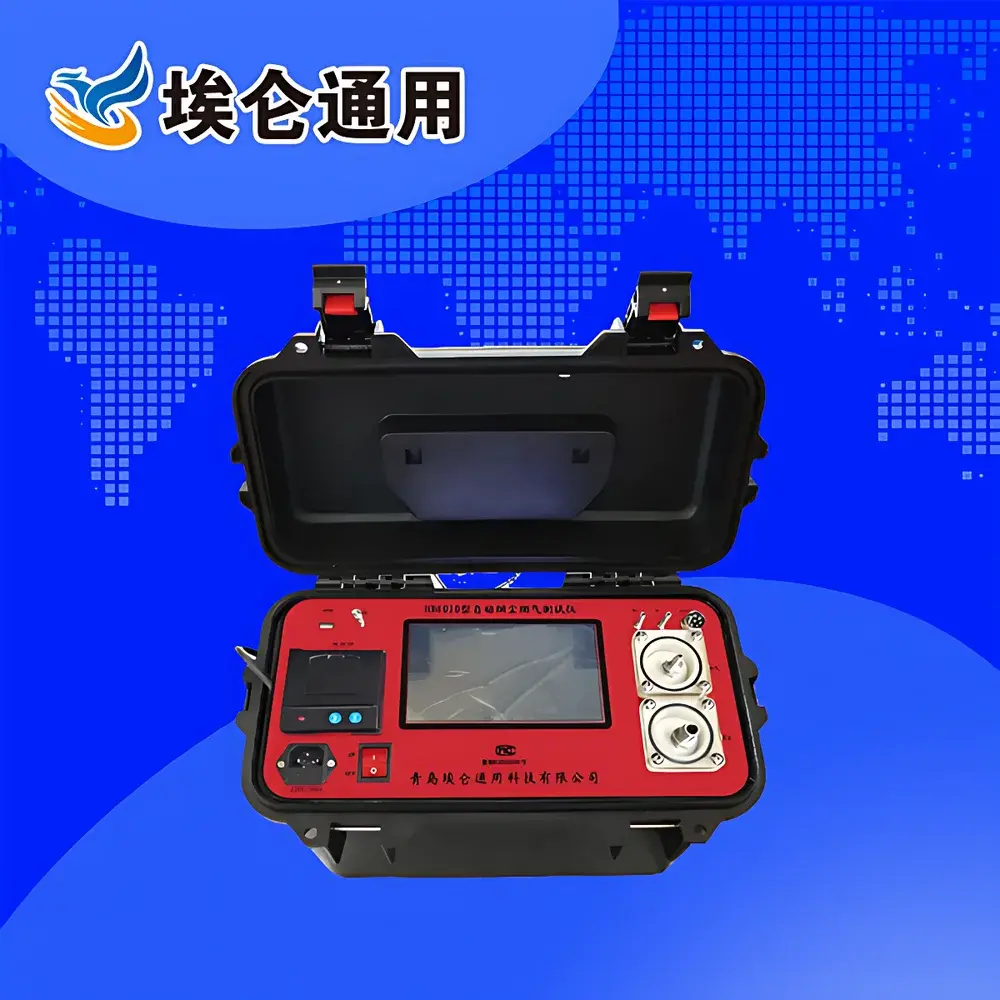
Ailun HB6020 Automatic Flue Gas and Particulate Emission Analyzer
| Brand | Ailun General / Qingdao Ailun |
|---|---|
| Origin | Shandong, China |
| Manufacturer Type | Authorized Distributor |
| Country of Origin | China |
| Model | HB6020 |
| Instrument Type | Flue Gas and Particulate Sampler |
| Measured Gases | O₂, SO₂, NO, NO₂, CO, CO₂, H₂S |
| Flow Accuracy | ≤ ±4.0% |
| Maximum Cumulative Sampling Volume | 999,999.9 L |
| Flue Gas Velocity Range | 1–45 m/s |
| Moisture Content Range | 0–60% |
Overview
The Ailun HB6020 Automatic Flue Gas and Particulate Emission Analyzer is an integrated, field-deployable instrument engineered for regulatory-compliant stack emission monitoring in industrial, municipal, and environmental compliance applications. It operates on dual measurement principles: isokinetic particulate sampling based on Pitot tube differential pressure tracking, and electrochemical gas sensing with real-time flue gas parameter compensation. Designed to meet the technical requirements of Chinese national metrological verification regulations JJG 680–2007 (Particulate Samplers) and JJG 968–2002 (Flue Gas Analyzers), the HB6020 supports both continuous emission monitoring (CEM)-adjacent spot sampling and periodic audit-level testing. Its architecture eliminates legacy single-chip microcontroller limitations by adopting a dual-CPU embedded control system with digital inter-processor communication and multi-stage opto-isolated signal conditioning—ensuring operational integrity under high-electromagnetic-noise industrial environments.
Key Features
- Integrated measurement of flue gas composition (O₂, SO₂, NO, NO₂, CO, CO₂, H₂S), particulate mass concentration, moisture content (0–60%), flue gas velocity (1–45 m/s), dynamic/static pressure, stack temperature, and derived parameters including excess air coefficient and volumetric emission rate.
- Intelligent isokinetic tracking: automatically adjusts sampling probe velocity to match real-time flue gas flow via Pitot tube feedback—enabling compliant particulate sampling per GB/T 16157 and ISO 9096 principles; switches to constant-flow mode for low-velocity stacks (<5 m/s).
- High-stability electrochemical gas sensors with integrated signal conditioning modules—no recalibration required upon sensor replacement; built-in temperature compensation, linearity correction, and cross-interference mitigation algorithms for SO₂/NO/CO/H₂S channels.
- Patented triple-function drying tube: combines Nafion-based moisture removal, sintered stainless-steel particulate filtration, and anti-backflow check valve—minimizing maintenance intervals and preserving flowmeter accuracy over extended deployments.
- Dual-CPU fault-tolerant architecture: CPUs monitor each other’s watchdog timers and memory states; all I/O channels employ galvanic isolation to suppress common-mode noise from variable-frequency drives or welding equipment.
- Onboard data storage: retains up to 200 complete sampling records with timestamp, location ID, operator code, and full parameter set—including raw sensor outputs and calculated emission metrics.
- Power failure recovery: automatically saves current sampling state (elapsed time, volume, pressure differentials) during unexpected outage; resumes sampling at identical isokinetic conditions upon power restoration.
Sample Compatibility & Compliance
The HB6020 is validated for sampling across diverse combustion sources including coal-fired boilers, waste incinerators, cement kilns, asphalt mixing plants, and metal smelters. It accommodates particulate phases ranging from coarse fly ash (>10 µm) to submicron condensable aerosols—including semi-volatile organic compounds (SVOCs) when equipped with optional quartz fiber filter + polyurethane foam (PUF) sorbent cartridges. All gas measurements comply with Q/0212AIL002–2012 (Ailun internal standard), while mechanical and metrological performance aligns with JJG 680–2007 (particulate sampler accuracy class ±4.0% flow error) and JJG 968–2002 (gas analyzer repeatability ≤2% FS). The instrument supports traceable calibration via certified span gases and certified reference particulates (e.g., ISO 12103–1 A2 test dust).
Software & Data Management
Data acquisition and reporting are managed through a ruggedized industrial mini-PC running a deterministic real-time OS. Raw sensor values, pressure differentials, temperature gradients, and flow profiles are logged at 1 Hz resolution. Export formats include CSV and XML compliant with China’s Ministry of Ecology and Environment (MEE) data submission protocols. Customizable report templates allow users to select fields for printed output—including QA/QC flags, calibration due dates, and audit trail timestamps. Audit logging meets GLP-aligned requirements: all parameter modifications, password changes, and calibration events are immutably timestamped and user-attributed. While not natively 21 CFR Part 11 compliant, the system supports external validation packages for regulated laboratories requiring electronic signature and change control.
Applications
- Regulatory stack testing per China’s GB 13271 (Boiler Air Pollutant Emission Standards) and GB 16297 (Comprehensive Emission Standard for Air Pollutants)
- Pre-compliance verification for CEMS installation and performance qualification
- Source apportionment studies involving co-emitted particulates and acid gases
- Process optimization in thermal power plants and chemical manufacturing units
- Field validation of continuous opacity monitors (COM) and parametric CEMS
- Research on SVOC partitioning behavior in flue gas cooling zones
FAQ
Does the HB6020 support ISO 12103–1 A2-certified particulate sampling?
Yes—the instrument’s isokinetic probe assembly and filter holder accept standard 90-mm quartz fiber filters calibrated per ISO 12103–1 A2, with documented collection efficiency >99.5% for PM₁₀.
Can the device perform simultaneous gas and particulate sampling without cross-contamination?
Yes—dual independent sampling paths isolate gas analysis (electrochemical cells) from particulate capture (filter + impinger); heated sample lines prevent condensation-induced analyte loss.
Is firmware upgrade capability available remotely?
Firmware updates require local USB connection and authenticated access; no remote update functionality is implemented to maintain data integrity and cybersecurity compliance.
What is the recommended calibration interval for electrochemical sensors?
Per manufacturer guidelines: zero/span calibration every 30 days under routine use; full sensor verification with certified gases every 90 days or after 200 hours of operation.
Does the HB6020 meet EU EN 15267 or US EPA PS-11 equivalency?
No—the HB6020 is designed and verified against Chinese national standards only; it has not undergone third-party type approval under EN 15267 or EPA Performance Specification 11.
Related Products







