
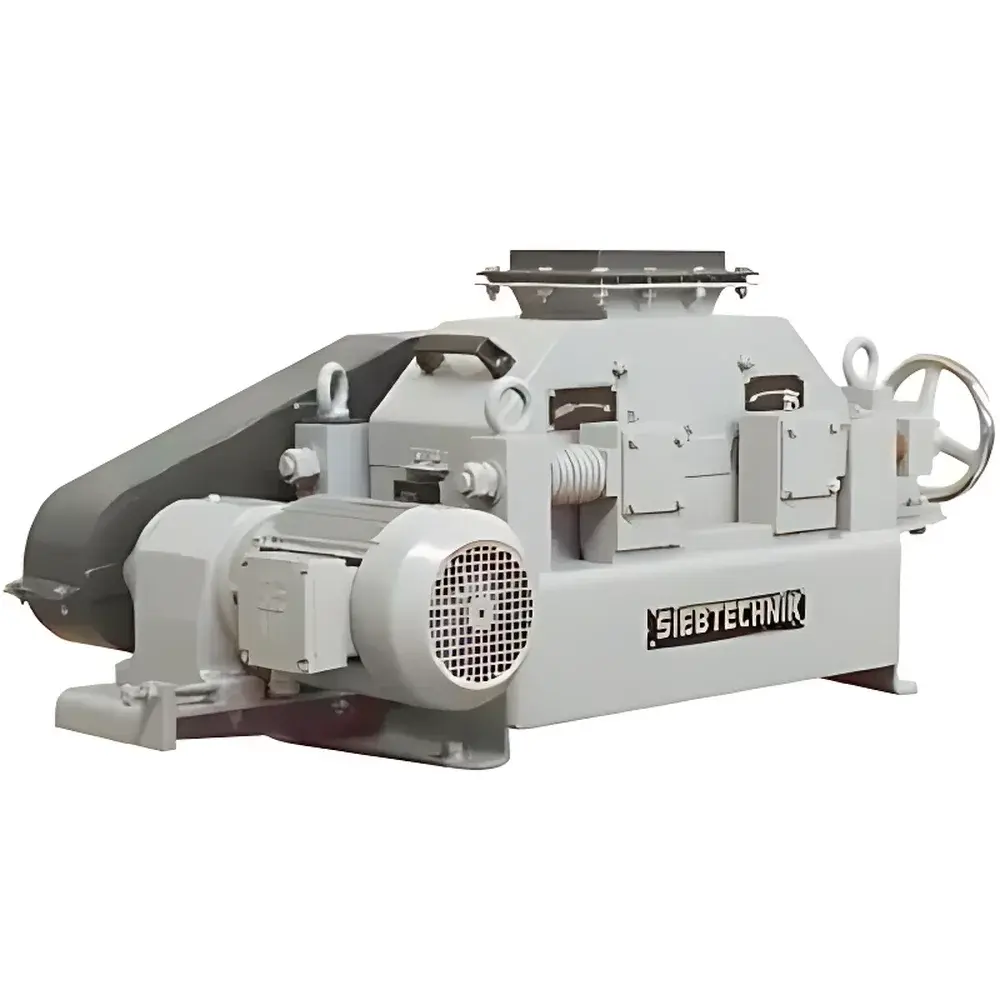
Siebtechnik WS 25/15 Double Roll Mill
| Brand | Siebtechnik |
|---|---|
| Origin | Germany |
| Model | WS 25/15 Double Roll Mill |
| Maximum Feed Size | <12 mm |
| Final Particle Size | <200 µm |
| Roll Gap Adjustment Range | 0.2–5 mm (continuously adjustable) |
| Throughput Capacity | 0.1–20 m³/h |
| Roll Speed | 259 rpm |
| Roll Dimensions | Ø250 mm × 150 mm |
| Drive Motor Power | 3,000 W |
| Roll Material | Stainless Steel / Tungsten Carbide |
| Overall Dimensions (w/o base) | 635 mm × 1135 mm × 530 mm |
| Applicable Materials | Brittle to medium-hard solids (Mohs hardness up to 8.5), e.g., limestone, coal, coke, quartz sand, ceramics, glass, bauxite, slag |
Overview
The Siebtechnik WS 25/15 Double Roll Mill is a precision-engineered laboratory and pilot-scale size reduction instrument designed for controlled comminution of brittle and medium-hard solid materials. Operating on the principle of compression and shear between two counter-rotating rolls, it delivers reproducible particle size reduction through mechanical stress rather than impact or attrition. This makes it particularly suitable for applications where minimal heat generation, low fines generation, and preservation of particle morphology are critical—such as in mineralogical analysis, cement raw material preparation, ceramic formulation, and quality control of industrial aggregates. The mill’s robust cast-iron frame, high-torque 3 kW motor, and tungsten carbide–reinforced roll surfaces ensure long-term dimensional stability and wear resistance under continuous operation. Its design conforms to DIN EN 61000-6-2 (EMC immunity) and DIN EN 61000-6-4 (EMC emission) standards, supporting integration into regulated laboratory environments.
Key Features
- Continuously adjustable roll gap (0.2–5 mm) via external handwheel, enabling precise control over final particle size distribution without tool change or recalibration.
- High-capacity throughput range of 0.1–20 m³/h, scalable from analytical batch processing to continuous feed applications in R&D and process validation workflows.
- Roll assembly constructed from hardened stainless steel or optional tungsten carbide cladding—engineered for extended service life when processing abrasive materials with Mohs hardness up to 8.5.
- Fully hinged grinding chamber allows rapid access to both rolls for visual inspection, manual cleaning, and residue removal—critical for cross-contamination mitigation between dissimilar samples.
- Low-noise operational profile (<78 dB(A) at 1 m), achieved through precision gear alignment, vibration-damped mounting, and optimized roll surface geometry—enabling safe deployment in shared laboratory spaces.
- Integrated dust containment system compatible with optional local exhaust ventilation (LEV), meeting OSHA 1910.90 and EU Directive 2004/37/EC (carcinogens and mutagens) requirements for operator protection.
Sample Compatibility & Compliance
The WS 25/15 accommodates feed particles up to 12 mm in maximum dimension and consistently reduces them to a final top size below 200 µm. It is validated for use with geologically diverse brittle solids including but not limited to: limestone, coal, coke, quartz sand, alumina, feldspar, ceramic green bodies, tempered glass shards, and metallurgical slags. Its mechanical design and material contact surfaces comply with FDA 21 CFR Part 11–ready documentation practices when paired with optional digital logging modules. The unit supports GLP-compliant operation through traceable gap-setting records and repeatable torque-load profiles—essential for method transfer between QC labs and production sites adhering to ISO/IEC 17025 or ASTM D3403 standards.
Software & Data Management
While the base WS 25/15 operates via manual gap adjustment and analog motor control, optional digital upgrades include a programmable logic controller (PLC) interface with RS-485 Modbus RTU output. This enables integration into centralized LIMS or MES platforms for automated logging of roll speed, motor current draw, operating duration, and user-logged gap settings. Audit trails generated meet FDA 21 CFR Part 11 requirements for electronic records when deployed with time-stamped, role-based user authentication and non-erasable event logs. Optional USB data export supports post-processing in MATLAB, Python (Pandas), or JMP for statistical grain size distribution modeling per ISO 9276-2.
Applications
- Preparation of representative subsamples for XRF, XRD, and SEM-EDS analysis in geochemical laboratories.
- Routine particle size reduction of coal and coke prior to proximate and ultimate analysis (ASTM D3172, D3176).
- Standardized grinding of cement clinker and additives in accordance with EN 196-6 for Blaine fineness testing.
- Batch-wise size conditioning of ceramic powders before dry pressing or spray drying—minimizing agglomeration and flow variability.
- Controlled fragmentation of recycled glass cullet for optical sorting validation and melt homogeneity studies.
- Pilot-scale simulation of industrial roll crusher performance for process scale-up and equipment specification.
FAQ
What is the recommended maintenance interval for the WS 25/15 roll surfaces?
Roll surface inspection and cleaning should be performed after each sample batch; full lubrication and bearing check every 500 operating hours.
Can the mill handle wet or sticky feed materials?
No—it is strictly designed for dry, free-flowing, brittle feedstocks; moisture content above 1% w/w may cause clogging and uneven gap loading.
Is CE marking available for this model?
Yes—the WS 25/15 carries full CE marking under Machinery Directive 2006/42/EC and EMC Directive 2014/30/EU.
Does Siebtechnik provide calibration certificates for gap setting accuracy?
Traceable gap verification certificates (DIN EN ISO/IEC 17025 accredited) are available upon request for GMP-regulated installations.
What safety interlocks are integrated into the machine?
A dual-channel electro-mechanical safety switch deactivates drive power when the grinding chamber door is opened, compliant with EN ISO 14119.
Related Products



