
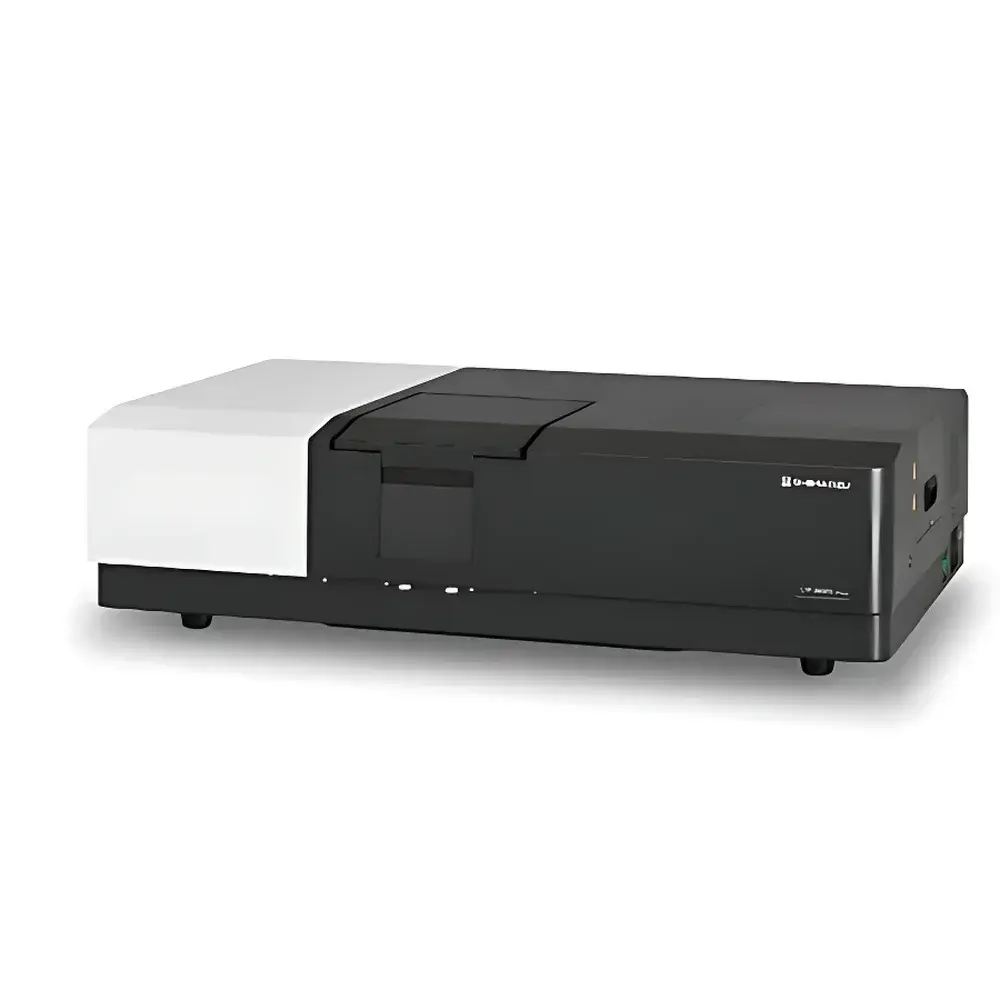
Shimadzu UV-3600i Plus UV-Vis-NIR Spectrophotometer
| Brand | Shimadzu |
|---|---|
| Origin | Japan |
| Manufacturer Type | Original Equipment Manufacturer (OEM) |
| Import Status | Imported |
| Model | UV-3600i Plus |
| Instrument Architecture | Double-beam |
| Automation Level | Automatic Wavelength Scanning |
| Wavelength Range | 185 nm to 3300 nm |
Overview
The Shimadzu UV-3600i Plus is a high-performance double-beam UV-Vis-NIR spectrophotometer engineered for precision quantitative and qualitative analysis across an exceptionally broad spectral range—from deep ultraviolet (185 nm) through visible light to near-infrared (3300 nm). Its optical design employs a high-stability xenon lamp for UV-Vis excitation and a tungsten-halogen source for NIR, coupled with a monochromator featuring optimized grating dispersion and aberration correction. The instrument operates on classical Beer–Lambert law-based absorbance measurement principles, with real-time baseline correction enabled by simultaneous reference and sample beam monitoring. This architecture ensures high photometric accuracy, long-term wavelength stability (< ±0.02 nm over 24 h), and minimal thermal drift—critical for regulatory-compliant routine analysis in pharmaceutical QC, materials science, and academic spectroscopy laboratories.
Key Features
- Triple-detector configuration: Photomultiplier tube (PMT) for 185–860 nm, extended-range InGaAs photodiode for 860–1700 nm, and PbS detector for 1700–3300 nm—enabling seamless, high-sensitivity coverage across the full 185–3300 nm range.
- Ultra-low stray light performance: < 0.00008% at 220 nm (NaI) and < 0.0001% at 340 nm (NaNO₂), minimizing spectral interference in high-absorbance measurements (e.g., concentrated solutions or thin-film transmittance).
- Low-noise NIR detection: RMS noise ≤ 0.00003 Abs at 1500 nm (1 s integration time, 2 nm slit width), supporting reliable quantification of weakly absorbing NIR transitions in polymers, semiconductors, and biological tissues.
- Double-beam optical path with real-time compensation: Minimizes baseline drift from source intensity fluctuations and environmental temperature variations—essential for kinetic studies and multi-hour stability tests.
- Modular sample compartment: Accommodates up to 8-position automatic cuvette changers, large-format solid-sample holders, and optional accessories without recalibration.
Sample Compatibility & Compliance
The UV-3600i Plus supports liquid, suspension, powder, thin-film, and solid-state samples via interchangeable accessories—including 60 mm integrating spheres (with BaSO₄-coated interior for >98% diffuse reflectance), absolute reflectance measurement units compliant with ASTM E1331 and ISO 13468, and thermostatted cell holders (±0.1 °C stability) for temperature-dependent spectral studies. All hardware and software modules are designed to support GLP/GMP environments: audit trails, electronic signatures, and user-access-level controls are fully integrated into LabSolutions UV-Vis CS (Compliance Support) edition, which meets FDA 21 CFR Part 11 requirements for data integrity, traceability, and secure archiving.
Software & Data Management
LabSolutions UV-Vis software provides unified control across spectral acquisition, photometric quantitation, kinetics modeling, and report generation. Key capabilities include automated peak identification with customizable thresholding, batch processing of multi-sample sets with auto-zero and auto-scale functions, and direct export to Excel-compatible CSV or XML formats. The DB (Database) and CS editions extend functionality with relational database storage, version-controlled method templates, and role-based permissions. All raw spectra are stored with embedded metadata (instrument ID, operator, date/time stamp, calibration status), enabling full traceability during internal audits or regulatory inspections.
Applications
- Pharmaceutical development: Active pharmaceutical ingredient (API) assay, dissolution profile analysis, and excipient compatibility screening per USP and ICH Q2(R2) guidelines.
- Materials characterization: Bandgap determination of nanomaterials, optical density profiling of anti-reflective coatings, and moisture content analysis in hygroscopic polymers using NIR overtone bands (e.g., O–H stretch at ~1940 nm).
- Environmental testing: Quantification of nitrate, phosphate, and heavy metal complexes in water matrices using standardized colorimetric methods (e.g., EPA Method 353.2).
- Academic research: Time-resolved absorption kinetics in photochemical reactions, solvent polarity effects on π→π* transitions, and multivariate calibration for NIR-based compositional analysis.
FAQ
What is the maximum scan speed and resolution achievable with the UV-3600i Plus?
Maximum scan speed is 28,800 nm/min at 1.0 nm data interval; spectral resolution is selectable from 0.1 nm to 5.0 nm (nominal bandwidth), with 0.1 nm resolution validated per NIST SRM 2034.
Is the instrument compatible with third-party accessories such as fiber-optic probes or flow cells?
Yes—via optional SMA-905 or FC/PC optical interfaces; Shimadzu provides mechanical and optical alignment specifications for OEM integration.
How does the triple-detector system handle signal switching between PMT, InGaAs, and PbS?
Detector switching occurs automatically at predefined crossover wavelengths (860 nm and 1700 nm) with < 50 ms transition time and built-in intensity normalization to ensure spectral continuity and photometric consistency.
Can LabSolutions UV-Vis be validated for use in regulated GxP environments?
Yes—the CS edition includes IQ/OQ documentation templates, 21 CFR Part 11 compliance reports, and validation support services aligned with ASTM E2500 and Annex 11 principles.
What maintenance protocols are recommended for long-term wavelength accuracy?
Annual verification using NIST-traceable holmium oxide and didymium filters is recommended; Shimadzu provides certified calibration kits and service contracts with ISO/IEC 17025-accredited field engineers.
Related Products






