
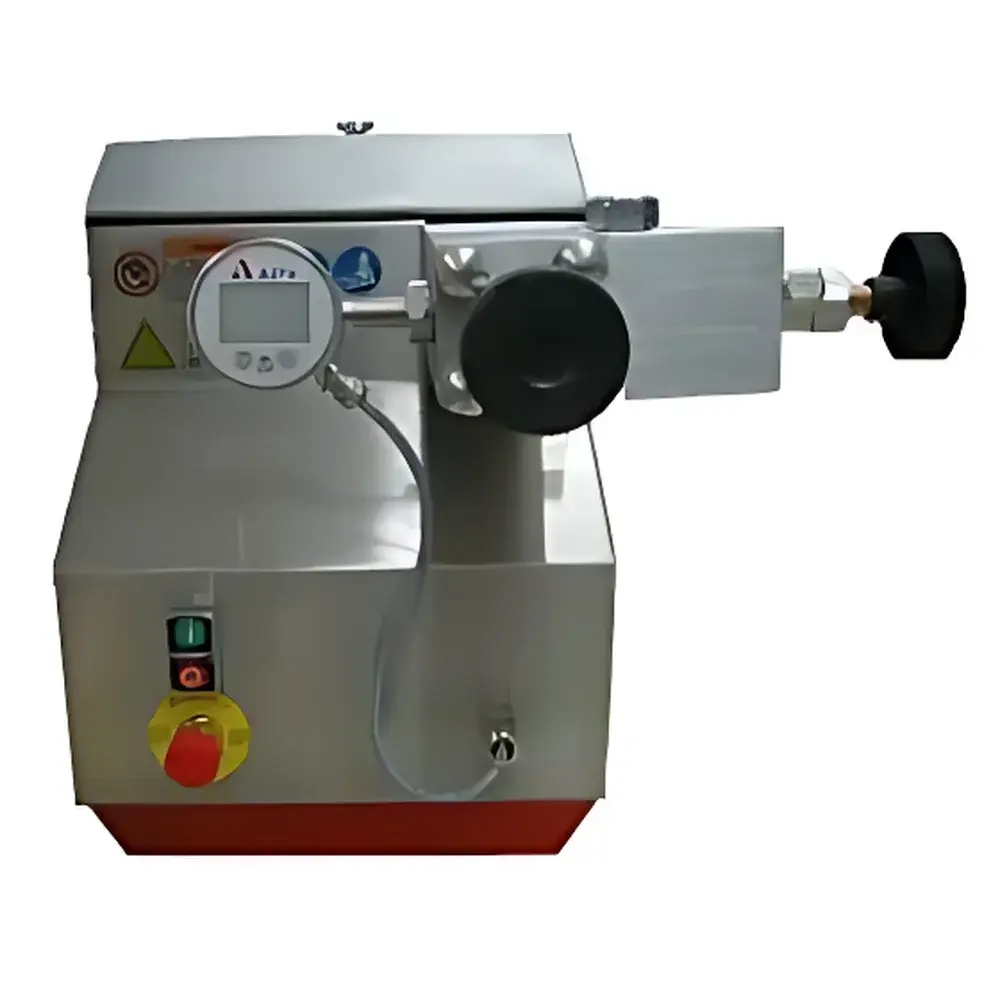
APV 2000–2 High-Pressure Homogenizer
| Brand | APV |
|---|---|
| Origin | Germany |
| Type | High-Pressure Laboratory Homogenizer |
| Model | 2000–2 |
| Max. Operating Pressure | 2000 bar |
| Adjustable Pressure Range | 0–2000 bar (manual handwheel) |
| Flow Rate | 11 L/h |
| Valve Material | Zirconia Ceramic Alloy (SEO ceramic valve) |
| Max. Inlet Particle Size | ≤500 µm |
| Operating Temperature Range | Ambient to 100 °C |
| Power Supply | 380 V / 50 Hz |
| Power Consumption | 3 kW |
| Dimensions (W×H×L) | 370 × 620 × 818 mm |
| Weight | 105 kg |
| Noise Level | 50 dB(A) |
Overview
The APV 2000–2 High-Pressure Homogenizer is a precision-engineered laboratory-scale instrument designed for scalable, reproducible nano- and micro-scale particle size reduction across pharmaceutical, biotechnology, food science, and advanced materials research. Based on the principle of high-shear cavitation and turbulent flow disruption under ultra-high hydrostatic pressure, it subjects fluid samples to instantaneous pressure drops across a precisely engineered dual-stage homogenization valve—generating intense mechanical forces sufficient to disrupt cell membranes, disintegrate aggregates, and produce monodisperse sub-100 nm colloidal dispersions. Unlike pneumatic or air-driven systems, the APV 2000–2 employs a direct-drive electric motor coupled with a robust reciprocating plunger pump, eliminating risks of sample contamination from compressed air moisture or oil carryover. Its architecture mirrors full-scale production homogenizers, enabling seamless process transfer from lab-scale formulation development to pilot and commercial manufacturing.
Key Features
- Dual-stage zirconia ceramic homogenization valve (SEO design) offering >6× longer service life versus tungsten carbide or hardened alloy alternatives—critical for GMP-aligned workflows requiring minimal downtime and consistent performance over extended campaigns.
- Manually adjustable pressure control via calibrated handwheel, enabling precise, stepless regulation from 0 to 2000 bar—optimized for method development of lipid nanoparticles (LNPs), liposomes, solid lipid nanoparticles (SLNs), nanoemulsions, and fat emulsions.
- Integrated plunger lubrication and active water-cooling system supporting continuous 24-hour operation without thermal drift or mechanical fatigue—validated for unattended overnight processing in regulated environments.
- Digital front-panel display showing real-time homogenization pressure and sample temperature, with audible overpressure alarm and fail-safe pressure relief circuitry compliant with EN ISO 13850.
- CIP (Clean-in-Place) and SIP (Sterilize-in-Place) compatibility—fully validated for steam sterilization at 121 °C per FDA Process Validation Guidance and EU Annex 1 requirements for aseptic processing equipment.
- Low acoustic signature (≤50 dB[A]) achieved through vibration-damped frame construction and optimized hydraulic path geometry—suitable for shared laboratory spaces and noise-sensitive facilities.
Sample Compatibility & Compliance
The APV 2000–2 accommodates aqueous and organic-phase suspensions, emulsions, and biological slurries with inlet particle sizes up to 500 µm. It is routinely deployed in the development of parenteral lipid-based formulations—including intravenous fat emulsions (IVFE), liposomal doxorubicin analogs, mRNA-LNPs, and polymer-stabilized nanosuspensions—where narrow polydispersity index (PDI < 0.1) and batch-to-batch reproducibility are mandated by USP , Ph. Eur. 2.9.36, and ICH Q5A(R2). The unit is manufactured under ISO 9001 quality management systems and bears CE marking per Machinery Directive 2006/42/EC and Pressure Equipment Directive 2014/68/EU. All wetted surfaces contact-grade 316L stainless steel and zirconia ceramic meet USP Class VI biocompatibility requirements.
Software & Data Management
While the APV 2000–2 operates as a standalone benchtop instrument with analog pressure regulation, its mechanical design supports integration into automated process trains via 4–20 mA pressure feedback outputs and digital I/O interfaces (optional). For regulatory compliance, users may implement external data acquisition systems configured to meet 21 CFR Part 11 requirements—including electronic signatures, audit trails, and secure user access controls. The absence of embedded firmware or proprietary software minimizes validation burden during GxP audits; all operational parameters (pressure setpoint, runtime, temperature) are manually recorded and traceable via laboratory notebooks or LIMS-integrated SOPs.
Applications
- Pharmaceutical R&D: Scalable preparation of liposomes, solid lipid nanoparticles (SLNs), nanostructured lipid carriers (NLCs), and self-emulsifying drug delivery systems (SEDDS).
- Biologics Processing: Gentle yet effective lysis of microbial and mammalian cells for protein extraction without denaturation or foaming artifacts.
- Nutraceutical & Food Science: Production of stable nanoemulsions for enhanced bioavailability of fat-soluble vitamins and phytochemicals; homogenization of dairy-based functional beverages.
- Materials Science: Dispersion of carbon nanotubes, graphene oxide, and metal oxide nanoparticles in polymer matrices for conductive inks and composite precursors.
- Quality Control: Standardized particle size reduction prior to DLS, TEM, or HPLC analysis—ensuring representative sampling and measurement fidelity.
FAQ
What is the maximum allowable inlet particle size for the APV 2000–2?
The system accepts feed suspensions with particles up to 500 µm in diameter. Pre-filtration or coarse milling is recommended for samples exceeding this limit to prevent valve clogging.
Does the APV 2000–2 require compressed air or gas supply?
No. It is fully electrically driven with no reliance on compressed air, eliminating risks of moisture ingress, oil contamination, or pressure fluctuations associated with pneumatic systems.
Can the instrument be validated for GMP manufacturing use?
Yes. Its CIP/SIP capability, CE/ISO 9001 certification, and production-line-equivalent mechanical architecture support IQ/OQ/PQ execution in accordance with ASTM E2500 and EU GMP Annex 15.
How does the zirconia ceramic valve improve process consistency compared to tungsten carbide?
Zirconia offers superior wear resistance, chemical inertness, and thermal stability—resulting in >6× longer valve service life and negligible metal leaching, critical for injectable product development.
Is temperature control integrated into the homogenization process?
The unit includes real-time sample temperature monitoring at the outlet manifold. External chillers or heated recirculation loops can be connected to maintain temperature-sensitive formulations within ±2 °C.



