
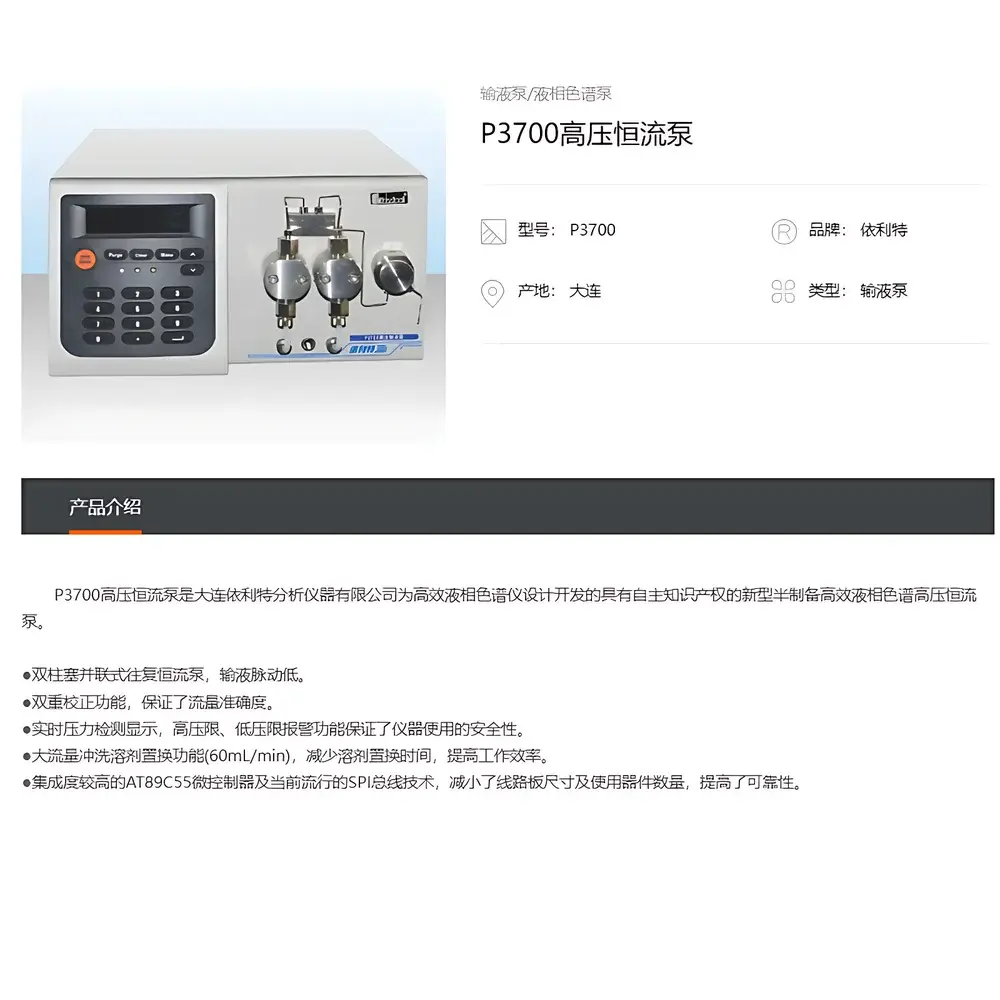
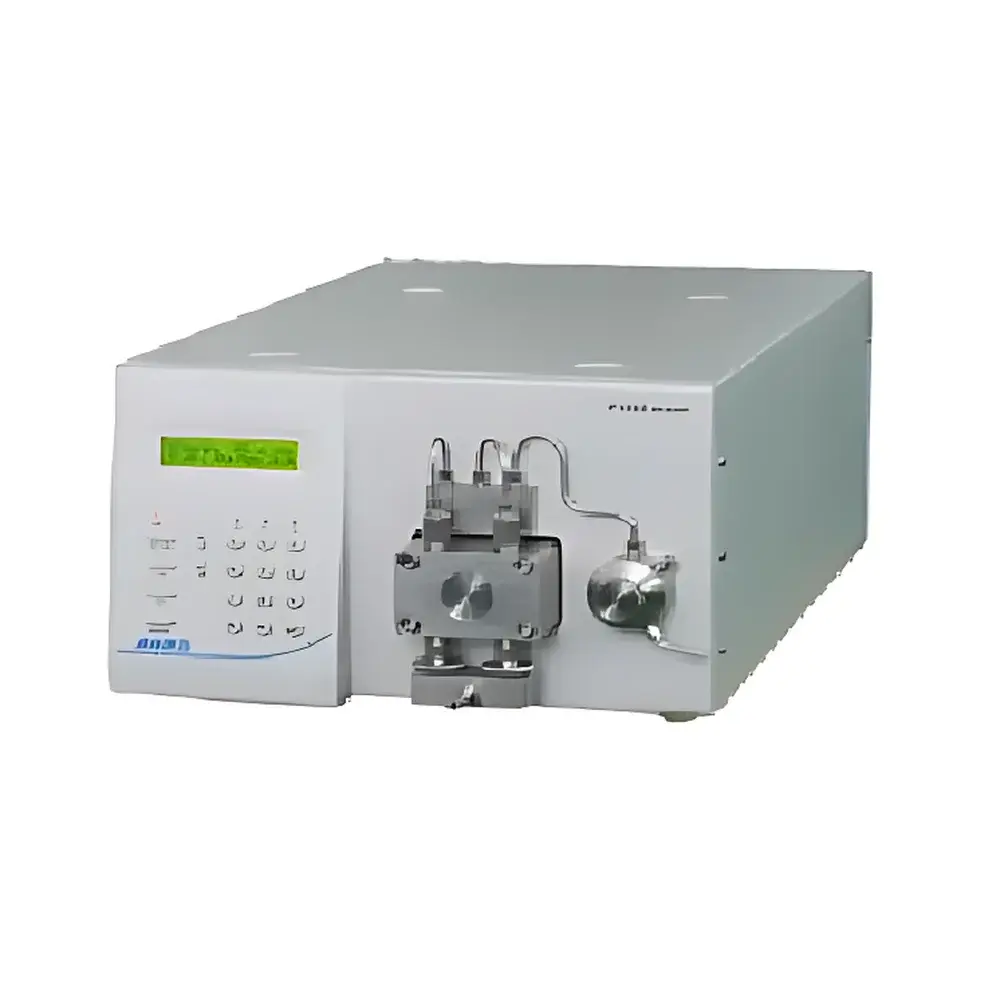
Elite P500 High-Pressure Preparative Piston Pump
| Brand | Elite |
|---|---|
| Origin | Liaoning, China |
| Manufacturer Type | Direct Manufacturer |
| Product Origin | Domestic (China) |
| Model | P500 |
| Flow Rate | 500 mL/min |
| Maximum Pressure | 20 MPa |
Overview
The Elite P500 High-Pressure Preparative Piston Pump is a robust, high-capacity constant-flow pumping system engineered for preparative liquid chromatography (Prep LC), process-scale purification, and industrial solvent delivery applications. Based on dual parallel reciprocating piston architecture driven by an AC servo motor, the P500 delivers precise, pulse-minimized flow across its full operational range (1–500 mL/min). Its design adheres to fundamental principles of positive displacement fluid dynamics, where volumetric displacement per stroke—combined with real-time flow compensation and cam-profile-optimized actuation—is calibrated to ensure high reproducibility under variable backpressure conditions up to 20 MPa. Unlike peristaltic or diaphragm-based systems, the P500’s mechanical integrity and seal longevity are enhanced through floating-guided plunger assemblies and imported high-wear-resistant sealing components, making it suitable for continuous operation in GMP-aligned purification workflows and method transfer from analytical to preparative scale.
Key Features
- AC servo motor drive: Ensures extended service life, low acoustic emission (<65 dB), and elimination of mechanical resonance during extended runtime.
- Optimized cam mechanism: Precision-machined cam profile and kinematic modeling reduce flow pulsation to <1.2% RSD at 500 mL/min, critical for gradient stability in multi-column prep systems.
- Floating guide and plunger assembly: Accommodates thermal expansion and minor alignment deviations; paired with imported ceramic-coated plunger rods and fluoropolymer composite seals for >10,000-hour mean time between failures (MTBF) under 15 MPa continuous load.
- Dual pressure protection: Digital over-pressure alarm (configurable threshold) plus mechanical safety relief valve (set at 21 MPa) compliant with ISO 13849-1 Category 3 safety architecture.
- Real-time flow & pressure monitoring: Integrated high-stability pressure transducer (0.25% FS accuracy) and calibrated flow sensor enable closed-loop feedback and remote parameter validation via RS-485 interface.
- Flow compensation function: Adjustable ±15% volumetric correction to offset viscosity- or temperature-induced deviations—essential for mobile phases containing acetonitrile, THF, or ionic liquids.
- Large-volume solvent purge mode: Automated priming and line flushing with up to 2 L/min equivalent purge rate (via timed high-flow override) reduces carryover between batches.
Sample Compatibility & Compliance
The P500 is compatible with common organic solvents (e.g., methanol, ethanol, ethyl acetate, DCM), aqueous buffers (pH 1–12), and moderately aggressive media including 0.1 M HCl and 0.1 M NaOH—provided compatible wetted materials (316L stainless steel pump head, sapphire check valves, PEEK/PTFE tubing interfaces) are selected per application. It meets electromagnetic compatibility requirements per IEC 61326-1 (industrial environment), and its pressure containment design conforms to PED 2014/68/EU Annex I essential safety requirements for Group 2 fluid category. While not certified for hazardous area use, it supports integration into ISO/IEC 17025-accredited labs when deployed with documented calibration procedures traceable to NIST standards.
Software & Data Management
The P500 communicates via isolated RS-485 (Modbus RTU protocol) for bidirectional control and telemetry with third-party chromatography data systems (CDS), including Chromeleon, Empower, and custom LabVIEW or Python-based orchestration platforms. All operational parameters—including setpoint flow, actual flow, system pressure, motor torque, and error codes—are timestamped and exportable as CSV or XML. Audit trail functionality (including user login, parameter changes, and alarm events) satisfies basic FDA 21 CFR Part 11 readiness when deployed with validated CDS software and role-based access controls. Firmware updates are performed via USB port using signed binary packages verified by SHA-256 checksum.
Applications
- Preparative HPLC purification of pharmaceutical intermediates (APIs, chiral compounds, peptides) at 10–100 g/batch scale.
- Continuous chromatography systems (e.g., SMB, MCSGP) requiring stable multi-pump synchronization and pressure resilience above 15 MPa.
- Solvent delivery in flash chromatography and automated column packing stations.
- Process development support for bioprocessing buffer exchange and tangential flow filtration (TFF) feed supply.
- Method scouting and scale-up studies where flow accuracy (≤±3% @ 5 MPa) and long-term stability (RSD ≤0.5%) directly impact fraction purity and yield consistency.
FAQ
What is the maximum solvent viscosity the P500 can handle at rated flow?
The P500 maintains specified accuracy up to 15 cP at 500 mL/min; for viscosities >20 cP, flow range should be derated to ≤300 mL/min to preserve pressure stability and seal life.
Is the pump compatible with corrosive mobile phases such as trifluoroacetic acid (TFA)?
Yes—with optional Hastelloy C-276 pump head and ETFE-sealed check valves; standard configuration supports ≤0.1% TFA in water/acetonitrile.
Does the P500 support gradient formation when used with multiple pumps?
No—gradient generation requires external proportioning valves or a dedicated quaternary mixing module; the P500 operates as a single-solvent constant-flow source.
Can the P500 be integrated into a GMP-compliant manufacturing environment?
Yes—when operated with validated software, calibrated transducers, and documented preventive maintenance logs aligned with ISO 9001 and EU Annex 11 expectations.
What is the recommended maintenance interval for seal replacement?
Under typical Prep LC usage (8 h/day, 5 MPa average pressure), primary seals require replacement every 6–12 months; high-pressure (>15 MPa) or abrasive solvent use reduces interval to 3–6 months.



