

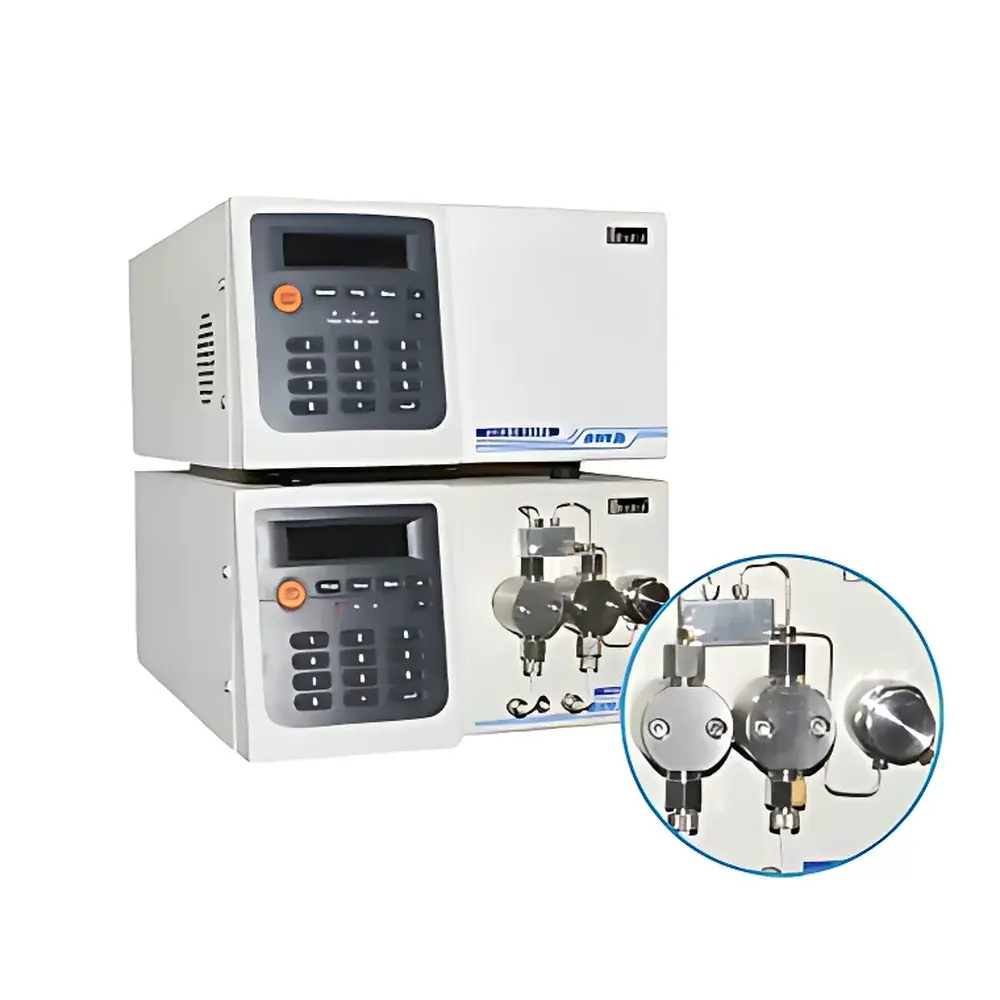
Elite P3700 Semi-Preparative High-Performance Liquid Chromatography System
| Brand | Elite |
|---|---|
| Origin | Liaoning, China |
| Manufacturer Type | Direct Manufacturer |
| Product Category | Domestic |
| Model | P3700 Semi-Preparative |
| Application Level | Laboratory-Grade |
| Instrument Type | High-Pressure Preparative HPLC |
| Flow Rate Range | 0.01–100.00 mL/min |
| Flow Accuracy | ≤ ±1.5% |
| Maximum Operating Pressure | 30 MPa |
| Wavelength Range | 190–700 nm |
| Baseline Noise | ≤ ±0.5 × 10⁻⁵ AU |
Overview
The Elite P3700 Semi-Preparative High-Performance Liquid Chromatography (HPLC) System is an integrated, laboratory-grade preparative chromatography platform engineered for precise fractionation and purification of organic compounds, pharmaceutical intermediates, natural products, and synthetic molecules at milligram-to-gram scale. Built upon a dual-plunger parallel reciprocating high-pressure pump architecture, the system delivers stable, low-pulsation solvent delivery across a wide flow range—enabling robust method translation from analytical to semi-preparative conditions. Its core design adheres to fundamental principles of reversed-phase, normal-phase, and ion-exchange chromatography, with full compatibility with common silica- and polymer-based stationary phases (e.g., C18, C8, amino, cyano, and HILIC). The system operates under ISO/IEC 17025-aligned engineering practices and supports GLP-compliant workflows through traceable parameter logging, pressure monitoring, and hardware-level safety interlocks.
Key Features
- Dual-plunger parallel reciprocating pump with real-time pressure feedback and programmable high/low pressure alarms—ensuring operational safety and column protection.
- Flow rate programmability from 0.01 to 100.00 mL/min in 0.01 mL/min increments; flow accuracy ≤ ±1.5% and RSD ≤ 1.0% for high reproducibility across batch runs.
- Maximum system pressure rating of 30 MPa (4350 psi), compatible with sub-10 µm particle-packed preparative columns and monolithic media.
- UV-Vis detection via either UV3100 or UV230II detector modules—both featuring holographic concave grating optics, microprocessor-controlled wavelength scanning, and PC-driven time-programmable wavelength switching.
- Integrated high-flow solvent purge mode (up to 60 mL/min) for rapid mobile phase equilibration and gradient reconditioning between injections.
- Thermally optimized detector cell design with enhanced heat dissipation, reducing baseline drift to ≤ 1.0 × 10⁻⁴ AU/h and baseline noise to ≤ ±0.5 × 10⁻⁵ AU (UV3100).
- Optional analog output (DA) interface for integration with external fraction collectors or PLC-based process control systems.
Sample Compatibility & Compliance
The P3700 accommodates standard semi-preparative flow cells (2 mm pathlength, 6 µL volume) and analytical cells (10 mm, 11 µL), supporting both isocratic and multi-step gradient elution protocols. It complies with widely referenced chromatographic standards including ASTM D7097 (for hydrocarbon separation), USP (Chromatography), and ICH Q2(R2) guidelines for method validation parameters such as precision and robustness. All electronic components meet CE electromagnetic compatibility (EMC) directives and IEC 61010-1 safety requirements for laboratory equipment. Data integrity features—including user-access logs, audit-trail-capable method storage, and timestamped run records—support alignment with FDA 21 CFR Part 11 expectations when deployed with validated software environments.
Software & Data Management
The system interfaces with Elite’s proprietary chromatography data system (CDS) via USB 2.0 or RS485, enabling full remote control of pump gradients, detector wavelength programs, and valve switching sequences. The CDS supports peak integration using tangent skim, valley-to-valley, and exponential curve fitting algorithms; all processing parameters are saved with each dataset for full traceability. Raw absorbance data is exported in ASCII-compatible formats (.txt, .csv) for third-party analysis (e.g., MATLAB, Python pandas, or ChemStation). Method templates can be version-controlled and locked against unauthorized modification—facilitating SOP adherence in regulated QC laboratories.
Applications
- Purification of synthetic peptides and oligonucleotides prior to structural characterization (NMR, MS).
- Isolation of active pharmaceutical ingredients (APIs) and chiral metabolites from fermentation broths or reaction mixtures.
- Fractionation of plant extracts for bioactivity-guided isolation of lead compounds.
- Preparative-scale separation of geometric isomers and diastereomers using chiral stationary phases.
- High-throughput method scouting for scalable purification processes—leveraging analytical-to-prep transfer functions embedded in the CDS.
- Use as a precision feed pump in continuous-flow synthesis or membrane-assisted extraction systems requiring stable, pulse-free delivery.
FAQ
What is the maximum recommended column internal diameter for optimal performance on the P3700?
The system is optimized for columns with internal diameters ranging from 10 mm to 30 mm, corresponding to typical semi-preparative applications (load capacities: 1–50 mg per injection).
Does the P3700 support gradient elution with more than two solvents?
Yes—the integrated quaternary low-pressure mixing module allows programming of up to four mobile phase solvents with linear, step, or custom-defined gradient profiles.
Can the UV3100 detector perform full-spectrum scanning during a run?
Yes—it supports real-time spectral acquisition (190–700 nm) at user-defined intervals, with simultaneous chromatogram display and peak purity assessment.
Is method validation documentation available for regulatory submissions?
Elite provides IQ/OQ documentation templates and instrument qualification protocols aligned with ISO/IEC 17025 and GMP Annex 15; final validation must be executed by the end-user laboratory per local regulatory requirements.
What maintenance intervals are recommended for the high-pressure pump seals?
Under standard use (≤ 25 MPa, aqueous/organic mobile phases), pump seal replacement is recommended every 6–12 months or after 2000 hours of operation—whichever occurs first.





