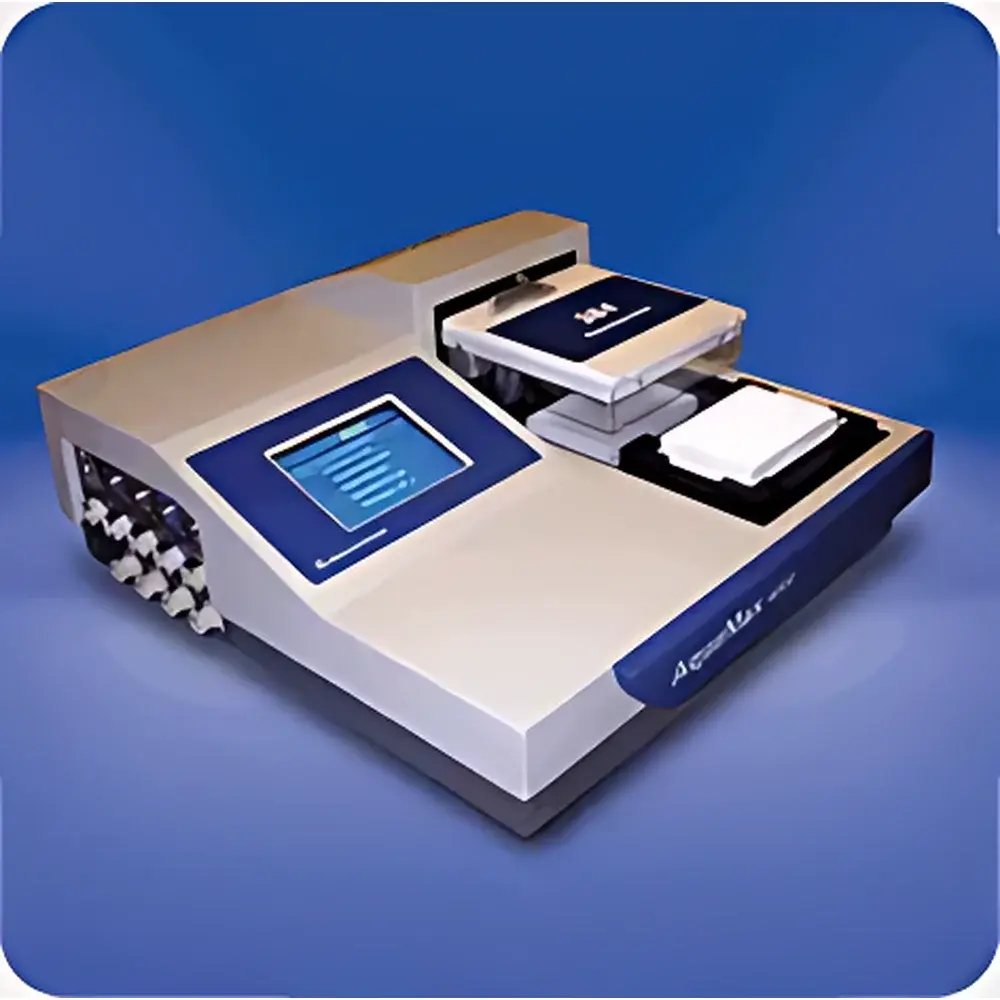
Molecular Devices AquaMax 2000 & 4000 Microplate Washer
| Brand | Molecular Devices |
|---|---|
| Origin | USA |
| Manufacturer | Yes |
| Import Status | Imported |
| Model | AquaMax 2000 & AquaMax 4000 |
| Plate Formats | 96-well and 384-well |
| Wash Head Design | Dual-needle |
| Wash Fluid Channels | Up to 4 independent ports |
| Soak Time Range | 0–600 seconds |
| Wash Cycles | 1–3 cycles per protocol |
| Residual Volume per Well | <2 µL |
| Orbital Shaking | 3 programmable speeds |
Overview
The Molecular Devices AquaMax 2000 and AquaMax 4000 are fully integrated, self-contained microplate washers engineered for precision, reproducibility, and operational flexibility in life science laboratories. Designed around a robust fluidic architecture and optimized aspiration/wash kinetics, these instruments perform simultaneous washing of all wells in 96-well and 384-well microplates—eliminating sequential or partial-well processing that introduces variability. The system operates on the principle of synchronized dual-needle aspiration and dispense, ensuring uniform fluid exchange across the entire plate surface while minimizing shear stress on sensitive adherent cells. Unlike pressure-pump-dependent washers, the AquaMax series integrates an internal positive-pressure fluid delivery system and vacuum-controlled aspiration manifold, enabling stable flow rates and consistent residual volume control (<2 µL/well) without external infrastructure. Its compact footprint (35.6 cm W × 40.6 cm D × 27.9 cm H), tool-free head interchangeability, and stand-alone touchscreen interface make it suitable for benchtop deployment in core facilities, QC labs, and high-throughput screening (HTS) environments.
Key Features
- Interchangeable 96-well and 384-well wash heads—mechanically aligned and calibrated at factory; no user recalibration required
- Dual-needle wash head design with independently controllable aspiration and dispense paths for balanced fluid dynamics
- Up to four color-coded fluid ports (AquaMax 4000) or two ports (AquaMax 2000), supporting multi-step wash protocols without manual reconfiguration
- Programmable soak time (0–600 s) and wash cycles (1–3), with real-time monitoring of fluid level and cycle completion status
- Three-speed orbital shaking function optimized for residue removal while preserving cell monolayer integrity
- Touchscreen interface with up to 99 stored protocols; each protocol supports up to 50 discrete steps including pre-wash, soak, aspirate, dispense, shake, and post-wash rinse
- Integrated standby mode: wash needles remain submerged in buffer to prevent drying and ensure immediate readiness
- Native compatibility with Molecular Devices StakMax® stacker systems for unattended walk-away operation in automated workflows
Sample Compatibility & Compliance
The AquaMax washer accommodates standard ANSI/SLAS-compliant microplates—including flat-bottom, round-bottom, and V-bottom polystyrene copolymer and polypropylene plates—as well as tissue-culture-treated plates for adherent cell assays. Optional 96-well and 384-well cell wash heads feature angled nozzle geometry and low-velocity dispensing profiles validated for gentle detachment of fragile monolayers without compromising viability or morphology. All fluid pathways are constructed from chemically resistant materials compatible with common ELISA buffers (e.g., PBS, Tris-HCl), detergents (e.g., Tween-20), and sterilants (e.g., 70% ethanol). The system supports GLP/GMP-aligned documentation through optional audit trail logging (when paired with compliant LIMS or ELN platforms) and meets mechanical safety requirements per IEC 61010-1. While not FDA 21 CFR Part 11–certified out-of-the-box, its deterministic protocol execution and non-volatile parameter storage support validation under ISO 13485 and ASTM E2500 frameworks.
Software & Data Management
Operation is managed via an embedded 7-inch capacitive touchscreen running proprietary firmware with intuitive icon-driven navigation. Protocols are created, edited, duplicated, and archived directly on-device; no PC connection or third-party software is required. Each protocol stores full parameter metadata—including fluid port assignments, dispense/aspirate volumes, dwell times, and shake profiles—enabling traceable method replication. Export capabilities include CSV-formatted run logs (timestamp, plate ID, protocol name, cycle count, error flags) via USB flash drive. For integration into enterprise lab informatics ecosystems, the AquaMax supports RS-232 and TTL-level digital I/O signals for handshake communication with robotic arms, plate readers (e.g., SpectraMax®, FLIPR Tetra®, FlexStation® 3), and scheduling middleware. Firmware updates are delivered via encrypted USB image files with SHA-256 verification.
Applications
The AquaMax washer serves as a critical preprocessing module in quantitative assay workflows requiring stringent removal of unbound reagents. Primary use cases include:
- Enzyme-linked immunosorbent assay (ELISA) — precise buffer exchange between capture, detection, and substrate incubation steps per ASTM E2983 and ISO 15197 guidelines
- Cell-based functional assays — gentle washing of adherent neuronal, endothelial, or stem cell lines prior to calcium flux (FLIPR Tetra) or membrane potential measurements
- High-content screening (HCS) — compatibility with ImageXpress®-class imaging platforms for post-fixation antibody stripping and counterstain rinsing
- Protein interaction studies — removal of non-specifically bound ligands in AlphaScreen®, TR-FRET, and proximity ligation assays
- Maintenance cleaning — automated decontamination cycles using validated NaOH or Virkon® solutions to prevent cross-contamination between runs
FAQ
Does the AquaMax require an external air compressor or vacuum pump?
No. It incorporates an integrated positive-pressure fluid delivery system and a dedicated vacuum manifold—no external utilities are needed.
Can both 96-well and 384-well plates be washed on the same instrument without hardware modification?
Yes. Interchangeable wash heads are designed for rapid, tool-free swapping; alignment is factory-verified and does not require user recalibration.
Is the system compatible with non-Molecular Devices plate readers or automation platforms?
Yes. Standardized physical dimensions (ANSI/SLAS), digital I/O triggers, and repeatable timing profiles enable integration with third-party stackers, conveyors, and readers.
What is the minimum recommended maintenance interval?
Daily needle inspection and weekly fluid path flushing are recommended; quarterly calibration verification is advised for regulated environments.
How is residual volume validated across different plate types and liquid heights?
Residual volume <2 µL/well is specified for standard flat-bottom polystyrene plates at nominal fill volumes (e.g., 300 µL in 96-well, 80 µL in 384-well); actual performance may vary slightly with plate geometry and liquid viscosity.