
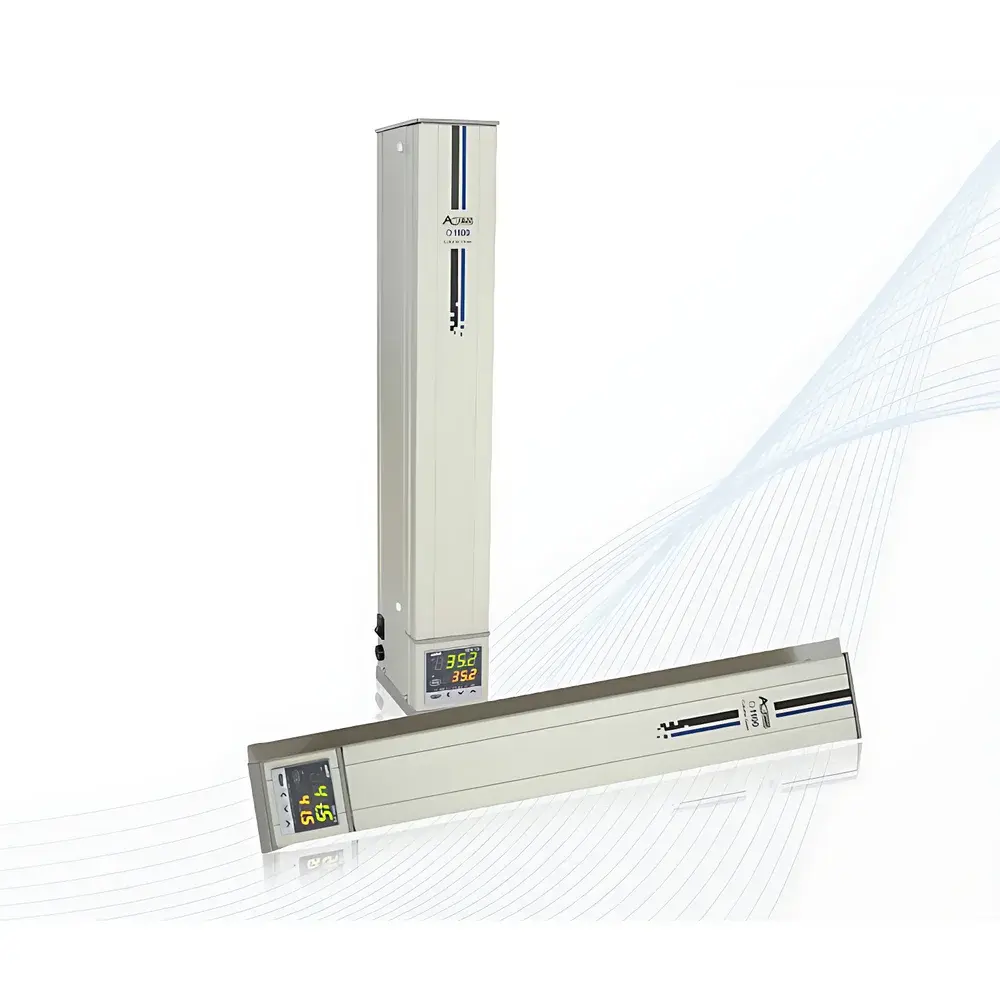
Elite O1100 HPLC Column Oven
| Brand | Elite |
|---|---|
| Origin | Liaoning, China |
| Manufacturer Type | OEM Manufacturer |
| Region of Origin | Domestic (China) |
| Model | O1100 |
| Price Range | USD 2,800 – 7,000 |
| Temperature Control | Heating-Only (No Active Cooling) |
| Temperature Range | 5 °C to 99 °C |
| Temperature Stability | ±0.1 °C |
| Dimensions (L×W×H) | 120 mm × 65 mm × 500 mm |
| Weight | 8.5 kg |
| Power Supply | AC 220 V ±10%, 50 Hz |
| Rated Power | 150 W |
| Heating Technology | TPC Film Heater |
| Safety Features | Over-Temperature Alarm, Thermal Cut-Off Protection |
| Controller | Imported PID Temperature Controller with High-Stability RTD Sensor |
Overview
The Elite O1100 HPLC Column Oven is a precision-engineered temperature control module designed for integration with high-performance liquid chromatography (HPLC) systems and ultra-high-performance liquid chromatography (UHPLC) platforms. Operating on resistive film heating principles—specifically utilizing TPC (Thick-Film Printed Circuit) heater technology—the O1100 delivers stable, uniform thermal environments essential for reproducible retention time alignment, peak symmetry, and method robustness. Unlike ambient-compensated column compartments, the O1100 actively maintains setpoint temperatures from 5 °C above ambient up to 99 °C, enabling method transfer across laboratories and seasonal environmental variations. Its compact vertical footprint (120 mm × 65 mm × 500 mm) allows seamless placement beneath or beside standard HPLC modules without obstructing tubing routing or detector access. The unit complies with IEC 61010-1 safety standards for laboratory electrical equipment and is constructed with flame-retardant ABS housing and internal thermal insulation to minimize external heat dissipation.
Key Features
- Precision PID temperature control architecture with imported platinum RTD (Pt100) sensor and digital microprocessor feedback loop, achieving ±0.1 °C stability over 24-hour continuous operation.
- TPC film heating element—engineered for uniform surface heat distribution and extended service life (>10,000 hours MTBF), eliminating hot spots and reducing thermal gradient-induced column deformation.
- Heating-only design optimized for ambient-stable labs; no compressor or refrigerant required—reducing maintenance complexity, noise, and energy consumption relative to dual-mode ovens.
- Integrated safety subsystem including over-temperature cut-off (105 °C hardware limit), real-time fault diagnostics, audible/visual alarm activation, and automatic power disengagement upon sensor failure.
- Modular mechanical interface compatible with 1/8″–1/4″ stainless steel and PEEK capillary tubing; accommodates up to two 250 mm × 4.6 mm ID analytical columns or one 150 mm × 3.0 mm ID narrow-bore column with full-length thermal coverage.
Sample Compatibility & Compliance
The O1100 supports all commercially available reversed-phase, HILIC, ion-exchange, and size-exclusion chromatographic columns—including those with polymeric, silica-based, or hybrid organic-inorganic stationary phases. Its non-corrosive interior chamber and low-outgassing construction prevent contamination of sensitive LC-MS interfaces. From a regulatory standpoint, the oven meets the physical infrastructure requirements of GLP and GMP-compliant laboratories when deployed within validated HPLC methods. While the device itself is not FDA 21 CFR Part 11 certified (as it lacks electronic record functionality), its analog temperature output signal and hardware-level alarms support audit-ready operation when paired with compliant data acquisition systems. It conforms to ISO/IEC 17025 clause 5.5.2 for equipment suitability in accredited testing laboratories.
Software & Data Management
The O1100 operates as a standalone analog-controlled instrument with no embedded firmware or network interface. Temperature setpoint adjustment is performed via front-panel rotary encoder with LED display; no drivers, USB connectivity, or software installation is required. For automated workflows, optional analog voltage output (0–5 V DC proportional to actual chamber temperature) enables integration with third-party chromatography data systems (CDS) such as Thermo Chromeleon, Waters Empower, or Agilent OpenLab CDS for external logging and alarm correlation. All operational parameters—including setpoint, measured temperature, and fault status—are accessible via rear-panel BNC terminals for oscilloscope monitoring or PLC interfacing.
Applications
- Retention time stabilization in gradient elution methods for pharmaceutical impurity profiling per USP and ICH Q2(R2) guidelines.
- Enhancing resolution of closely eluting isomers in chiral separations by fine-tuning mobile phase viscosity and stationary phase kinetics.
- Supporting QC/QA workflows in food safety labs performing multi-residue pesticide analysis (e.g., AOAC 2007.01) where column temperature directly impacts extraction recovery and matrix effect mitigation.
- Enabling method development for polymer characterization using SEC/GPC, where precise temperature control minimizes shear degradation and improves molar mass distribution accuracy.
- Facilitating long-duration unattended runs in environmental testing labs analyzing PAHs, PCBs, and phthalates under EPA Method 8330B and ISO 18856 protocols.
FAQ
Does the O1100 support sub-ambient temperature operation?
No. The O1100 is a heating-only column oven with a minimum operating temperature of 5 °C above ambient. For sub-ambient applications, a thermoelectric or compressor-based column chiller is required.
Can the O1100 be used with UHPLC systems operating at 1000 bar?
Yes. The chamber design imposes no pressure limitations; compatibility depends solely on column hardware and tubing integrity—not the oven’s thermal enclosure.
Is calibration documentation provided with shipment?
Each unit ships with a factory calibration certificate traceable to NIM (National Institute of Metrology, China), verifying temperature accuracy at three points (25 °C, 50 °C, and 75 °C) per ISO/IEC 17025 Annex A.3.
What is the recommended maintenance interval?
No scheduled maintenance is required. Users should visually inspect heater contacts and sensor mounting annually; cleaning is limited to exterior wiping with isopropyl alcohol—no internal servicing is intended.
How does the O1100 compare to competitive ovens with digital communication protocols?
The O1100 prioritizes reliability, electromagnetic immunity, and deterministic thermal response over networked features. Its analog architecture eliminates firmware vulnerabilities, latency in temperature ramping, and compatibility dependencies common in digitally controlled ovens.




